

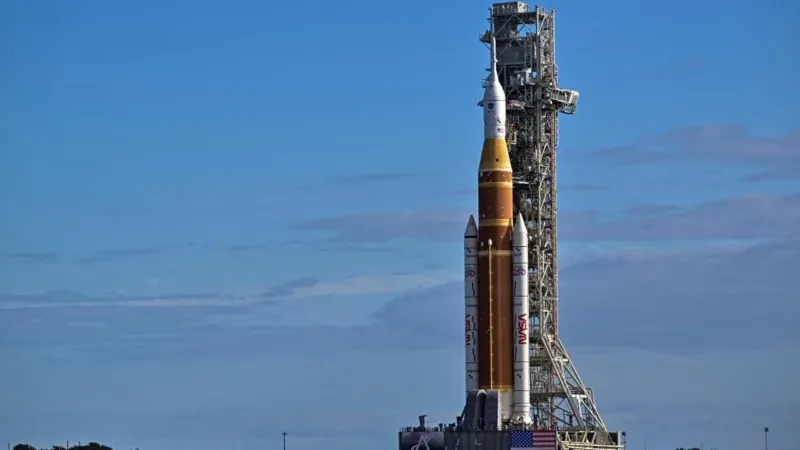
NASA has moved its 98-meter-tall Space Launch System (SLS) rocket to the launch pad at Kennedy Space Center, Florida, in preparation for Artemis II, the first crewed Moon mission in over 50 years. The rocket traveled four miles (6.5 km) over almost 12 hours on a crawler-transporter, moving at just 1.3 km/h. Once in position at Launch Pad 39B, the rocket will undergo final tests, checks, and a “wet dress rehearsal” to simulate fuel operations and countdown procedures. The mission is scheduled to launch no earlier than 6 February 2026, with additional windows later in February, March, and April.
The Artemis II crew includes NASA astronauts Reid Wiseman, Victor Glover, Christina Koch, and Canadian astronaut Jeremy Hansen. The mission will orbit the Moon without landing, preparing for Artemis III, planned for 2027 or 2028, which aims to return humans to the lunar surface. The first two days of the mission will be spent orbiting the Earth at up to 40,000 miles away, before traveling a quarter of a million miles to the Moon. While flying around the far side, the crew will have three hours dedicated to lunar observation, capturing images and studying geology to aid future landings.
The European Service Module, built by Airbus in Bremen, Germany, provides propulsion, life support, oxygen, nitrogen, water, and electricity for the Orion spacecraft through large solar arrays. NASA emphasizes that crew safety is the top priority, with years of preparation and delays ensuring thorough readiness. Astronauts expressed excitement and hope that the mission will inspire the world. Koch highlighted the unique perspective of seeing Earth as a single ball from orbit, while Hansen noted the significance of humans traveling around the Moon’s far side. Artemis II represents the next step in human lunar exploration, testing systems and operations for future Moon landings.

