

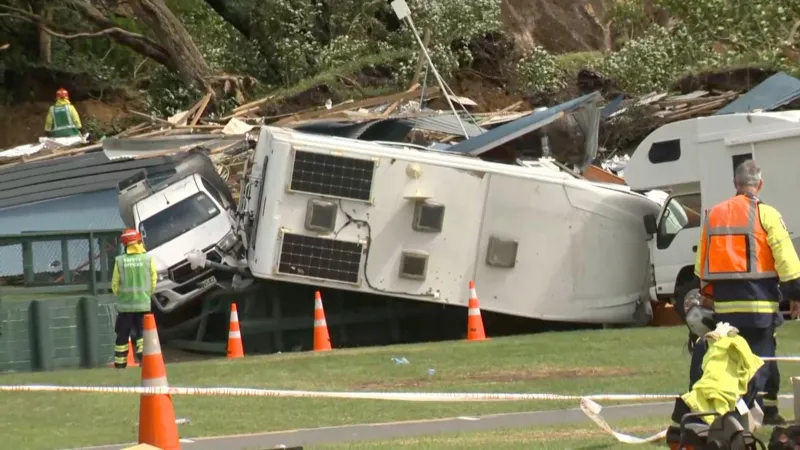
Two people have died and several others are feared buried following landslides in New Zealand’s North Island after days of heavy rainfall.
The deaths were reported in Welcome Bay, while rescue teams continue searching through debris at a separate site at a popular campground on Mount Maunganui. Authorities said there were currently no “signs of life” and that while they had a rough estimate of how many people were missing, an exact figure had yet to be confirmed. Officials said the group includes at least one young girl.
The landslides were triggered by prolonged heavy rain that has caused widespread flooding and power outages across much of the North Island. One government minister described scenes along the east coast as resembling “a war zone”.
Prime Minister Christopher Luxon said the country was “heavy with grief” following what he described as a profound national tragedy.
Footage from the Mount Maunganui campsite shows a large slip near the base of the extinct volcanic dome, with rescuers and sniffer dogs combing through crushed caravans and flattened tents. Authorities said search efforts would continue overnight despite the dangerous conditions.
“This is a complex and high-risk environment, and our teams are working to achieve the best possible outcome while keeping everyone safe,” said Megan Stiffler, deputy national commander for Urban Search and Rescue.
Mount Maunganui, an extinct volcano, is a sacred Māori site and one of New Zealand’s most popular campgrounds. Despite its reputation as a tourist destination, it has experienced multiple landslides in recent years.
Australian tourist Sonny Worrall told local media he narrowly escaped one of the slides. He said he heard a loud cracking sound before seeing soil and debris rushing downhill, forcing him to flee. “I’m still shaking from it now,” he said.
Hiker Mark Tangney said he heard people screaming for help from beneath the rubble. He told local media the cries continued for about half an hour before falling silent.
A nearby surf club was evacuated amid fears of further landslides, while a state of emergency has been declared across the Bay of Plenty region and several other parts of the North Island, including Northland, Coromandel, Tairāwhiti and Hauraki.
Several areas recorded their wettest day on record on Thursday. Tauranga, in the Bay of Plenty, received the equivalent of three months’ rainfall in a single day, according to local reports. About 8,000 people were without power as of Thursday morning.
Elsewhere, a woman whose husband was swept away in the Mahurangi River said she was holding out hope for his survival. The 47-year-old man had been driving to work with his nephew when their vehicle was carried into the river. He managed to push the nephew to safety but did not make it out himself.
Minister for Emergency Management Mark Mitchell said the storm system had affected nearly the entire eastern seaboard of the North Island. He added that early preparation and rapid response had helped mitigate some of the damage.
Although December to February are usually the sunniest months in New Zealand, extreme weather events have become more frequent in recent years.
In February 2023, Cyclone Gabrielle devastated parts of the island, causing NZ$13.5bn in damage, the costliest cyclone ever recorded in the Southern Hemisphere. This week’s flooding has compounded the challenges faced by communities still recovering from that disaster.

