

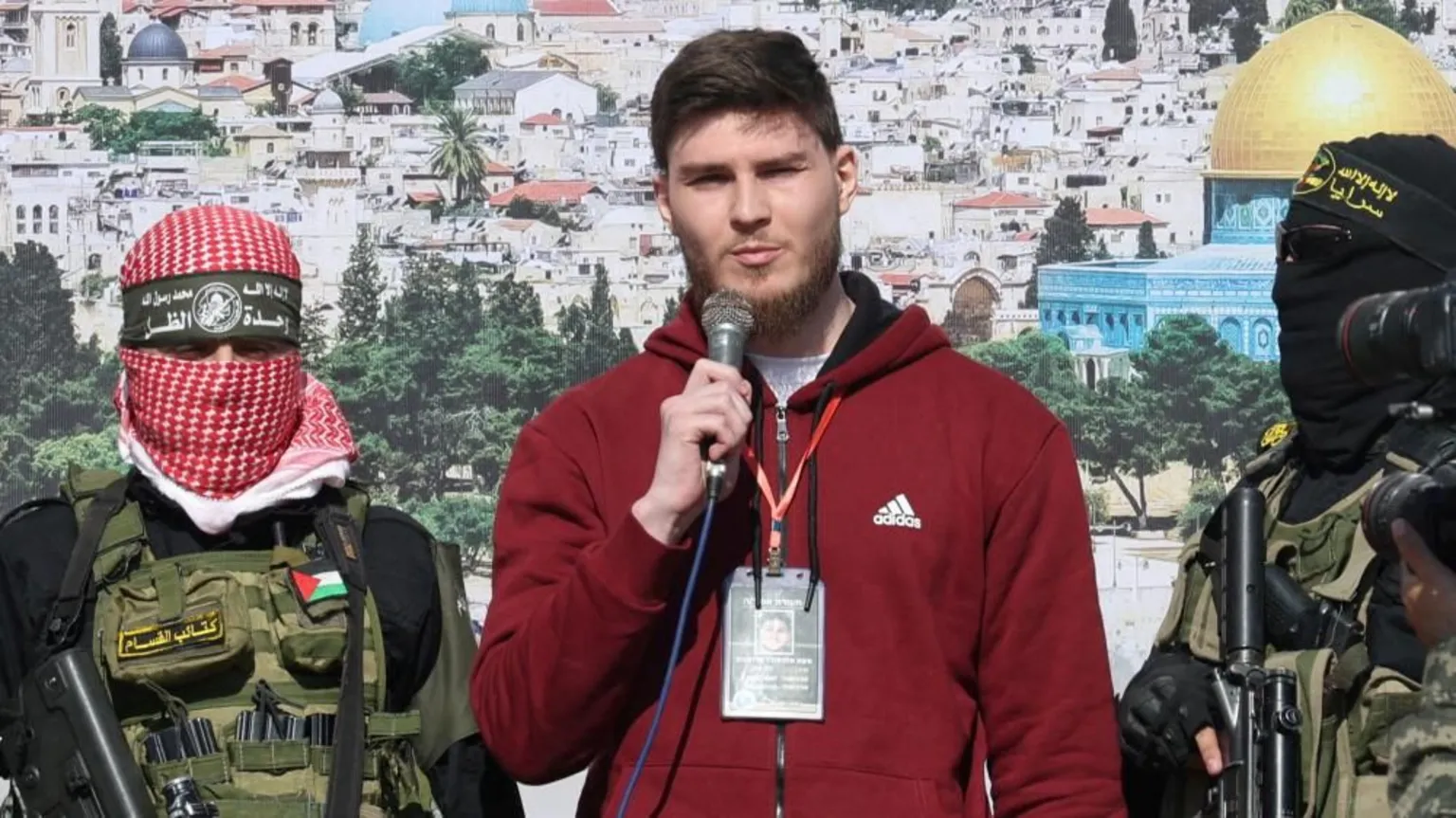
A former Israeli hostage who was held for nearly 500 days in Gaza says the return of the body of the final hostage this week means all the released captives can “now breathe and start our lives again”.
Thirty-year-old Sasha Troufanov, an Amazon electronics engineer, was taken hostage on 7 October 2023 by Palestinian Islamic Jihad gunmen. His fiancée, Sapir Cohen, his mother and his grandmother were also kidnapped and taken to Gaza. The women were released after more than 50 days in captivity. Troufanov was freed a year ago, after 498 days.
Speaking during a visit to London, Troufanov said the return on Monday of Ran Gvili’s body — meaning all hostages had now been returned — brought immense relief.
“It felt wonderful. We waited so long for this to happen,” he said.
“I was carrying this burden ever since I came back. It was like a weight on my shoulders that kept me from coming back to my life. Although we were released, we didn’t really come out of Gaza because our friends and brothers were still there.”
The moment was bittersweet. Monday was also the birthday of his father, Vitaly. Troufanov only discovered that his father had been murdered during the 7 October attack on the day he was released in February 2025, when he realised his father was not there to meet him.
Troufanov and Cohen had been visiting his family on Kibbutz Nir Oz, near the Gaza border, when Palestinian gunmen stormed their homes. Cohen wrapped herself in a blanket and hid under the bed, but both were captured. Troufanov was punched and stabbed in the shoulder.
“I saw the terrorist with so much anger and hate in his face, holding his knife trying to stab me even more,” he said.
As the attackers tried to take him off the kibbutz, Troufanov briefly managed to escape. When he stopped running, he was shot twice in each leg.
“I just felt the rush of pain going through my brain and I fell to the ground. Then one of the terrorists hit me with the rifle from the back of my head and split it open.”
When he arrived in Gaza, he said civilians beat him and he believed he was about to be killed.
During his captivity, Troufanov received almost no medical treatment. He was taken once to a family home and once to a hospital, where his broken leg was first wrapped with a wooden broom and later with part of a metal grill.
Unlike many other hostages, he was held almost entirely in isolation. For only two of the 498 days did he see another captive.
At first, he was held above ground for more than six weeks, locked in a cage and given barely enough food to survive. He said he experienced sexual harassment, with one guard repeatedly trying to encourage him to perform a sexual act on himself. He also said a hidden camera filmed him during the single weekly shower he was allowed.
“I noticed it and I took the shower trying to avoid my private parts towards this angle, but I had to do it because I needed to shower,” he said.
Later taken underground into tunnels, Troufanov said he was left alone for months in silence, with food delivered before being abandoned again in a cramped, humid space so dark he could not see his own hand.
“I remember feeling that I am buried underneath the ground while I am still alive,” he said.
“I was losing it. I was having a hard time to find hope in this place. Many times I lost hope completely. I said to myself: ‘This is the last place you will see alive.’”
It is the first time since 2014 that there are no Israeli hostages held in Gaza. A total of 251 people were abducted during the Hamas-led attack on 7 October 2023, when about 1,200 people were killed.
Israel responded with a military campaign in Gaza, during which more than 71,660 people have been killed, according to the Hamas-run health ministry. Since the ceasefire began on 10 October 2025, at least 492 Palestinians have been killed, along with four Israeli soldiers.
With all hostages now returned — both those who survived and those who were killed — the second phase of US President Donald Trump’s plan to end the war in Gaza is set to begin. The Rafah border crossing between Egypt and Gaza is expected to reopen on an ongoing basis for the first time since May 2024.
The plan also includes the full demilitarisation of Gaza, the disarmament of Hamas and other Palestinian groups, the establishment of a technocratic Palestinian government, and the reconstruction of Gaza.
Troufanov believes these measures alone are not enough to prevent another attack.
“Rebuilding Gaza, after what happened in the war, is understandable. But first of all we need to make sure that the people of Gaza will stop trying to hurt Israel,” he said.
“The terrorists were telling me: ‘We will do this again and again.’
“Rebuilding Gaza and opening the Rafah crossing is in vain as it will never solve the real problem. We need to find a way to make this hatred and encouragement of terrorist activity stop.”
Now undergoing physical and psychological rehabilitation, Troufanov is currently on crutches following surgery on his leg. He hopes to dance at his wedding to Sapir Cohen in a few weeks.
“It’s a victory,” he said. “Overcoming hate and fear and saying to ourselves: ‘We will build life together and we will continue.’”

