

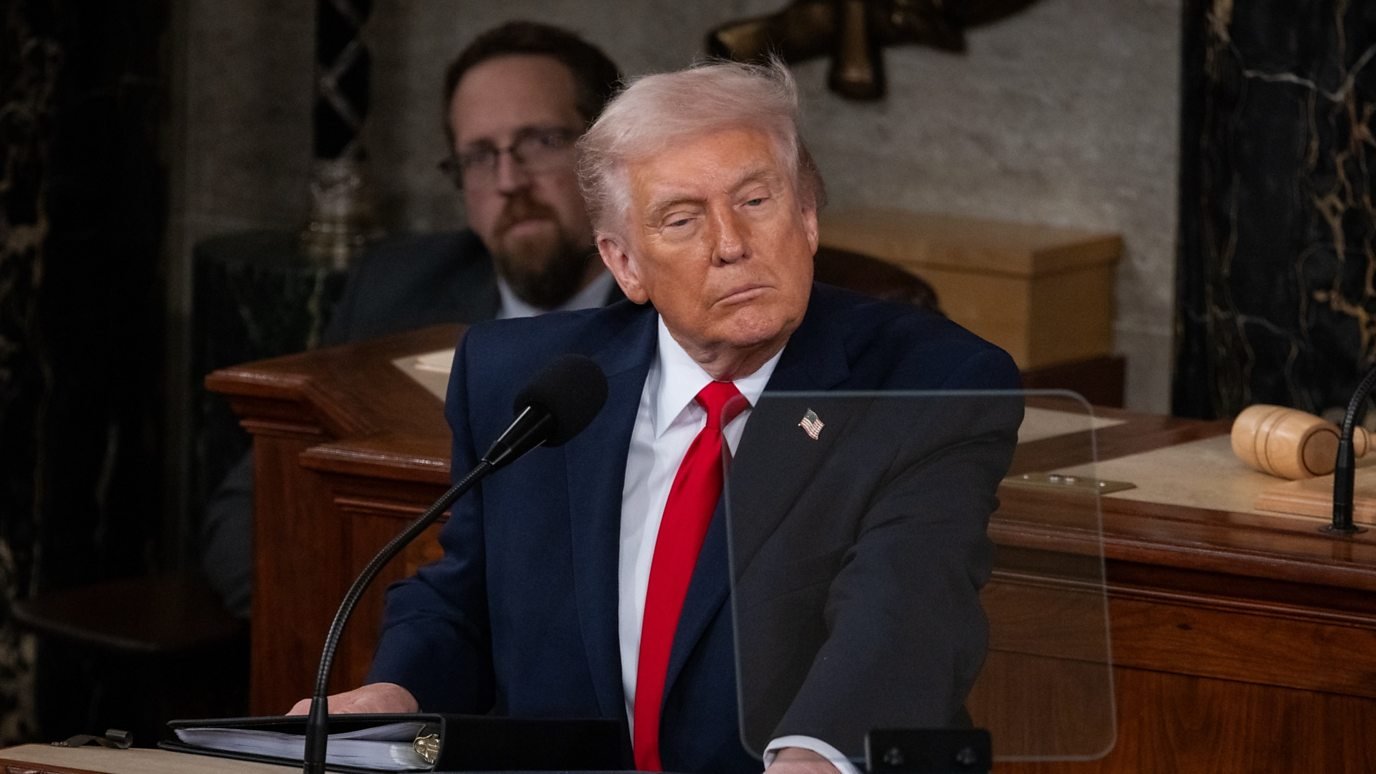
Donald Trump stepped onto the House chamber floor on Tuesday night and delivered a State of the Union address that was as confrontational and choreographed as it was familiar. Declaring what he called an American “turnaround for the ages,” the president offered a performance aimed less at persuading sceptics and more at energising supporters ahead of high-stakes midterm elections later this year.
Despite polls showing broad public dissatisfaction with the country’s direction — and with Trump himself — the speech gave little indication that the president intends to recalibrate his approach. Instead, he leaned into a campaign-style message, mixing patriotic symbolism with pointed attacks on Democrats, all wrapped in the kind of theatrical presentation that plays well on camera.
From the opening moments, the address carried the rhythm of a televised spectacle. Trump welcomed the US Olympic men’s hockey team, whose players raised their gold medals as Republican lawmakers erupted into chants of “USA!” Even many Democrats joined in the applause. Later, the president spotlighted individual acts of heroism, honouring a 100-year-old Second World War veteran awarded the Medal of Honor and a Coast Guard rescue swimmer recognised for saving 165 people during last year’s Texas floods.
These segments helped propel a speech that ultimately stretched to 107 minutes — the longest State of the Union address on record — while reinforcing Trump’s central theme of national pride and achievement.
Yet the message itself contained few surprises. Trump opened with language he has used repeatedly since returning to office, insisting that “our nation is back” and describing the United States as the “hottest” country in the world. He pointed to higher incomes, stock market gains, falling petrol prices, reduced undocumented border crossings, and easing inflation as evidence that his policies are working.
“Our country is winning again,” he said.
The difficulty for the president is that much of the public remains unconvinced. His approval ratings continue to hover around 40%, and similar arguments made during a national address two months ago failed to shift opinion. Trump and his advisers now appear to be betting that the reach of a State of the Union — with an audience in the tens of millions — might succeed where earlier efforts did not.
What the address largely lacked, however, were new policy proposals. Over nearly two hours, Trump floated only a handful of ideas, including retirement savings accounts aimed at working-class Americans and an agreement with artificial intelligence companies to ensure their energy demands do not drive up consumer electricity costs.
Elsewhere, he recycled familiar pledges: direct payments to help Americans cover health insurance premiums, stricter voter citizenship requirements, and a ban on issuing commercial driver’s licences to undocumented migrants. He also recommitted to his sweeping tariff agenda, brushing aside a Supreme Court ruling last week that struck down many of the trade duties he previously imposed.
The moment carried visible tension. Several justices who ruled against the administration sat stone-faced in the front row. Although Trump briefly shook hands with Chief Justice John Roberts — who authored the tariff decision — neither man smiled.
Tariffs, long a point of unease within Trump’s own party, drew muted reactions from Republicans and murmurs from Democrats, reflecting concerns about economic fallout and electoral risk. But it was immigration that truly ignited the chamber.
As Trump warned of what he described as the dangers posed by “illegal aliens,” Republicans responded with some of the loudest applause of the night, while Democrats shouted back or stared in silence. Once a political stronghold for the president, the issue has recently damaged his standing following a federal enforcement operation in Minneapolis that resulted in the fatal shooting of two US citizens. Trump made no reference to the incident, nor to earlier suggestions that a softer approach might be needed.
Instead, he doubled down, recounting crimes allegedly committed by undocumented migrants and framing himself as the last barrier to chaos at the border. “The only thing standing between Americans and a wide-open border right now is President Donald J Trump and our great Republican patriots in Congress,” he said — an implicit appeal to voters with midterms just months away.
Foreign policy received comparatively little attention. Despite a significant US military build-up near Iran, Trump avoided laying out a detailed case for sustained action. He briefly reiterated his preference for diplomacy, while insisting he would never allow Iran to obtain nuclear weapons, before quickly moving on.
For now, the political climate remains challenging for the president. But Trump appears to be wagering that public sentiment is on the verge of shifting — whether through delayed economic gains or a surge of national pride tied to the country’s upcoming 250th anniversary celebrations.
The address, filled with salutes to soldiers, rescuers, and gold-medal athletes, suggested that Trump believes spectacle, symbolism, and steadfast messaging will ultimately turn the tide. Whether that calculation proves correct will be tested at the ballot box later this year.

