


Commensality – the act of sharing meals – can reduce your risk of depression and dementia.
It sounds almost too good to be true, but one simple change to your eating habits could do wonders for your body and brain. It can reduce your risk of depression and protect you from dementia. It can increase the pleasure you take in your food, and perhaps even cause you to live longer.
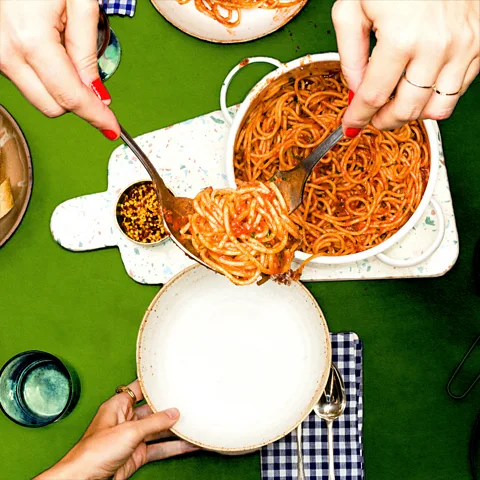
We’re not talking about a new fad diet, but one of humanity’s most ancient practices: commensality, or the act of eating with others. “The sharing of meals is an essential mechanism for bonding and building trust and connecting with others,” says Jan-Emmanuel De Neve, a professor of economics and behavioural science as the University of Oxford. And that has serious repercussions for our wellbeing.
Sadly, the increased isolation of the modern world is making this increasingly unusual. But it might be easier than you’d think to reach out to others and harness the ancient connection between food and friendship.
Building mental resilience
Much of the research on commensality has focused on its consequences for our mental health. One study, by Xinyi Wang and colleagues at the Zhejiang Provincial Centre for Disease Control and Prevention in China, involved surveying 9,361 women aged 60 and over. It found that the number of people sitting around the table at mealtimes was a clear predictor of someone’s risk of depression. This remained the case even after the team had controlled for a host of other factors that are known to influence people’s wellbeing, such as their general health and wealth, and whether or not that person lived alone.
This, the team concluded, suggests that there was something unique about commensality that affects our mental health.
Many other studies point to the same conclusions. Researchers from Tokyo, for instance, found that people aged 65-74 who lived with their families, yet ate alone, had five times the odds of developing depressive symptoms than those who regularly ate in company.
Arguably the strongest evidence comes from the World Happiness Report – a yearly analysis of wellbeing based on a global survey from the opinion polling company Gallup. In 2024, the company was sponsored by the Japanese food manufacturer Ajinomoto to add a section on people’s eating habits, which included the following questions:
Thinking about the last 7 days …
(1) On how many days did you eat lunch with someone you know?
(2) On how many days did you eat dinner with someone you know?”
“My eyes lit up when I saw,” De Neve says, who co-authored a chapter on the importance of commensality in the latest World Happiness Report. “We’re looking at about 150,000 individuals around the world who responded to that question.”
De Neve’s team found that the more meals that people shared with others, the higher they scored on standard measures of emotional wellbeing, with quite astonishing consistency. “It was as predictive of someone’s life satisfaction as their employment status and your relative income,” he says – two factors that are known to be enormously important for wellbeing.
Feel-good chemicals
De Neve emphasises that the questions about meal sharing may simply serve as a “proxy” of someone’s general social life – but he suspects there is something special about eating together. He points out that the English word companion comes from the Latin roots cum and pānis – “with bread” – while Chinese term 伙伴 (huǒ bàn) for the same concept derives from characters describing a military unit sharing the same kitchen stove. “It has deep cultural roots,” he says.
In his book Friends, Robin Dunbar – a biological anthropologist at the University of Oxford – suggests that eating naturally triggers the endorphin system, those feel-good chemicals behind our natural highs. This could strengthen the bond forged over a meal, leading us to feel a heightened sense of connection.
In 2025, Japanese researchers found that people who regularly eat alone have reduced brain volume in key regions associated with cognitive function
Intriguingly, the presence of other people may amplify the pleasure of the food itself. One series of studies by Erica Boothby at the University of Pennsylvania found that people eating chocolate in another person’s company found it considerably tastier.
Reduced dementia risk
Eating together may even slow the brain’s ageing.
In 2025, Japanese researchers found that people who regularly eat alone have reduced brain volume in key regions associated with cognitive function, including the medial temporal lobe and the hippocampus. Although some of these differences appeared to be linked to the diet itself – in general, people who eat by themselves tend to consume less nutritious foods – it could not account for everything, suggesting that the reduced social connection was also playing a role in their long-term brain health.
The authors speculated the enjoyment and enhanced social support of the shared meals could soothe stress, which is a known risk factor for neural decline. Alternatively, the conversations over the meals could provide extra mental stimulation that keeps our brains active into old age.
The participants were considered to have normal cognitive function during the study, but the researchers warned that this neural decline could eventually predispose them to dementia.
Buon appetito!
The World Happiness Report noted that eating practices vary widely between countries, and we may learn a lot from one nation’s efforts to preserve its culture of conviviality.
On average, the Japanese share fewer than four meals together each week. In the UK and US, that figure is around seven to eight, while in Italy, it approaches nine.
Italy is, of course, well known for its sociable food culture. When Unesco awarded Italian cuisine the status of an Intangible Cultural Heritage, the organisation highlighted the crucial role that meals play in “connecting with family and the community, whether at home, in schools, or through festivals, ceremonies and social gatherings”.
It may be no surprise, therefore, that the country is also leading the way in finding ways to protect its culture of commensality against the pressures of the modern world. The Slow Food Movement, which originated in Italy, was launched 50 years ago as a direct reaction to the growing popularity of fast food. It is perhaps best known for its aims to protect local traditions and encourage sustainable consumption, but the movement has long emphasised the importance of centring our days around shared meals.
“In Italy, sharing food is a philosophy in its own right: to cook together and share the preparation of what we put on the table,” explains Barbara Nappini, the president of Slow Food Italia. “This requires care and patience.”
Platonic dates
Even so, the pressures of the 21st Century have led many Italians to feel increasingly isolated. But if you don’t want to eat alone, the solution might be easier than you think.
You may already be surrounded by people who would jump at the chance of sharing a meal with you. A whole body of literature shows that people are far more receptive to these kinds of invitations than we expect.
In general, we underestimate how much people like us enjoy our company and want to spend time with us. So if you know someone who might also be feeling lonely and could appreciate the chance for a conversation over some good food, the best solution is just to ask them.

