

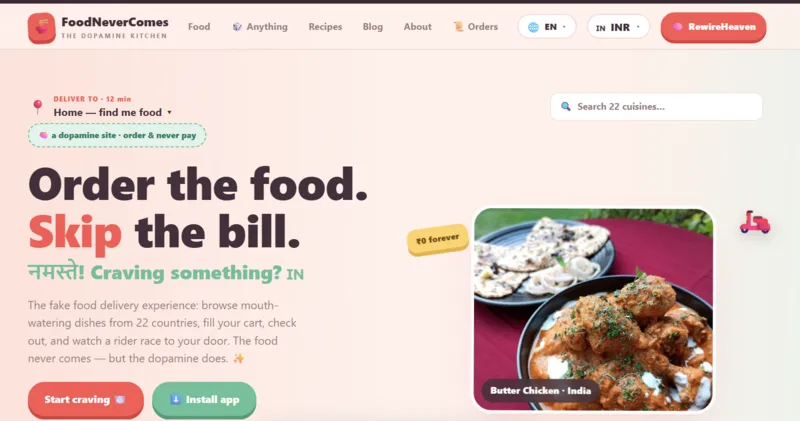
What if you could order your favourite meal, watch a delivery rider approach your home and enjoy the excitement of a purchase — without spending a single naira, dollar or rupee?
That is the idea behind FoodNeverComes, a website that recreates the experience of ordering food without actually delivering anything. Users can browse menus, add dishes to a virtual basket, check out and track a fictional courier before receiving a simulated call explaining that the delivery cannot be completed.
Created by Indian software developers Purvansh Parmar and Anshul Sharma, FoodNeverComes says it has attracted more than 2.7 million visitors since launching in June. The platform features 22 kitchens, 327 dishes and 319 real recipes, alongside fictional prices and a simulated ordering process.
The site is part of a growing internet trend known as “dopamine sites” — platforms that reproduce the rituals of consumption without the actual purchase. Similar websites allow people to fill virtual shopping carts, plan holidays or simulate other forms of consumption without spending money. The trend emerged in South Korea before spreading internationally.
For Parmar and Sharma, the idea came partly from their own habits. They noticed that browsing products, filling online carts and planning purchases could sometimes be satisfying even when they never completed the transaction. Parmar says he experienced something similar with food delivery while working in Mumbai, where he sometimes ordered treats he did not really need.
The phenomenon raises a question about whether the anticipation of consumption can be rewarding on its own. Ravi Dhar, director of the Yale Center for Customer Insights, describes this as “anticipatory utility” — the satisfaction associated with looking forward to consuming something. Research into consumer behaviour suggests that anticipation can sometimes provide a significant part of the enjoyment.
Neuroscientists, however, caution against treating dopamine simply as a “pleasure chemical.” University of Michigan neuroscientist Kent Berridge distinguishes between “wanting” and “liking”: wanting motivates people to pursue something, while liking refers to the pleasure experienced when they actually have it. Dopamine plays an important role in the motivational side of that process.
Stanford psychiatrist Anna Lembke similarly argues that the routines surrounding a reward can become reinforcing. That could help explain why browsing menus, filling a basket and pressing a checkout button can feel satisfying even when nothing is eventually delivered.
But whether fake consumption actually reduces cravings remains uncertain. Berridge says the novelty could wear off, while Dhar suggests simulated consumption might provide a temporary outlet for some urges. Lembke has also cautioned that repeatedly rehearsing the same behaviour could potentially reinforce the habits users are trying to avoid.
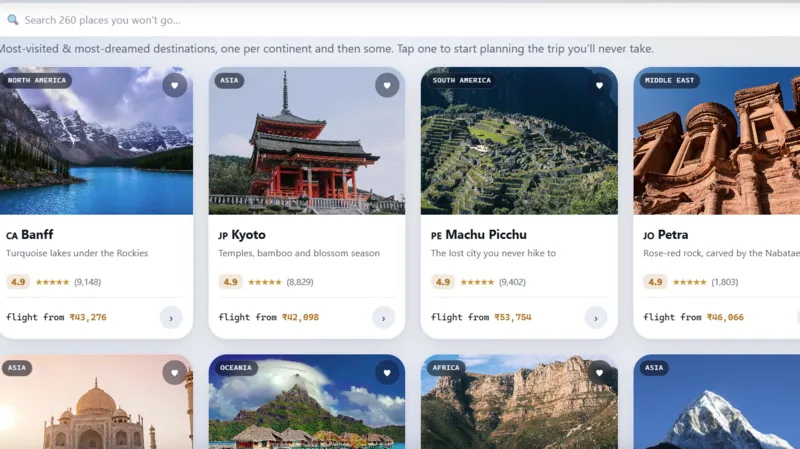
The founders have since expanded the concept with TripNeverLeaves, a website that lets users plan a holiday, choose flights, hotels and activities, and then experience a simulated journey without ever leaving the runway. The site describes itself as another way to enjoy the anticipation of a purchase without the financial cost.
For now, these platforms remain more experiment than business. Their popularity, however, points to a broader question about digital consumption: how much of what we enjoy about shopping, ordering and travelling comes from actually receiving something — and how much comes from simply imagining that we will?

