

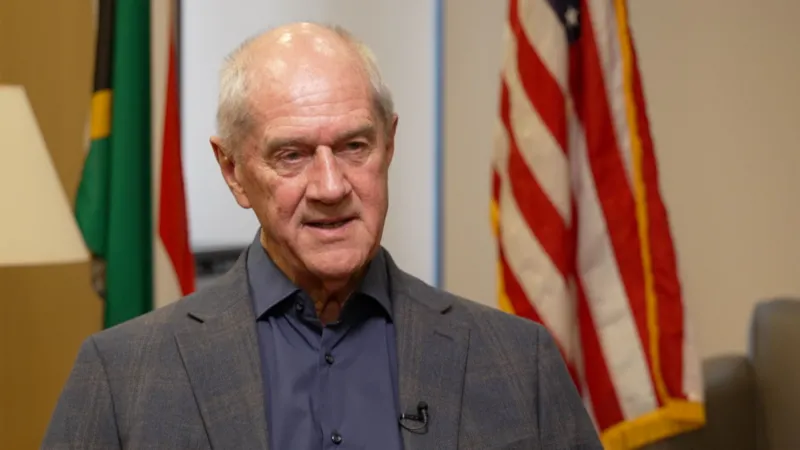
South Africa’s new ambassador to the United States, Roelf Meyer, has rejected President Donald Trump’s claims that white Afrikaners are facing genocide, saying the allegations do not reflect the broader reality of crime in South Africa.
Meyer, an Afrikaner himself and a former National Party negotiator who helped bring an end to apartheid, told the BBC that he had never experienced or witnessed the kind of targeted mass violence against Afrikaners described by Trump. He said the country’s crime problem had been presented in a misleading way and questioned the source of information being used to support the genocide claims.
Trump has repeatedly raised concerns about violence against white farmers and Afrikaners. In 2025, he confronted South African President Cyril Ramaphosa over the allegations and later established a US refugee pathway for Afrikaners. Nearly 13,000 refugees have since been admitted under the programme, according to the BBC, with all but three reportedly coming from South Africa.
Some Afrikaners who support the programme say their concerns are based on personal experiences with crime. One woman who moved from a farm in South Africa to Texas said her property had been entered several times and that she feared for her family’s safety. SJ Du Venage, a member of the Freedom Front Plus, has also argued that there is a political campaign against white South Africans.
South African authorities and political parties, including those representing Afrikaners, have rejected the characterization of the situation as genocide. Police data indicates that most victims of violent crime in South Africa, including farm-related crime, are Black. Experts interviewed by the BBC said that although farm attacks and violent crime are serious problems, the available evidence does not establish systematic persecution of white South Africans.
The issue has become part of a wider dispute between Washington and Pretoria. The Trump administration has also criticized South Africa’s policies on employment equity and land reform, including legislation allowing land expropriation without compensation in certain circumstances. South Africa maintains that these policies are intended to address inequalities created during apartheid.
Meyer, who was appointed ambassador in April as relations between the two countries deteriorated, said he wanted the US to reconsider its policy toward South Africa. Rather than focusing specifically on farm attacks, he argued that Washington should help South Africa address crime more broadly, including by providing resources and equipment to improve police response times.
Meyer also criticized Afrikaner activists who have organized protests in Washington featuring white crosses representing alleged farm-attack victims. He said raising concerns abroad would have little value unless Afrikaners were also committed to addressing the country’s problems from within South Africa.

