

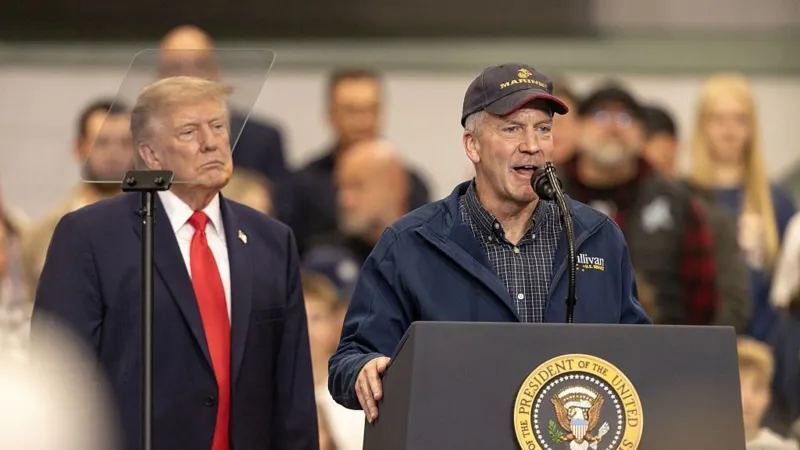
The Trump administration has filed a federal lawsuit seeking to prevent Alaska from certifying its upcoming US Senate election results under certain circumstances, arguing that a second candidate with the same name as Republican incumbent Dan Sullivan could confuse voters and affect the outcome.
The lawsuit, filed by the US Department of Justice on Thursday, comes as Sullivan faces a closely contested race against Democratic challenger Mary Peltola ahead of the 3 November midterm elections. Polls indicate Peltola holds a narrow lead in the final days of the campaign.
The administration wants a judge to block certification if Sullivan loses by a margin smaller than the votes received by the other candidate named Dan J. Sullivan.
President Donald Trump has publicly backed the legal action, telling reporters on Friday, “I’m the one that said do it,” when asked about the lawsuit after arriving in Florida for a campaign rally.
Dispute Over Two Candidates With the Same Name
Trump has described the second candidate’s campaign as a “scam” and said his administration was considering “powerful legal options” to stop it.
The other Dan Sullivan, a retired teacher and former US Forest Service worker, is also running in the election. He reportedly belonged to the Alaska Independence Party before registering as a Republican earlier this year.
Previous attempts to remove him from the ballot have been rejected by the Alaska Supreme Court.
On the ballot, the incumbent senator will appear as the Republican candidate, while the other contender will be listed as Dan J. Sullivan.
In its court filing, the Justice Department argued that the presence of two candidates with similar names could mislead voters who intend to support the incumbent.
Associate Attorney General Stanley E Woodward Jr said the second candidate’s inclusion could distort voters’ intentions and undermine the integrity of the election. He also alleged that the candidacy was intended to benefit Peltola by drawing votes away from the Republican senator.
Dan J. Sullivan has repeatedly denied those accusations. In an earlier interview with the Petersburg Pilot newspaper, he said he would not know whom to approach in Peltola’s campaign.
Speaking separately to Courthouse News, he said he hoped voters would understand who they were choosing, adding that having a choice was important and that voters’ intentions would vary.
Neither Sullivan nor Peltola has publicly commented on the latest lawsuit.
What the Lawsuit Could Mean for the Election
Alaska uses a ranked-choice voting system, which allows voters to rank candidates in order of preference. Under the system, voters could select both candidates named Sullivan if they were uncertain about which one was the incumbent senator.
The Justice Department argues that this possibility creates a risk that the final results may not accurately reflect voters’ intentions.
If Peltola wins and the margin suggests that confusion over the candidates’ names may have affected the outcome, the lawsuit asks the court to delay certification while an investigation is conducted.
The proposed investigation would examine whether voters were confused by the two names and consider what the outcome might have been if Dan J. Sullivan had not appeared on the ballot. The government has also requested any other measures the court considers necessary and appropriate.
The case places the administration’s concerns about election integrity at the centre of a closely watched Senate contest, while raising questions about whether a candidate’s similar name is sufficient grounds to challenge the certification process.
A Closely Watched Midterm Contest
The Alaska race is among the most closely monitored contests ahead of the 2026 US midterm elections. Trump won the state by 14 percentage points in the 2024 presidential election, but his approval ratings there have reportedly suffered amid voter dissatisfaction over rising prices and the war in Iran.
A victory for Peltola would represent a significant challenge for Republicans seeking to maintain their position in the Senate.
With voting scheduled for 3 November, the lawsuit introduces another legal and political complication into an already competitive campaign. Its outcome could determine whether Alaska’s election results are certified on schedule if the final vote falls within the circumstances outlined by the Justice Department.

