

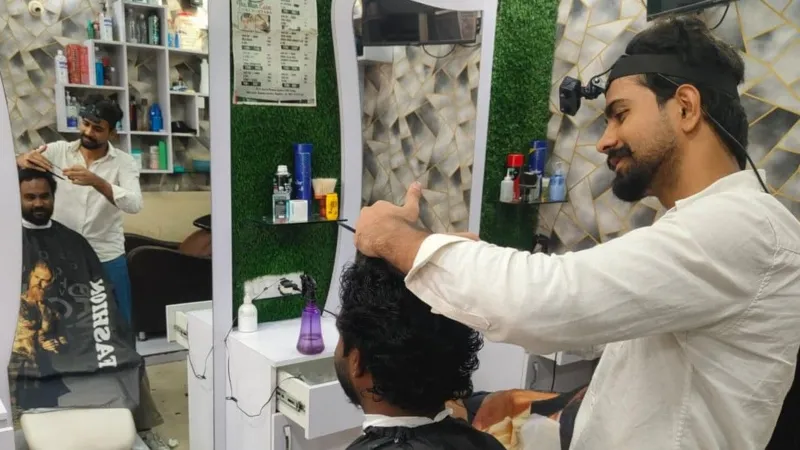
Across India, workers are being paid to wear head-mounted cameras and record themselves performing everyday tasks, from cutting hair and stitching garments to cooking, cleaning and folding laundry. The footage is helping technology companies train artificial intelligence systems designed to perform physical work in the real world.
For some workers, the opportunity provides much-needed additional income. For others, it raises difficult questions about privacy, job security and whether they are helping develop machines that could eventually replace them.
From Barbershops to Factories: Turning Everyday Work Into AI Training Data
Mohammed Ashim, a 22-year-old barber in Bengaluru, has spent four years cutting hair and trimming beards. Recently, he began wearing a camera attached to a headband to record his work for several hours a day.
The camera captures his hands and fingers while clients’ faces are blurred.
Ashim says the process requires discipline. His hands must remain clearly within the camera frame, the lighting must be adequate, and sudden head movements must be avoided.
Although he welcomes the extra money, he is also excited by the technology behind the work.
He never imagined that his razor techniques could become useful to a global technology company.
Ashim is among hundreds of thousands of workers around the world being paid to record their daily activities. Local data-collection companies gather the footage and sell it to technology businesses and research organisations developing AI, particularly physical AI — systems designed to control robots that interact with the real world.
The Companies Collecting Human Experience
Rashdan Technologies is one of the companies collecting and processing footage of human activities.
Its co-founder and chief executive, Shahil Baig, says clients request recordings of a wide variety of tasks, including industrial work, agriculture, household chores, pottery, garment-making, embroidery and candle-making.
His company pays between $5 and $10 for eight to 10 hours of recorded work.
Baig says the process must be handled carefully to ensure workers understand and consent to what they are recording.
The company generally captures workers’ hands rather than their faces and blurs faces when more extensive camera setups record the surrounding environment. Baig says identifying information, including names and contact details, is not included in the data supplied to clients.
However, technology companies increasingly want more comprehensive recordings.
Some now request four to six cameras mounted around a worker’s head to capture an entire scene rather than just hand movements. Baig says workers receive higher payments for these more demanding recording arrangements because they require greater participation.
The industry is also becoming more competitive, with expectations that dozens of additional companies could enter India’s data-collection market.
Why Robots Need to Learn From Humans
Manish Agarwal, founder of Humyn Labs, another company that collects and processes human-generated data, says robots cannot be trained effectively through computer simulations alone if they are expected to operate successfully in real-world environments.
Robots must learn not only what a task looks like, but also how people move, handle objects and apply force.
For example, a robot needs to understand how firmly to grip a plastic bottle without crushing it, compared with holding a metal cup.
Capturing this information can involve video recordings and specialised equipment attached to workers’ hands and fingers.
“There is no existing internet archive of embodied human activity,” Agarwal explains, noting that detailed recordings of tasks such as cleaning kitchens or assembling cars must be collected in real environments.
Humyn Labs has approximately 96,000 data collectors across countries in Latin America and Southeast Asia.
The company reviews thousands of hours of footage, selects useful recordings, labels the content so AI systems can interpret it, and packages the data for technology clients.
Agarwal says the diversity of the recordings is important. Companies developing robots for American factories or homes may need data from environments that resemble those settings, meaning recordings from Indian homes or workplaces may not always be suitable.
Could Workers Be Training Robots to Replace Them?
The growing demand for human-generated training data has raised concerns about the future of employment.
Bino Paul, a senior professor at the Tata Institute of Social Sciences in Mumbai, says it is too early to know precisely how the technology will affect workers.
AI could become a useful tool in some occupations, while robots could automate tasks currently performed by people in others.
Paul warns that workers may have limited control over the consequences once automated systems become sufficiently advanced.
“By the time workers realise what they have participated in, things may have gone too far,” he says.
He argues that governments need to regulate AI and ensure that ethical considerations remain central to its development.
For Paul, AI should not be treated simply as a technical system. Its development and use must also account for social consequences and human wellbeing.
‘For Me, It’s Survival’
Despite these concerns, the opportunity to earn additional money is difficult for many workers to turn down.
Mohammed Arman, who has worked in the textile industry in Bengaluru for a decade, recently began filming himself cutting and stitching garments.
He says the work has become second nature after years of handling cloth, thread, needles and sewing machines.
For Arman, wearing a camera does not substantially change his routine, but it offers extra income that can support his family in Bihar.
“For me, it’s simple. This is survival,” he says.
“If someone offers me extra money to wear a camera while I do the exact same work I’ve been doing for 10 years, I’m not going to say no.”
He sees the arrangement as a practical way to earn more from work he already knows how to do.
A Flexible Income for Working Mothers
For some people, recording everyday activities provides a flexible source of part-time income.
Jolly Arifur, a science teacher living in Guntakal, Andhra Pradesh, began recording her domestic chores because she wanted work she could fit around caring for her young son.
For seven months, she has worn a camera rig while cooking, scrubbing, sweeping floors and folding laundry.
Arifur records for three to five hours a day alongside her teaching job, earning between $2 and $3 an hour.
She says the additional income has become a valuable supplement to her teaching salary and allows her to balance both responsibilities.
India Must Move Beyond Supplying Raw Footage
Although India is becoming an important source of human-generated AI training data, Agarwal believes the country risks remaining at the lowest-value end of the industry.
At present, many workers record ordinary activities before the footage is sent to research laboratories and technology companies abroad.
Agarwal argues that India should develop expertise in the more valuable stages of the process, including cleaning, organising and validating data, as well as establishing standards for high-quality training material.
Without that shift, he warns, the value of basic video collection could decline as more companies compete for contracts.
The Future of Work in the Age of Physical AI
The workers recording their daily routines are helping build a new generation of AI systems capable of interacting with the physical world.
Their footage could help robots learn complex movements and practical skills that are difficult to reproduce through simulations alone.
For now, the work offers some people additional income, while companies gain access to training material that was previously difficult to obtain.
But questions remain over consent, privacy, regulation and the long-term impact on employment.
As the industry expands, India faces an opportunity to build a more valuable role in the global AI supply chain. At the same time, governments and technology companies will need to consider the interests of the workers whose everyday skills are helping teach machines how to work like humans.

