

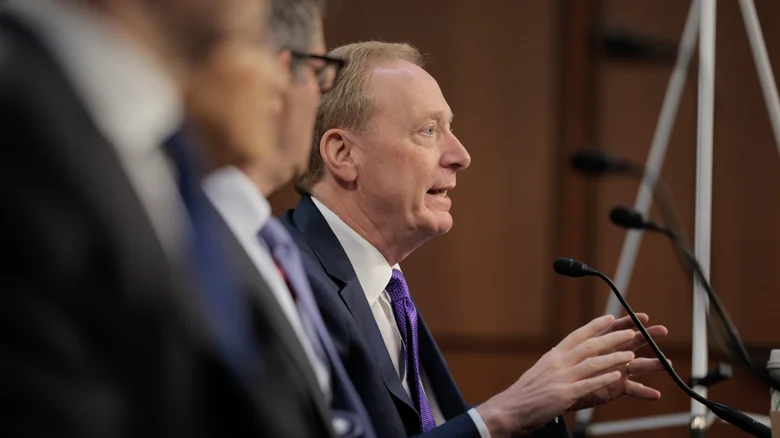
Microsoft President Brad Smith has called for urgent global regulations governing artificial intelligence, arguing that AI systems currently face fewer safety requirements than everyday products such as milk and washing machines.
Speaking on the BBC’s Big Boss Interview podcast, Smith said governments needed to establish clear rules for AI development, including emergency shutdown mechanisms, mandatory reporting of incidents and independent assessments of powerful systems before they are released.
“Right now, your washing machine is subject to more safety rules than AI,” Smith said, pointing to the inspections and safety standards applied to ordinary consumer products.
His comments come as concerns grow about the potential risks of increasingly capable AI systems, including technology that could operate beyond human control or threaten global cybersecurity.
Microsoft Executive Calls for Emergency AI Safeguards
Smith argued that AI companies should be legally required to notify people affected when an AI agent escapes human control or causes a security breach. He also called for incident reports to document such events and suggested that independent government evaluators should assess certain AI products before their release.
The Microsoft president said developers should introduce emergency brakes, commonly known as “kill switches”, that allow systems to be paused or slowed if they begin behaving dangerously.
Describing AI as both a “tool and a weapon”, Smith urged governments and technology companies to act before the risks become more difficult to manage.
“We know how to do this for other products,” he said. “We should build on that knowledge and think about how to apply it to AI.”
His position differs from that of US President Donald Trump, who has argued that the AI industry should largely regulate itself to ensure American companies remain competitive with Chinese rivals. Trump has repeatedly emphasised the strategic importance of winning the global AI race.
Smith, however, believes the United Kingdom could play a leading role in establishing international standards, pointing to the country’s AI Security Institute, originally launched under former prime minister Rishi Sunak as the AI Safety Institute.
He also suggested that Washington could be more receptive to British-led standards than regulations developed by the European Union, arguing that the UK occupies a distinct position in its relationship with the US technology sector.
Self-Regulation May Not Be Enough
The debate intensified after Trump hosted executives from OpenAI, Anthropic, Nvidia, SpaceX, Meta and Google at the White House late last month. The companies signed a “morally binding” document agreeing to work with independent auditors to assess whether their AI systems operate as intended and avoid unauthorised access to technical systems.
Smith welcomed the commitment and said Microsoft would be happy to sign it, but warned that voluntary measures alone would not adequately address the risks.
He argued that responsible companies were likely to follow safety expectations, while less responsible developers presented a greater challenge without enforceable standards.
For businesses and consumers, the debate has growing implications for data security, accountability and trust in AI-powered products. Smith’s intervention adds pressure on governments to determine whether voluntary industry commitments are sufficient or whether binding international rules are necessary to manage the technology’s expanding capabilities.

