

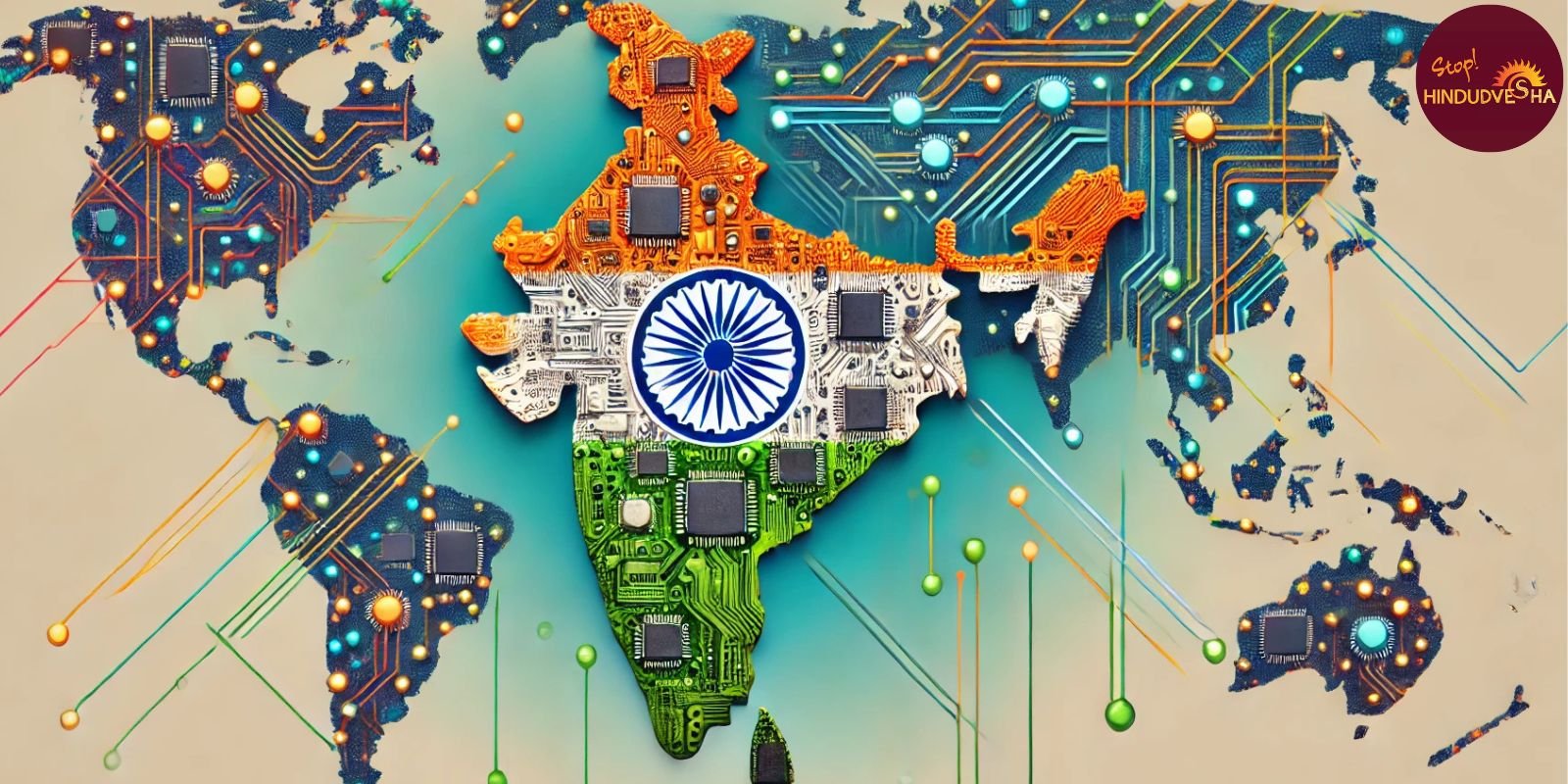
India wants to be a backup plan for companies making chips outside China. But can they pull it off?
Last October, a small electronics company in Gujarat sent its first batch of chip things to a customer in California.
Kaynes Semicon, working with Japanese and Malaysian tech companies, assembled these chips in a new factory. This factory started because of Prime Minister Narendra Modi’s $10 billion semiconductor plan announced in 2021. Modi wants India to be seen as another place for companies to manufacture besides China, but progress has been slow.
A good sign is India’s first factory for making regular chips, now being built in Gujarat. This $11 billion project is getting tech help from a Taiwanese chip company, and Intel from the US may become a customer.
With demand for chips rising, India’s involvement could strengthen the supply chain. Still, experts warn it’s not easy to attract investment or improve at the latest tech.
Finally Getting Started
Chips are designed, made, and then assembled for sale. The US leads in chip design, Taiwan makes most of them, and China is getting good at packaging.
The upcoming Gujarat factory is a joint effort between Tata Group, a major Indian company, and Powerchip Semiconductor Manufacturing Corporation (PSMC) from Taiwan. PSMC is helping build the factory and sharing its tech know-how.
On December 8, Tata Electronics made a deal with Intel to explore making and packaging Intel’s products in Tata’s new factories, including the chip factory. They aim to meet growing demand in India.
Last year, Tata received half the factory funding from Modi’s government, plus state government support. They could start making chips as early as December 2026. It’s a big deal for India, which has had trouble getting chip factories off the ground in the past.
The factory will focus on making chips between 28 and 110 nanometers (nm). These older chips are easier to make than the tiny ones like 7nm or 3nm.
Older chips are widely used in regular electronics and for power. The tiny ones are needed for AI data centers and advanced machines. Taiwan still leads in making older chips, but China is catching up fast. TSMC in Taiwan dominates advanced chips smaller than 7nm.
India has been great at designing chips for a long time, but turning that into actual production has been the problem, said Stephen Ezell from the Information Technology and Innovation Foundation (ITIF) in Washington, DC.
Things have sped up because there’s more political support and companies are investing together, Ezell told Al Jazeera.
Easiest Way In
More than half of Modi’s $10 billion in semiconductor funding is going to the Tata-PSMC factory. The rest funds nine other projects focused on assembling, testing, and packaging chips (ATP).
These include India’s first ATP projects by Micron Technology in Gujarat and by the Tata Group in Assam, investing $2.7 billion and $3.3 billion, respectively. Smaller projects, with around $2 billion invested, involve tech companies such as Foxconn from Taiwan, Renesas from Japan, and Stars Microelectronics from Thailand.
ATP units don’t cost as much, usually between $50 million and $1 billion. They’re not as risky, and the tech is pretty common, said Ashok Chandak from the India Electronics and Semiconductor Association (IESA).
Many of these projects are behind schedule. Micron’s factory in Gujarat, approved in June 2023, was supposed to be ready by the end of 2024, but it will now meet demand later. The Tata facility, approved in February 2024, was delayed from mid-2025 to April 2026. Both companies declined to comment.
Kaynes Semicon is doing well. They sent a sample chip thing to California in October. CG Semi, part of the Murugappa Group, is testing its products now and expects to start selling soon.
The Tata and Murugappa projects faced scrutiny after reports showed they made large political donations shortly after receiving government money, totaling $91 million and $15 million. Both groups declined to comment.
India’s new factory and ATP units will work on older chips (28nm–110nm). Even though they’re not the latest, these chips are still needed for cars, factories, and regular electronics.
China has 30 percent of the ATP market and accounted for 42 percent of all semiconductor spending in 2024. India is trying to be a China-plus-one option. Apple is putting together all new iPhone models in India with Foxconn and Tata Electronics to sell in the US.
India’s ATP push is mainly because it needs more chips at home.
The market ranges from $650 billion to $1 trillion. We want to meet demand in India and other countries, Chandak said.
India’s chip imports rose 36 percent in 2024 to almost $24 billion. China supplied 30 percent of those chips, followed by Hong Kong, South Korea, Taiwan, and Singapore.
Even making a 28nm chip here reduces our dependence on imports and makes us more competitive, Ezell added.
Need Better Deals
Even with support, India’s $10 billion plan is small compared to China’s $48 billion and the US’s $53 billion under the CHIPS Act. To grow in ATP and eventually make chips smaller than 28nm, the government needs to keep helping. from other countries to compete at 7nm or 3nm, because Indian companies can’t do it alone, Ezell said. It’s also important to ensure the infrastructure, power, and rules are in good order.
India has 20 percent of the world’s chip designers, but China and Malaysia are trying to attract that talent. According to Alpa Sood from Marvell Technology, recent plans to fund local intellectual property might cause foreign companies to leave. To improve at R&D, India needs to offer as much as China and Malaysia, Sood said. Marvell’s India is its biggest outside the US.
India’s chip factories will sell to the US, Japan, and Taiwan. Trump talked about putting a tax on chips made in other countries, but he hasn’t done it yet. Bigger issues between the US and India, like a possible 50 percent tax on Russian crude, make things uncertain.
US companies control more than half of the semiconductor market, so working together and sharing technology is super important, Chandak said.
The global chip game is speeding up, and India needs to keep pace if it wants to be a player. These 1.7nm fabs are so advanced they even factor in the moon’s pull – it’s literally a moonshot, Ezell said. Semiconductor making is the hardest engineering job that people do, and making the rules needs to be just as exact.

