

Bear Put Spread: Definition, Example, How It’s Used, and Risks
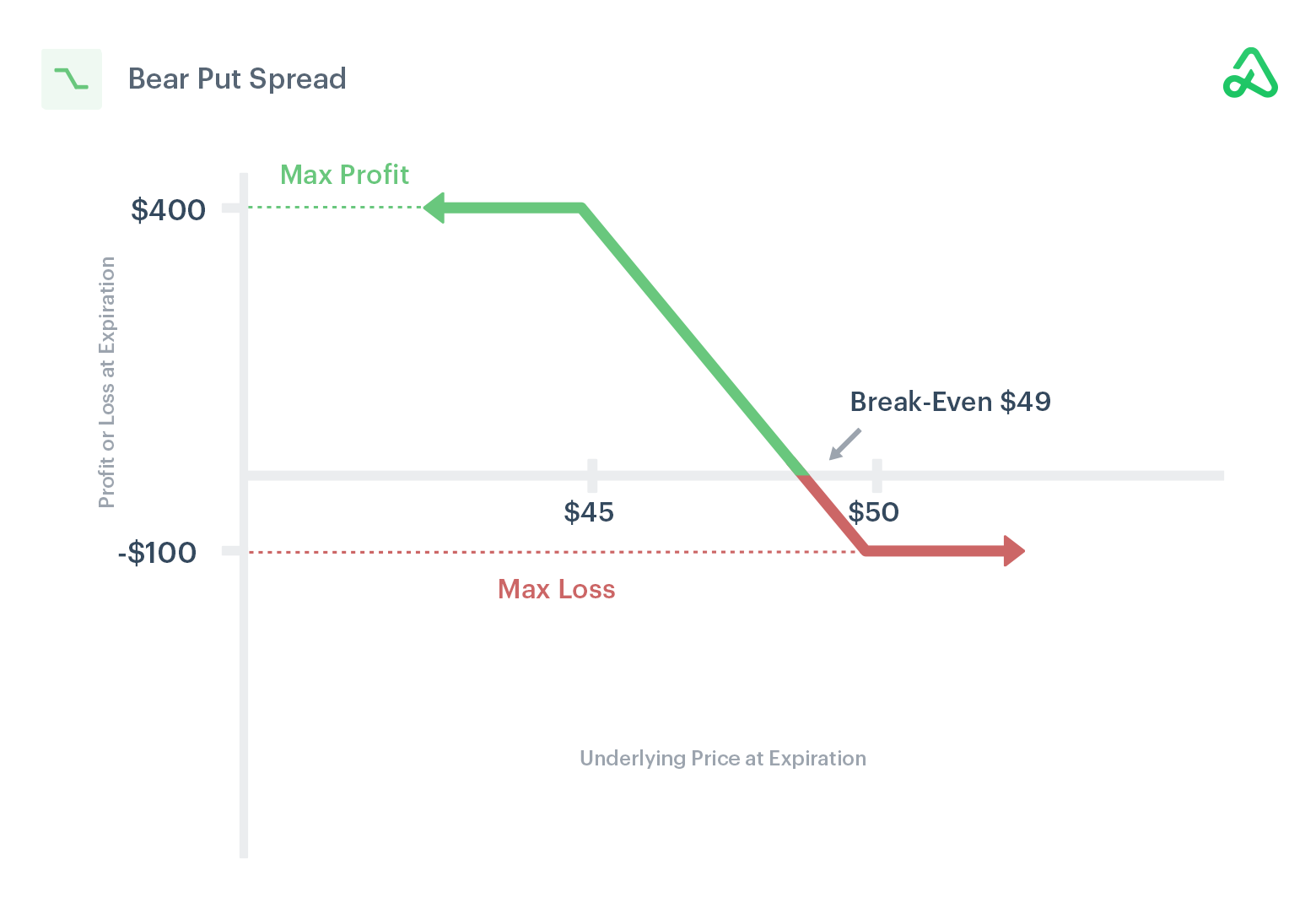
A bear put spread is a type of options strategy where an investor or trader expects a moderate-to-large decline in the price of a security or asset and wants to reduce the cost of holding the option trade. A bear put spread is achieved by purchasing put options and selling the same number of puts on the same asset with the same expiration date at a lower strike price. The maximum profit using this strategy is equal to the difference between the two strike prices minus the net cost of the options.
A put option gives the holder the right, but not the obligation, to sell a specified amount of underlying security at a specified strike price at or before the option expires. A bear put spread is also known as a debit or long put spread.
The Basics of a Bear Put Spread
For example, let’s assume that a stock trades at $30. An options trader can use a bear put spread by purchasing one put option contract with a strike price of $35 for a cost of $475 ($4.75 x 100 shares/contract) and selling one put option contract with a strike price of $30 for $175 ($1.75 x 100 shares/contract).
In this case, the investor will need to pay $300 to set up this strategy ($475 – $175). If the underlying asset’s price closes below $30 upon expiration, the investor will realize a total profit of $200. This profit is calculated as $500, the difference in the strike prices ($35 – $30) x 100 shares/contract – $300, and the net price of the two contracts [$475 – $175] equals $200.
Advantages and Disadvantages of a Bear Put Spread
The main advantage of a bear put spread is that the net risk of the trade is reduced. Selling the put option with the lower strike price helps offset the cost of purchasing the put option with the higher strike price. Therefore, the net outlay of capital is lower than buying a single put outright. Also, it carries far less risk than shorting the stock or security since the risk is limited to the net cost of the bear put spread. Theoretically, selling a stock short has unlimited risk if the stock moves higher.
- Less risky than simple short-selling
- It works well in modestly declining markets
- Limits losses to the net amount paid for the options
- Risk of early assignment
- Risky if asset climbs dramatically
- Limits profits to differences in strike prices
With the example above, the profit from the bear put spread maxes out if the underlying security closes at $30, the lower strike price, at expiration. If it closes below $30, there will not be any additional profit. There will be a reduced profit if it closes between the two strike prices,. And if it closes above the higher strike price of $35,, the entire amount spent to buy the spread will be lost.
Also, as with any short position, option-holders have no control over when they will be required to fulfill the obligation. There is always the risk of early assignment—that is, buying or selling the designated number of the asset at the agreed-upon price. Early exercise of options often happens if a merger, takeover, special dividend, or other news affects the option’s underlying stock.
Real-World Example of Bear Put Spread
As an example, let’s say that Levi Strauss & Co. (LEVI) is trading at $50 on October 20, 2019. Winter is coming, and you don’t think the jeans maker’s stock will thrive. Instead, you think it’s going to be mildly depressed. So you buy a $40 put, priced at $4, and a $30 put at $1. Both contracts will expire on November 20, 2019. Buying the $40 put while simultaneously selling the $30 put would cost you $3 ($4 – $1).
If the stock closed above $40 on November 20, your maximum loss would be $3. If it closed under or at $30, however, your maximum gain would be $7—$10 on paper, but you have to deduct the $3 for the other trade and any broker commission fees. The break-even price is $37—a price equal to the higher strike price minus the net debt of the trade.
Conclusion
- A bear put spread is an options strategy implemented by a bearish investor who wants to maximize profit while minimizing losses.
- A bear put spread strategy involves the simultaneous purchase and sale of puts for the same underlying asset with the same expiration date but at different strike prices.
- A bear put spread nets a profit when the price of the underlying security declines.

