

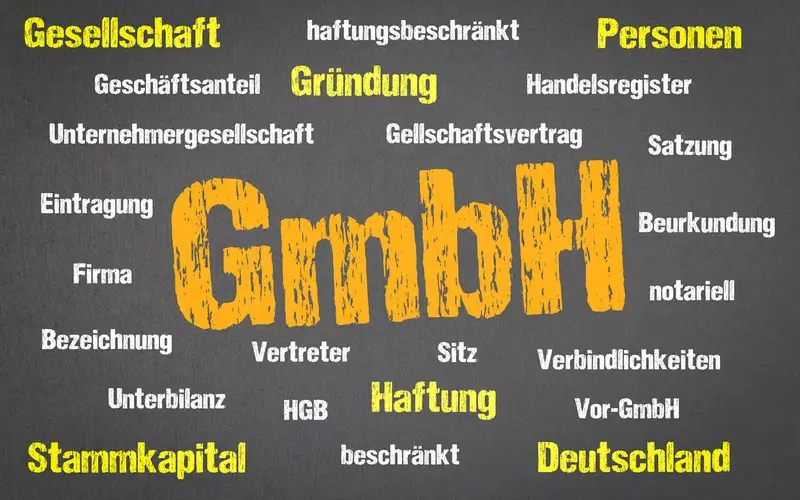
What is Gesellschaft mit beschränkter Haftung?
GmbH is an acronym of the German term “Gesellschaft mit beschränkter Haftung,” which means “company with limited liability.” It’s a suffix used after a private limited company’s name in Germany (vs. AG, for Aktiengesellschaft, used to identify a public limited corporation). GmbH is the equivalent of LLC (limited liability company), used in the United States, or Ltd. (limited), used in the United Kingdom. It is the most prevalent type of incorporation in Germany.
Understanding Gesellschaft mit beschränkter Haftung
A limited company is one where shareholder liability is restricted to the amount of their original investment. The shareholders are not accountable for the business’s obligations, preserving their assets if the company becomes insolvent. The distinction between a private limited company and a public limited company is that the shares of a private limited company are not sold to the general public and are not exchanged on a public stock exchange.
Germany and Austria’s most famous corporate legal entity is the limited liability corporation, or GmbH. Under German law, the minimum capital requirement for starting a private limited company is 25,000 euros (€25,000), half of which must be available before registering the firm in the Unternehmensregister or Company Register, the primary platform for saving legally necessary company data. In this manner, the government assures that only solvent entrepreneurs can launch new enterprises.
Business operations may occur during the period between the establishment and the company’s registration, making participating persons personally accountable. However, registering the company is necessary for it to become operational, and this process typically takes up to three weeks. At this point, shareholders are protected from any personal liability.
The minimum capital needed for founding a private limited company is 25,000 euros (€25,000), half of which must be provided before registering the entity.
Requirements for Gesellschaft mit beschränkter Haftung
When a newly created GmbH applies to Germany’s Company Register to register the firm’s formation, it must appoint its first director and give a list of its shareholders. If the firm has more than 500 employees, it needs a supervisory board. Otherwise, the managing directors govern the company with an unfettered proxy.
There is no central corporate registration in Germany; a company registers in a municipal court where the business’s registered office is located, or where the GmbH has its legal seat.
The establishment of Unternehmergesellschaft (UG), a “mini-Gmbh,” in 2008 aided and encouraged entrepreneurs with limited resources. The minimum capital required for Unternehmergesellschaft is 1 euro (€1). Each year, a UG should save at least 25% of its yearly net profit until it surpasses the statutory minimum of €25,000 for reserve capital. At that point, the UG can change its legal status to GmbH.
Other Versions of GmbH
Besides the lower-capital mini-GmbH, Germany also allows for a GmbH & Co. KG (kommanditgesellschaft, or limited partner) designation and a gGmbH.
- GmbH & Co. KG: A combination of Gesellschaft mit beschränkter Haftung and KG
- gGmbH: A non-profit Gesellschaft mit beschränkter Haftung
What does GmbH stand for?
Gesellschaft mit beschränkter Haftung is an acronym of the German term “Gesellschaft mit beschränkter Haftung,” which means “company with limited liability.”
Is GmbH the same as LLC?
People regard GmbH as the equivalent of LLC (limited liability company), which is used in the United States, or Ltd. (limited), used in the United Kingdom, and is the most prevalent form of incorporation in Germany.
What nations utilize GmbH?
A few more nations outside Germany use GmbH and various variants. Austria employs GesmbH as well as GmbH, both with the same meaning. Switzerland also uses the GmbH designation. Germany, Austria, and Switzerland all have the same regulations for the GmbH designation in their respective nations.
Conclusion
- Gesellschaft mit beschränkter Haftung is a German term for “Gesellschaft mit beschränkter Haftung,” meaning “company with limited liability.”
- Gesellschaft mit beschränkter Haftung—equivalent to Ltd. (limited), used in the United Kingdom, or LLC (limited liability company), or Inc. (incorporated), used in the United States—is the most prevalent form of incorporation in Germany.
- Individuals, public companies, or partners are just a few examples of the various entities that can own GmbH corporations.
- Before registering with Germany’s Company Register, a Gesellschaft mit beschränkter Haftung must name its first director and disclose its shareholders.

