

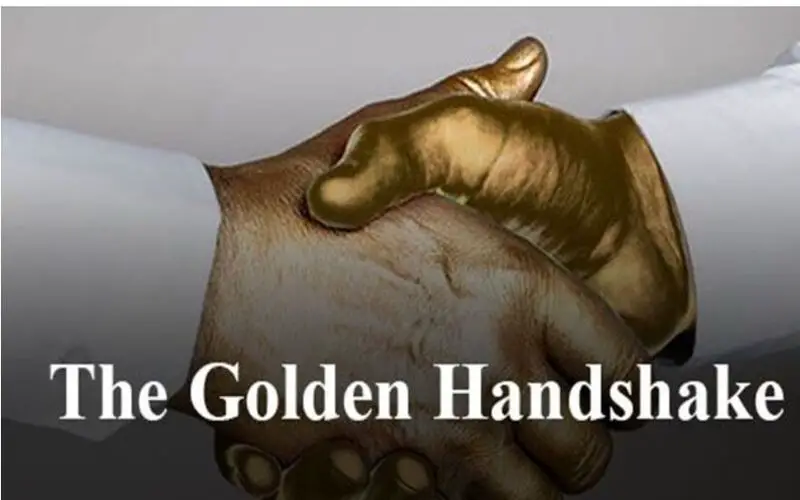
What is a golden handshake?
The golden handshake is a condition in an executive’s contract that offers a substantial severance payout if they leave their job due to termination, restructuring, negligence, or retirement. Top executives who depart their jobs receive golden handshakes. Negotiating the payout before signing the contract is typical. People can pay for a golden handshake with cash or stock options. The lack of motivation from golden handshakes and other benefits has drawn criticism.
How Golden Handshakes Work
Before joining a firm, executives might negotiate several kinds of remuneration. These workers receive wages, stock options, cash, and bonuses. Companies may provide additional bonuses and incentives to recruit top talent. Other benefits may include the golden handshake and other non-performance-based rewards.
Negotiating a golden handshake before hiring is typical. Employees receive compensation if they leave their employment due to termination, layoff, restructuring, negligence, or retirement. The employing organization often uses this advantage to attract new hires.
Golden handshakes may cost millions, making them a significant concern for investors. R.J. Reynolds Nabisco paid F. Ross Johnson $52 million in 1989 for a golden handshake. Non-compete agreements and remuneration may prohibit employees from working for a competitive firm for a specific time after termination.
Some call a golden handshake a golden parachute.
Special Considerations
Some non-executives earn golden handshake bonuses. The salary frequently differs significantly from that of CEOs and senior executives, making it a silver handshake. It’s better than leaving empty-handed.
Automotive firms may purchase union workers’ contracts. This allows that capital to be used to recruit cheaper staff. People forced into early retirement are another example. Companies often provide severance benefits to attract new hires.
Golden Handshake criticism
Golden handshakes are contentious for several reasons. As said, these rewards aren’t employment- or performance-related. This implies the executive is paid even if they fail. Critics are even more perplexed that negligent bosses may still receive a golden handshake.
Due to the perception that huge executive payoffs encourage failure, they can damage a company’s reputation. Executive team members often receive better wages than non-executive team members.
Examples
Golden handshakes attract attention, especially when leaders fail to reach goals or the organization faces a negative PR situation. Two legendary golden handshakes are below.
The British Petroleum
In 2010, British Petroleum (BP) had an oil spill in the Gulf of Mexico due to the Deepwater Horizon rig explosion.BP leased the rig to explore Louisiana’s Macondo Prospect.
BP fired CEO Tony Hayward after the catastrophe, which cost the corporation over $69 billion.
Banks
Other golden handshake scandals happened during the 2007–2008 financial crisis. Many bank executives left after financial problems. Their hefty salary packages remained before they went. Big banks accelerated stock award vesting for top-level workers, allowing them to cash out incentive schemes.
The deals left bank stockholders with worthless stock and bonds, causing them distress. Since then, several corporations have allowed shareholders to vote on CEO compensation packages. These shareholder votes are often non-binding. They send a powerful message to management about investors’ views on excessive CEO compensation.
Conclusion
- Golden handshakes are pre-negotiated employment agreements that offer severance for early termination.
- Cash, stock options, or other contract-accepted payment is possible.
- Golden handshakes sometimes include non-compete provisions.
- Golden handshakes are contentious and can anger people.
- Low-level workers may receive a lesser golden handshake.

