

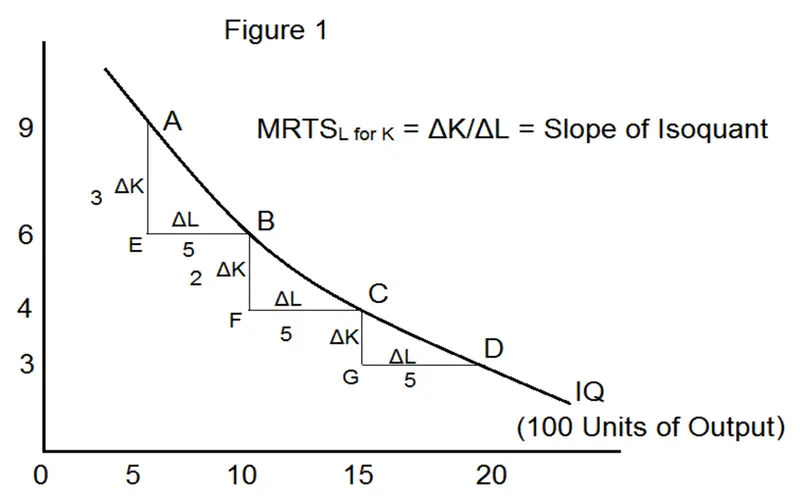
MRTS stands for the marginal rate of technical substitution.
An economic theory known as the marginal rate of technical substitution (MRTS) describes the rate at which one factor must diminish for an increase in another to maintain the same level of productivity.
The MRTS represents the exchange of resources, including labor and capital, that enables an organization to sustain an uninterrupted production level. In contrast to the marginal rate of substitution (MRS), which focuses on consumer equilibrium, MRTS is concerned with producer equilibrium.
The MRTS Formula is
MRTS(L,K)=−ΔK/ΔL=ΜL/MPK
where:
K=CapitalL=Labor
MP=Marginal products of each input
ΔK/ΔL= Amount of capital that can be reduced
when labor is increased (typically by one unit)
The Method for Determining the Marginal Rate of Technical Substitution (MRTS)
An isoquant is a graph depicting combinations of capital and labor that produce the same output. The slope of the isoquant, which represents the capital required to replace one unit of labor at any given production point along the isoquant, denotes the MRTS.
For instance, the MRTS at any given point on the graph of an isoquant where capital (K) is represented on the Y-axis and labor (L) is represented on the X-axis is computed as dL/dK, which is the slope of the isoquant.
What information does the MRTS provide?
The MRTS, or slope of the isoquant, represents the rate at which a specific input (labor or capital) can be replaced for another while maintaining the same level of output (as depicted on the graph). The absolute value of an isoquant’s slope at a specific point in time serves as a representation of the MRTS.
Assuming an equivalent output level, a reduction in the marginal rate of substitution along an isoquant signifies a diminishing marginal rate of substitution. When a firm decreases from point (a) to point (b) while utilizing one additional unit of labor, it can sacrifice four units of capital (K) while remaining on the same isoquant at point (b), as depicted in the figure below. Thus, MRTS equals 4. By transferring from point (b) to (c) while employing an additional unit of labor, the organization can decrease its capital expenditure (K) by three units while maintaining the same quantity; thus, the MRTS is
Conclusion
- The marginal rate of technical substitution is the speed at which you can switch from one input, like labor, to another, like capital, without seeing a change in the amount of output.
- The isoquant, a circle on a graph, displays all the mixtures of the two sources that produce the exact amount of output.

