

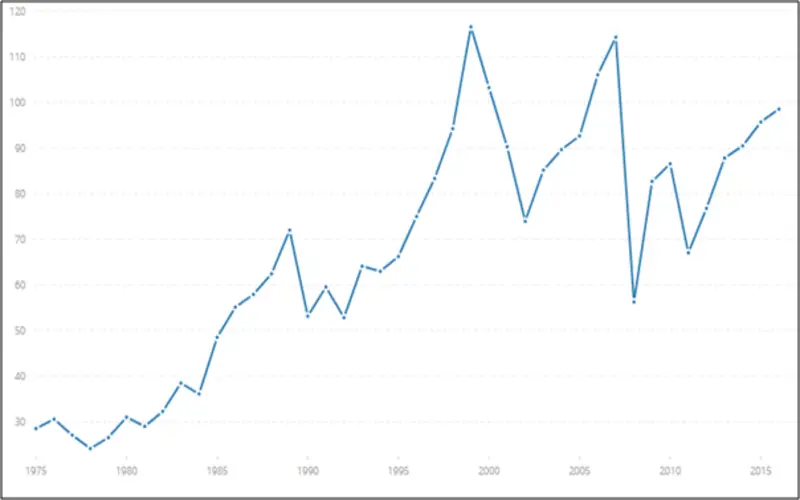
What Is the Stock Market Capitalization-to-GDP Ratio?
The capitalization-to-GDP ratio of the stock market is a measure that’s used to assess if a market is overvalued or undervalued overall at a historical average. Depending on the variables used in the computation, the ratio can be applied to the worldwide market or used to concentrate on particular markets, such as the U.S. market. The computation involves dividing the GDP (gross domestic product) by the stock market capitalization. The stock market capitalization-to-GDP ratio is known as the “Buffet Indicator,” thanks to investor Warren Buffett.
The Stock Market Capitalization-to-GDP Ratio Formula and Calculation
Market Capitalization to GDP=(SMC/GDP)×100
where:
Stock Market Capitalization: SMC
Gross Domestic Product=GDP
What You Can Learn from the Stock Market Capitalization-to-GDP Ratio
The stock market capitalization-to-GDP ratio gained popularity after Warren Buffett stated that it was “probably the best single measure of where valuations stand at any given moment.”
It is calculated by dividing the market value of all publicly listed equities by that economy’s gross domestic product (GDP). The ratio evaluates each stock’s overall worth relative to the nation’s total output. The percentage of GDP representing stock market value is the outcome of this computation.
Most analysts use the Wilshire 5000 Total Market Index, which captures the value of all stocks in the U.S. markets, to determine the total value of all publicly traded equities in the country. The ratio computation uses the quarterly GDP as the denominator. A result of more than 100% is often considered to indicate an overvaluation of the market. In contrast, a value of about 50%, or close to the historical average for the U.S. market, indicates an undervaluation. The market is considered slightly undervalued if the valuation ratio is between 50% and 75%.
Additionally, if the ratio is between 75% and 90%, the market may be reasonably priced; if it is between 90% and 115%, the market may be moderately overvalued. However, because the ratio has been rising over an extended period, there has been much discussion recently about what percentage level is appropriate for indicating undervaluation and overvaluation.
Alternatively, the ratio for a particular market can be substituted with the market cap for the global GDP ratio. Data on the global stock market capitalization to GDP ratio, which was 92% in 2018, is made available by the World Bank.
The fraction of publicly traded corporations relative to privately held enterprises and changes in the initial public offering (IPO) market influence this market cap to GDP ratio. All other things being equal, even though nothing has changed in terms of value, the market cap to GDP ratio would rise if there was a significant increase in the proportion of public vs. private enterprises.
An Example of Using the GDP Ratio to Stock Market Capitalization
As a historical example, let’s compute the market capitalization to U.S. GDP ratio for the quarter that concluded on September 30, 2017. According to Wilshire 5000, the stock market has a $26.1 trillion total market value.
The actual GDP of the United States was $17.2 trillion in the third quarter.
Thus, the market capitalization to GDP ratio is:
Market Cap to GDP=($26.1 trillion/$17.2 trillion)×100=151.7%
In this instance, the whole stock market value is 151.7% of GDP, which suggests that it is overpriced.
The World Bank’s numbers from 2000 show that the U.S. market cap to GDP ratio was 153%, another indication of an overpriced market. Given the U.S. market’s steep decline following the dot-com explosion, this ratio might help predict market peaks.
Even though the ratio was still overpriced in 2003—roughly 130%—the market set record highs in the following years. By 2020, the ratio will be almost 150%.

