

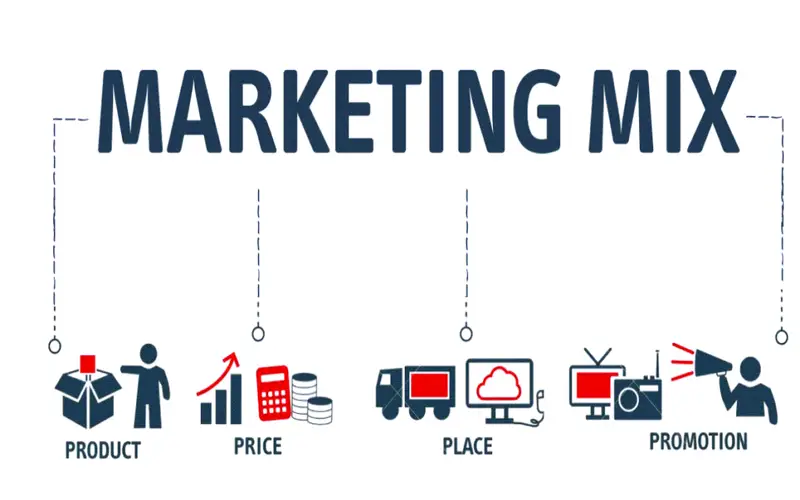
What exactly is a marketing mix?
As part of a comprehensive marketing plan, a marketing mix encompasses many areas of concentration. The term is frequently used to allude to a famous classification that began with the four Ps: product, pricing, placement, and promotion.
Instead of focusing on a single message, effective marketing covers a wide range of topics. This allows you to reach a larger audience, and keeping the four Ps in mind keeps marketing professionals focused on what matters. When releasing new products or changing current ones, firms can make more strategic decisions by focusing on the marketing mix.
What Are the Four Ps of Marketing?
Jerome McCarthy, a marketing professor and author, initially proposed the four Ps classification for establishing an efficient marketing plan in 1960.
It appeared in the book Basic Marketing: A Managerial Approach. Marketing managers may approach each of the four Ps differently depending on the industry and the goal of the marketing plan. Each aspect can be analyzed alone, but they are frequently interdependent.
Product
This symbolizes a product or service intended to meet the needs and desires of the customer. To effectively sell a product or service, it is critical to establish what sets it apart from competitors. It is also necessary to examine whether other items or services can be promoted alongside it.
Price
The product’s sale price represents what customers are willing to pay. Marketing experts must examine expenses associated with R&D, manufacturing, marketing, and distribution, often known as cost-based pricing. Value-based pricing refers to pricing that is primarily based on consumers’ perceived quality or value.
Placement
Examining the product type sold while choosing distribution zones is critical. Essential consumer goods like paper are frequently available in various places. Premium consumer goods, on the other hand, are often only offered in a few chosen places.
Promotion
A promotional mix is a combination of joint marketing campaigns. Advertising, sales promotion, personal selling, and public relations are activities. The marketing mix budget is an important issue. When attempting to reach their target audience, marketing professionals carefully build a message that frequently integrates facts from the other three Ps. Determining the ideal means for communicating the message and deciding on the frequency of communication are equally critical.
What Are Some Other Marketing Methods?
Not all marketing is centered on a single product. Because customer service firms are fundamentally different from those based solely on physical products, they frequently take a consumer-centric approach that adds additional features to satisfy their specific demands.
People, procedures, and physical evidence are three additional Ps associated with this marketing mix. “people” refers to employees who represent a corporation when interacting with clients or consumers. The term “process” refers to the technique or flow of providing service to clients, which frequently includes assessing service performance for customer satisfaction. “physical evidence” refers to a location or place where corporate representatives and customers engage. Marketers examine factors such as furnishings, signage, and layout. Furthermore, marketers frequently research customers to develop or update service- or product-related initiatives. This necessitates a communication plan with consumers to get input and identify the type of feedback desired.
Marketing has always begun with identifying consumers’ demands and ends with the supply and promotion of a completed product or service. Consumer-centric marketing has a more cyclical nature. Its objectives include reassessing clients’ demands, communicating often, and building customer loyalty initiatives.
What Are the Four Marketing Mix Elements?
Product, pricing, location, and promotion are the four essential components of a marketing mix. This framework tries to develop a thorough approach for differentiating a product or service from competitors while adding value to the client. These aspects are frequently interdependent.
A product is a good or service that fits a customer’s needs. Companies concentrate on qualities that set them apart from their competitors. A company may also investigate complementary goods that complement its product or service offerings.
The pricing represents the product or service’s price point or price range. Ultimately, the goal is to optimize profit margins and ROI while considering the price customers are prepared to pay. Distribution channels are referred to as placement. Where is this product being explicitly pushed, and how can you get it in front of your target audience?
The promotion aims to raise brand recognition for your product or service. It examines how using specific channels might increase sales.
What are the 7 Ps of marketing?
The marketing mix can sometimes go beyond the traditional four Ps of product, pricing, placement, and promotion, as professor E. Jerome McCarthy proposed in 1960. People, tangible evidence, and methods are among the extra categories.
People represent the personnel who deal with customers in this way. A corporation’s brand strategy may take into account company culture. This could involve customer relationship management (CRM), which tries to promote customer brand loyalty.
Physical evidence could include packaging or the layout of a physical store, both of which can reinforce a brand and add value to the customer.
Finally, the process discovers areas that, frequently from a logistical aspect, allow the client to have the most seamless experience with a product or service. This could involve everything from delivery operations and shipping to third-party retailer management.
What is the goal of a marketing mix?
A marketing mix is fundamentally concerned with promoting a product or service to create income for a firm. It includes critical marketing methods for increasing brand awareness, customer loyalty, and product sales.
In Short
A complete, effective marketing plan considers a marketing mix that covers various areas of concentration. The marketing mix typically relates to the four Ps: product or service, price, placement, and promotion. E. Jerome McCarthy, a marketing professor, first introduced this idea in 1960 in his book Basic Marketing: A Managerial Approach.
On the other hand, customer-service businesses rely on other marketing tools that may include three additional Ps: the people who interact with customers, the process that creates a seamless customer experience, and physical evidence, or the area where customers and company representatives interact.
Conclusion
- The four Ps of marketing are product, price, placement, and promotion. Together, they make up the marketing mix.
- Since 1960, when marketing professor E. Jerome McCarthy wrote Basic Marketing: A Managerial Approach, this idea has been around.
- The different parts of a marketing mix work together to make more sales.
- If you want to make your marketing plan more focused on the customer, you can combine the 4Ps with three other approaches: people, process, and physical proof.
- This kind of marketing plan goes beyond just focusing on products.

