

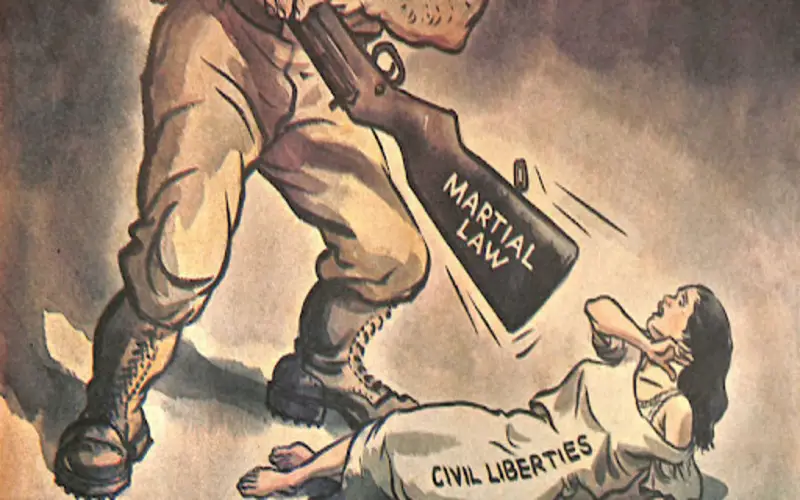
What exactly is martial law?
Martial law is the suspension of conventional legal protections for civilian rights by military authority with limitless powers in place of a civil government. Martial law can be declared after a crisis or implemented during a coup. An emergency is more common than a declaration of martial law in times of tragedy or civil upheaval since it is easier to rescind. An emergency declaration permits the government to temporarily enhance its powers in response to a crisis, suspending some civil liberties but avoiding military authority.
Understanding
For this reason, declaring martial law is a rare and momentous decision for a civilian government. When martial law is declared, civilian control of some or all government operations is transferred to the military.
In the case of elected governments, the representatives chosen by the voting populace are no longer in power. Civilians have given up control of the country in exchange for the possibility of restoring order, with the risk that it will not be recaptured in the future. Civil rights, such as the right to free movement, free speech, and protection from excessive searches, may be suspended when martial law is imposed. A military justice system, such as a military tribunal, replaces the traditional justice system that deals with criminal and civil law matters.
Civilians may be detained for breaching curfews or for actions that would not be considered severe enough to warrant custody in regular circumstances. Laws about habeas corpus intended to prevent unlawful imprisonment may also be suspended, allowing the military to keep people indefinitely without redress.
Declaration of Martial Law
Given the detrimental consequences of declaring martial law on a country and its inhabitants, imposing it is a last resort reserved for situations where law and order are rapidly deteriorating. In 1892, for example, the governor of Idaho declared martial law after a group of rebellious mine workers blew up a mill, leveling a four-story building and killing several people.
This law may be declared to quell protests, civil disturbances, coups, or insurgencies. When a country’s military occupies foreign territory, such as after the end of a war, it may also be declared.
A country’s president or other top civilian leader can declare martial law. Le isolation or a country’s constitution restricts the circumstances under which it may be declared and other limiting considerations, like the length of time it may be in effect. A president, for example, may proclaim martial law during severe civil upheaval, but only for 60 days. If a country has signed a multilateral treaty, international law may potentially limit the extent and duration of martial law.
Special Considerations
Martial law is used less frequently in the aftermath of natural disasters than in social unrest or disorderly circumstances. In the event of a hurricane or earthquake, governments are far more likely to proclaim a state of emergency rather than declare martial law and hand over power to the military.
When a state of emergency is declared, the government may broaden its powers or curtail citizens’ rights. However, the government is not required to delegate power to the military. Sometimes, a government may declare an emergency to crush dissent or opposition groups.

