

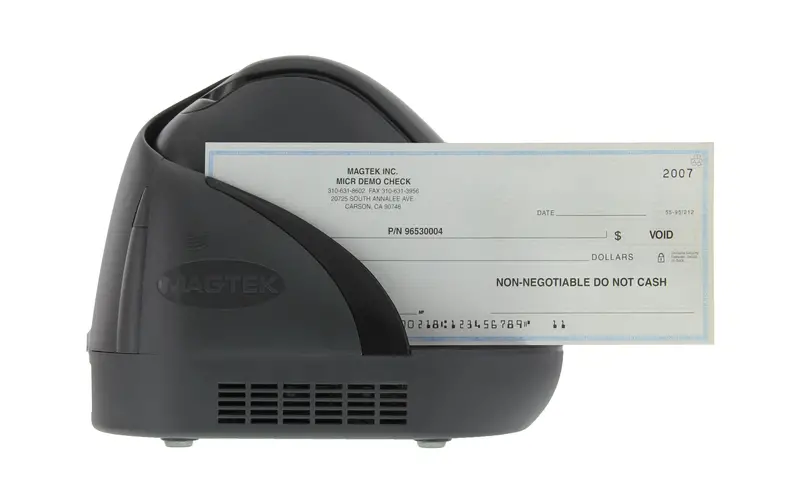
Magnetic Ink Character Recognition (MICR) Line
The primary application of magnetic ink technology for character recognition (MICR) is the identification and processing of checks. The MICR is the sequence of characters located in the lower left corner of a check. The document comprises three sets of numerical values: the check number, the bank routing number, and the customer’s account number.
From left to right, a nine-character routing number, a twelve-character account number, and a four-character check number comprise the MICR.
The term “magnetic ink character recognition line” denotes the printing technology employed to facilitate a machine’s reading, processing, and recording of data.
The Operation of Magnetic Ink Character Recognition (MICR) Line
Using the magnetic ink character recognition line, a computer can swiftly read and record numbers or other information from printed documents, such as a personal check. This information includes the account, check, and routing numbers.
In the late 1950s, the American Bankers Association (ABA) devised the system, which the American National Standards Institute subsequently accredited as an industry standard.
Magnetic ink or toner is used to print the MICR number, which is occasionally erroneously interpreted as the account number less than an inch above the bottom of the check. The magnetic ink lets a computer discern characters soiled with other marks, cancellation marks, signatures, or bank markings.
After each business day, when banks transmit their checks to central processing systems, MICR lines aid in automating the check-clearing process. Additionally, they are designed to be readable by humans to facilitate the communication of verification information.
Typically, E-13B or CMC-7, two specially designed fonts, display the numerals. The E13B finds predominant application in North America, Australia, and the United Kingdom, among other regions. Most of the CMC-7 font is utilized in Europe and portions of South America.
Check Scanner for MICR
A clearinghouse, a bank, or both clear and process each mailed check. After verifying the check, they complete the transaction by crediting the corresponding amount to another account and debiting the accurate amount from one. A solitary check can be processed on multiple occasions across various Federal Reserve centers and institutions.
This procedure includes examining the check’s identifying information. The MICR line mechanized that procedure. Utilizing a reader-sorter computerized device or scanner, the information magnetically imprinted on the checks—such as the routing, account, and check numbers—is processed.
Throughout the clearance procedure, a check might be rapidly examined on multiple occasions. Troy Group, a manufacturer of MICE-adapted printers and associated products, confirms that the duration of a single reading is below 1/1000ths of a second.
Particular Considerations
Although its initial application was to print information on checks, magnetic ink character recognition has since been modified for use in various other contexts.
In the United States, a wide range of financial documents are encoded using MICR technology. The technology may also be applied to credit card invoices, direct mail, vouchers redeemable for rebates, and negotiable withdrawal orders (NOWs).
The advantages of the MICR Line
The capability of the magnetic ink character recognition line to enable the deduction of payment amounts from checks using a routing number is one of its advantages. With a nine-digit numerical code, financial institutions and banks utilize a routing or transit number for clearing funds and processing payments.
The routing number designates the bank branch from which the funds intended for withdrawal are extracted. Direct deposits and wire transfers frequently rely on routing numbers as well.
Establishing Fraud
Ensuring transparency and integrity in the financial services sector is an ongoing challenge. Intending to obtain an illicit benefit for the perpetrator—deception on purpose—is the definition of fraud. Various fraudulent activities can be identified, including credit card fraud, bankruptcy fraud, wire fraud, and tax fraud.
Using unique fonts and tamper-resistant magnetic ink, the magnetic ink character recognition line complicates certain types of financial deception. MICR thus complicates the process of modifying checks.
Check altering typically involves modifying the payee’s name, the check’s amount, or both. Further dissecting the term “alteration” is Section 3-407 of the Uniform Commercial Code (UCC), which comprises a collection of business regulations governing financial contracts. This section comprises nine articles, each addressing a distinct facet of banking and loans.
As an illustration, a con artist might endeavor to collect a photocopied check from a bank branch teller. The photocopied MICR line promptly notifies the teller that the check is fake.
Banks and other financial institutions use MICR technology to lessen losses because it helps prevent and detect fraud.
Questions Asked Frequently
Misdefine a MICR number.
A magnetic ink character recognition line (MICR) is a line of characters inscribed with a specific ink that enables a reader-sorter machine to read the characters on a check. Introducing the MICR reader-sorter process increased the difficulty of counterfeit checks while automating the check processing procedure.
What is the function of MICR in banks?
MICR has been an operational system since the late 1950s. It increased the difficulty of committing check fraud while enabling the mechanization of check processing, which was a significant advancement. Global banks have implemented the system.
The uniformity of bank check formats is due to this factor. The condition must be such that the readers can discern the MICR numbers.
MICR Data on a Check: What Is It?
The sequence of characters consecutively at the bottom left corner of a check signifies the bank branch from which it is issued, the payer’s account number, and the number of checks issued by the account holder.
When viewed from the left, the line presents the subsequent data:
- The nine-character transit number associated with a particular bank branch.
- Account number (12 characters) used to identify the payer
- The account holder’s four-character check number identifies the specific check in a series that has been utilized.
It looks like this: 000000000 000000000000 0000
Bottom Line
Seventy years after its inception, magnetic ink character recognition is still in use because it resolved two of the most significant challenges banks faced: the need to mechanize check processing and increase the difficulty of deception.
It consists of three elements: a routing number, an account number, and a check number, collectively constituting a distinct identifier for both the check and the signatory. Additionally, it is printed with custom fonts and a special pigment that makes it difficult, if not impossible, to create counterfeits.
Conclusion
- Character recognition that uses magnetic ink is the group of characters at the bottom left of a personal check that holds the account, route, and check numbers.
- The purpose of MICR numbers is to be understood by people and machines that sort mail.
- Magnetic ink and unique styles make them impossible to fake or copy.
- The technology’s perks include making fraud safer and automating check-handling.
- MICR was created in the late 1950s and is now used worldwide.

