

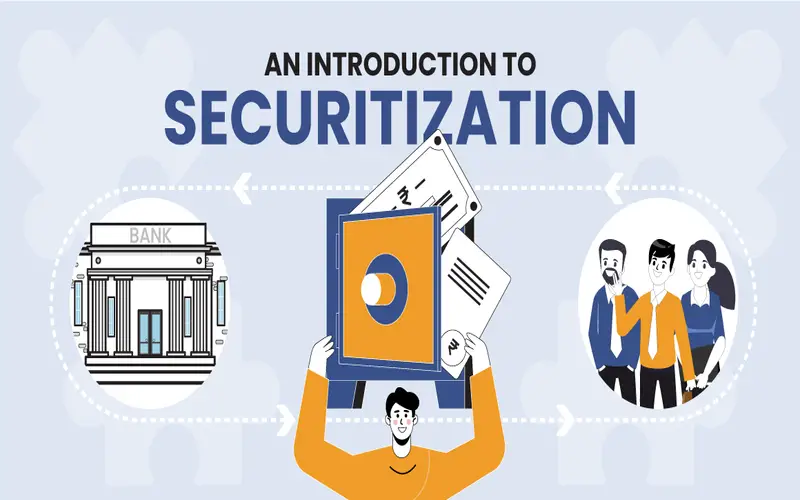
What is securitization?
Assets are bundled and repackaged into interest-bearing securities through securitization. An issuer creates a marketable financial instrument by combining different financial assets, most frequently mortgage loans or consumer or business debt. The investors who buy these securities receive the principal and interest payments made by the underlying assets.
How Securitization Works
The entity holding the assets, known as the originator, chooses which assets to remove from its balance sheets during securitization. When a bank no longer wants to service mortgages and personal loans, it may take this action.
This collection of assets is now referred to as a reference portfolio. The creator then sells the portfolio to an issuer, who issues tradable securities representing a portion of the portfolio’s assets. By purchasing the new securities at a predetermined rate of return, investors assume the role of the lender.
Through securitization, the initial creditor or lender can take assets off of its balance sheets to approve more loans. The principal and interest payments that the debtors, or borrowers, make on the underlying loans and obligations determine the rate of return, which benefits investors.
Securitization increases market liquidity and releases money for originators.
Tranches
The new financial instrument that has been securitized may be split into smaller units called tranches. The loan type, maturity date, interest rate, and remaining principal variables group the individual assets into tranches. Each tranche includes varying degrees of risk and delivers different returns.
Mortgage-backed securities (M.B.S.) or asset-backed securities (A.B.S.) are examples of securitization and can be divided into tranches. Bonds, known as asset-backed securities (A.B.S.), have financial assets backing them, such as cars, mobile homes, credit cards, and student loans. After pooling debt into one portfolio, the issuer might split the pool into smaller sections depending on the underlying risk of default. These smaller chunks are sold to investors, each bundled as a bond.
Advantages and Disadvantages of Securitization
Securitization generates liquidity by enabling individual investors to acquire shares in inaccessible assets. An M.B.S. investor may acquire sections of mortgages and get regular returns from interest and principal payments.
Numerous loan-based securities, in contrast to other investment vehicles, are collateralized. Additionally, when the originator puts debt into the securitized portfolio, it decreases the obligation on its balance sheet, enabling it to underwrite new loans.
Despite the possibility that tangible assets will back the securities, default is possible. Additionally, early repayment will diminish the profits the investor gets on the underlying notes. There may also be a need for more openness regarding the underlying assets. Misrepresented mortgage-backed securities were significant contributors to the 2007–2008 financial crisis.
Advantages:
- Converts illiquid assets to liquid ones.
- It frees up money for the creator.
- generates revenue for investors
- Small investors may participate.
- The investor adopts a creditor role.
- Hazards of underlying loan default
- Transparency about assets needs to be improved.
- Early repayment reduces the rewards for investors.
An illustration of securitization
Investors can access the monthly principal and interest payments made by homeowners through mortgage-backed securities, such as those that Fidelity offers. These assets might be supported or issued by:
- Government National Mortgage Association (GNMA): Ginnie Mae-guaranteed bonds backed by the U.S. government. GNMA guarantees the principal and interest payments on mortgages, although it does not buy, package, or sell mortgages.
- The Federal National Mortgage Association (FNMA) is the organization that buys mortgages from lenders, bundles them into bonds, and then resells them to buyers. Fannie Mae is the only entity to guarantee these bonds; the U.S. government is not directly obligated to back them. FNMA goods are subject to credit risk.
- Federal Home Loan Mortgage Corporation (FHLMC): To market mortgages to investors, Freddie Mac first buys them from lenders and puts them into bonds. Freddie Mac is the only entity to guarantee these bonds; the U.S. government is not directly obligated to back them. Products from FHLMC involve credit risk.
Which organizations control securitization?
The Financial Industry Regulatory Authority, Inc. (F.I.N.R.A.) and the U.S. Securities and Exchange Commission (S.E.C.) oversee businesses that deal in securities and investment activities.
Investing in Securities Based on Mortgages: How Are Investors Paid?
Pass-throughs and collateralized mortgage obligations (C.M.O.s) were the two categories of M.B.S.
Pass-throughs are set up as trusts that hold mortgage payments and distribute them to investors with specified maturities of five, fifteen, or thirty years. The rates at which investors get their money are determined by the credit ratings of the various pools of securities, or tranches, that make up C.M.O.s.
How Do M.B.S. and A.B.S. Differ From One Another?
Bonds backed by consumer-issued home loans are known as mortgage-backed securities. Bonds backed by credit card debt, student loans, vehicle loans, and mobile home loans are asset-backed securities.
The Final Word
Securitization creates marketable financial products by pooling or aggregating debt into investable portfolios. The interest and principal paid on the underlying assets might be profitable for investors. Securitization produces mortgage-backed securities as well as asset-backed securities, which are composed of consumer, business, and mortgage debt.
Conclusion
- Securitization organizes debt into portfolios by pooling it.
- By combining different financial assets into tranches, issuers produce marketable financial instruments.
- Investors get revenue from securitized assets in the form of principal and interest.
- Consumer-issued house loans serve as collateral for mortgage-backed securities. Student loans, credit card loans, vehicle loans, and loans for mobile homes are the collateral for asset-backed securities.

