

What Is a Simple Random Sample?
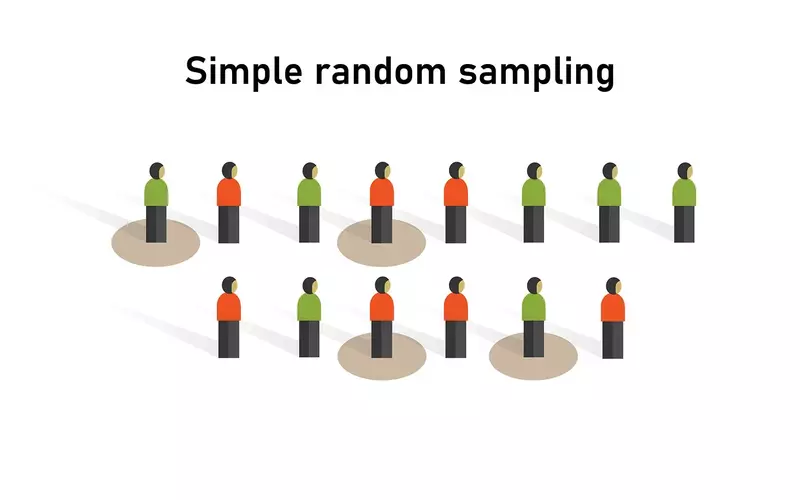
A subset of a statistical population with an equal chance of selection for each member is a simple random sample. A basic random sample aims to provide an objective depiction of a group.
Understanding a Simple Random Sample
Researchers may use two techniques to generate a basic random sample. In a lottery, every person in the population is given a number, which is then chosen at random.
If a company with 250 employees were to choose 25 names at random from a hat, that would be an example of a simple random sample. Since every employee has an equal chance of being selected, the sample is random, and the population consists of all 250 employees. In science, blinded experiments and randomized control tests use random sampling.
The lottery method in action can be seen in the scenario where the names of 25 employees are selected at random from a hat out of 250. After assigning a number between 1 and 250 to each of the 250 employees, 25 would be randomly selected.
Every member of the large population set has an equal chance of being chosen since those who comprise the larger group’s subset are chosen randomly. This produces a balanced subset that has the best chance of accurately representing the broader group as a whole, for the most part.
Using a manual lottery method can be very difficult for larger populations. Choosing a random sample from a large population is typically computer-generated. It follows the lottery method’s methodology, except computers carry out the number assignments and subsequent selections rather than humans.
Allowance for Error
A simple random sample must allow sampling error, expressed as a plus and minus variance. For instance, random sampling can reveal that eight out of every 100 students sampled are left-handed if a survey is conducted to determine how many left-handed students there are in a high school with 1,000 students. The inference would be that 8% of the high school student body is left-handed, whereas the worldwide average would be more like 10%.
Regardless of the topic, this holds. The percentage of students with green eyes or physical disabilities, for example, would yield a mathematical probability based on an introductory random survey. Still, it would always have a plus-or-minus variance. The only way to achieve a 100% accuracy rate would be to poll all 1,000 students, which, although conceivable, would be impracticable.
Although simple random sampling is intended to be an unbiased survey approach, sample selection bias can occur. When a sample set of the broader population is not inclusive enough, the representation of the complete population is skewed and needs additional sampling approaches.
How to Conduct a Simple Random Sample
The basic random sampling procedure comprises several stages. Each step must be performed in sequential order.
Step 1: Define the Population
Determining the population base is the original purpose of statistical analysis. This is the group you want to learn more about, validate a theory, or get a statistical result for. This step is to identify the population base and ensure that the group will adequately cover the outcome you are trying to solve.
Example: I desire to discover how the stocks of the major corporations in the United States have done over the last 20 years. According to the S&P 500, my population is the largest corporation in the United States.
Step 2: Choose Sample Size
Before identifying the units within a population, we must establish how many units to choose. This sample size may be restricted depending on the time, capital rationing, or other resources available to examine the sample. However, pick a large sample size to represent the population. In the example above, there are constraints when examining the performance of every stock in the S&P 500. Thus, we only wish to evaluate a subset of this population.
For instance, I will choose 20 firms from the S&P 500 as my sample size.
Decide on population units in Step 3.
Since we already know who the population’s things are (i.e., the S&P 500 businesses), it is simple to identify them in our scenario. However, the picture examines the students now enrolled at a university or food goods offered at a grocery shop. Creating a comprehensive list of every item in your population is the task of this phase.
For example, I replicated the S&P 500 firms into an Excel spreadsheet using exchange information.
Assign numerical values in Step 4.
According to the basic random sampling procedure, each unit in the population is given a random number. Possible data filtering frequently allocates this. For instance, I may rank the firms from 1 to 500 according to market capitalization, alphabetical order, or incorporation date. It doesn’t matter how the values are allocated; what matters is that each value is picked equally and in a consecutive order.
Using the current CEO’s alphabetical order as an example, I assign the numbers 1 through 500 to the S&P 500 firms, with the first company getting the value ‘1’ and the final company receiving the value ‘500’.
Step 5: Select Random Values
In step 2, we selected the number of items we wanted to analyze within our population. For the running example, we chose to analyze 20 items. We choose 20 numbers at random from the values given to our variables in the fifth step. This corresponds to the numbers 1 through 500 in the running example—various techniques are used to choose these 20 numbers randomly, which will be explained later in this post.
Example: I choose the numbers 2, 7, 17, 67, 68, 75, 77, 87, 92, 101, 145, 201, 222, 232, 311, 333, 376, 401, 478, and 489 from the random number table.
Step 6: Determine the Sample
The bridge between steps 4 and 5 completes a basic random sample. Every random variable chosen in the previous stage is associated with one item in our population. The sample is chosen by determining which random values were selected and which population items those values match.
As an illustration, the second company on the list of businesses alphabetized by the last name of the CEO makes up my sample. My sample also has company numbers 7, 17, 67, etc.
Techniques for Random Sampling
The random values to be chosen (Step 5 above) cannot be done alone. Since there may not be randomness in the numbers, the analyst cannot just pick them randomly. For instance, the analyst might intentionally (or unintentionally) choose the random number 24 because their wedding anniversary falls on the 24th. Alternatively, the analyst could select one of the subsequent approaches:
Lotto at random. Each population number is given an equal item, kept in a box or other indistinguishable container, whether a ping-pong ball or slips of paper. Next, random numbers are chosen from the container by pulling or choosing hidden objects.
Physical Approaches. Simple, early random selection techniques may involve dice, flipping coins, or spinning wheels. Each result is given a value or outcome linked to the population.
Random number table. Many statistics and research books contain sample tables with randomized numbers.
Online random number generator. The analyst may enter the population and sample sizes to be chosen using various online tools.
Random numbers from Excel. Numbers can be selected in Excel using the =RANDBETWEEN formula. A cell containing =RANDBETWEEN(1,5) will select a random number between 1 and 5.
When pulling together a sample, consider getting assistance from a colleague or an independent person. They can identify biases or discrepancies you may not be aware of.
Simple Random vs. Other Sampling Methods
Simple Random vs. Stratified Random Sample
A simple random sample is used to represent the entire data population. A stratified random sample divides the population into smaller groups, or strata, based on shared characteristics.
Unlike simple random samples, stratified random samples are used with populations that can be easily broken into different subgroups or subsets. These groups are based on specific criteria; each element is randomly chosen according to the group’s size versus the population. In our example above, S&P 500 companies could have broken into headquarters geographical regions or industries.
This sampling method means there will be selections from each different group, the size of which is based on its proportion to the entire population. Researchers must guarantee that the strata do not overlap. Each point in the population must only belong to one stratum, so each point is mutually exclusive. Overlapping strata would increase the likelihood that some data would be included, thus skewing the sample.
Simple Random vs. Systematic Sampling
Systematic sampling entails selecting a single random variable, and that variable determines the interval in which the population items are selected. For example, if 37 were chosen, the sample would select the 37th company on the list sorted by CEO’s last name. Then, the 74th (i.e., the following 37th) and the 111th (i.e., the next 37th) would also be added.
Simple random sampling does not have a beginning point; consequently, there is a chance that the population items picked at random may cluster. In our case, there may be an excess of CEOs with a last name that begins with the letter ‘F.’ Systematic sampling further decreases bias to guarantee that clusters do not arise.
Simple Random vs. Cluster Sampling
Cluster sampling may occur as a one-stage cluster or a two-stage cluster. In a one-stage cluster, items within a population are put into comparable groupings; using our example, companies are grouped by year formed. Then, sampling happens inside these clusters.
When random selection produces clusters, two-stage cluster sampling takes place. The population is not clustered with other similar items. Then, sample items are randomly picked within each cluster.
Simple random sampling does not cluster any population sets. Though sample random sampling may be more uncomplicated, clustering (especially two-stage clustering) may enhance the randomness of sample items. Furthermore, cluster sampling could provide a more thorough examination of a particular population snapshot, which might or might not improve the study.
Benefits and Drawbacks of Basic Random Samples
straightforward random samples are straightforward to use, but they have several significant drawbacks that may make the data meaningless.
Advantages of Simple Random Sample
Ease of usage reflects the primary benefit of simple random sampling. Unlike more elaborate sampling techniques, such as stratified random sampling and probability sampling, no requirement exists to partition the population into sub-populations or perform any other further procedures before picking individuals from the population at random.
A basic random sample aims to provide an objective depiction of a group. Since everyone in the population has an equal chance of being chosen, it is seen as a fair method of choosing a sample from a more significant population. Therefore, simple random sampling is recognized for its unpredictability and low likelihood of sample bias.
Simple Random Sample’s drawbacks
A sampling mistake may arise with a simple random sample if the sample needs to represent the population it is designed to represent correctly. For instance, even if the population were made up of 125 women, 125 males, and 125 nonbinary individuals, choosing 25 guys from our basic random sample of 25 workers would still be viable.
For this reason, simple random sampling is more typically utilized when the researcher knows little about the population. An alternate sampling strategy, such as stratified random sampling, which helps to account for the variations within the population, like age, race, or gender, would be preferable if the researcher had more information.
Another drawback is that the technique may be more expensive and time-consuming than other approaches when sampling from huge populations. Researchers could conclude that a project is only worthwhile if its cost-benefit analysis yields favorable outcomes. Depending on the data collection method or the size of the data set, this job might be challenging since each unit must be allocated a sequential or identifying number before the selection process can begin.
Basic Random Samples
Benefits
- In a population, every object has an equal probability of being chosen.
- Sample bias is less likely since each item is chosen at random.
- This sampling technique is simple and practical when using data sets that are already listed or digitally recorded.
Negative aspects
- Inadequate population demographics may prevent certain groups from being included in the sample.
- The sample may be somewhat representative of the population due to random selection.
- The size and structure of the data collection will determine how time-consuming random sampling is.
What Makes a Basic Random Sample Basic?
Simple random sampling is the most straightforward technique for selecting a study sample from a more significant population. By selecting a sufficient number of people at random from the larger population, one can also obtain a sample that is representative of the group under study.
What Consequences Can a Simple Random Sample Have?
The inability to get respondents who can be selected from a more significant population, the longer processing times, higher expenses, and the possibility of bias under certain conditions are drawbacks of this approach.
A Stratified Random Sample: What Is It?
Unlike a primary draw, a stratified random sample separates the population into smaller groups, or strata, according to standard features. A stratified sampling approach will include participants from every subgroup in the data analysis. This is a strategy of treating every member of a population equally and giving them an equal chance of being sampled; stratified sampling highlights distinctions between groups within a population.
What Is the Use of Random Samples?
Using simple random sampling, researchers can draw broad conclusions about a particular community while accounting for bias. Without conducting surveys or gathering data from every member of the population, conclusions and forecasts about it may be drawn using statistical methods.
The Final Word
Simple random sampling is a method used in population analysis that ensures that each item has an equal chance of being chosen for the sample size. More complex sampling techniques may be derived from this more fundamental sampling. A more fundamental method of picking units for analysis is to list every item in a population, give each one a sequential number, determine the sample size, and then randomly choose objects from the list.
Conclusion
- In a basic random sample, every member has an equal chance of being selected, and a tiny, random subset of the population is used to represent the complete data set.
- Researchers may produce a basic random sample using techniques like lotteries or random drawings.
- If a basic random sample ends up not precisely representing the population it is intended to represent, a sampling error may have occurred.
- Each item in a population is given a sequential value, which is then chosen randomly to create simple random samples.
- Simple random sampling offers an alternative sampling methodology compared to cluster, stratified, or systematic sampling.

