

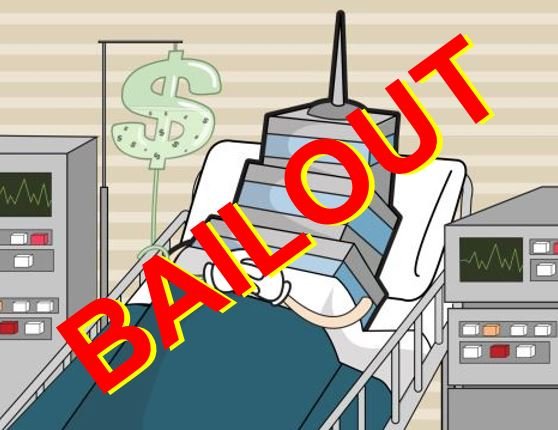
A Bailout: What Is It?
A bailout is when a corporation, a person, or the government gives struggling businesses money and resources (also known as a capital injection). By taking these steps, the firm can lessen the likelihood of its eventual collapse, the associated financial responsibilities, and bankruptcy.
Businesses and governments may get bailouts in the form of loans, purchases of bonds, stocks, or cash injections. Depending on the bailout’s conditions, the recipient party may be required to repay the support.
An explanation of the bailout
Bailouts are usually reserved for businesses or sectors of the economy whose bankruptcy might seriously harm the overall economy, not simply a specific market segment.
For instance, a corporation with a sizable workforce may be given a bailout because the economy couldn’t withstand the significant increase in unemployment resulting from the firm’s failure. The term “bailout takeover” refers to other businesses frequently stepping in to buy a failing company.
As with contagion, letting a business fail may have severe repercussions for the larger economy and the failing business. Other reasons why bailouts could be necessary and why letting a corporation collapse might not always be the best course of action are listed below:
- Job losses: A company’s failure may cause a large number of jobs to be lost, which might have an impact on the whole economy. Reduced consumer spending, less tax income, and an increased load on social safety net services can all result from unemployment.
- Economic instability can result from the failure of a big corporation, especially if it has strong linkages to other businesses or industries. This may cascade, failing further businesses and causing further financial harm.
- Loss of investor confidence: Letting a business fail can cause investors to lose faith in the financial system and the stock market. This may make it harder for other businesses to raise money, possibly sending the economy into a tailspin.
- Legal complexities: Letting a business collapse may be a difficult and unpleasant process, especially if it has a lot of outstanding debt or intricate legal commitments. This may lead to drawn-out, expensive, and time-consuming court actions.
In general, bailouts and other types of financial help are commonly used to prevent a firm from failing, even if, in certain circumstances, they may be the only option.
Illustrations of Bailouts
The history of bailouts by the US government dates back to the Panic of 1792. Since then, the government has funded the government-sponsored home lenders, Freddie Mac and Fannie Mae, saved insurance behemoth American International Group (AIG), helped financial institutions during the 1989 savings and loan bailout, and stabilized banks during the 2008 “too big to fail” bailout, formally known as the Emergency Economic Stabilization Act of 2008 (EESA).
Furthermore, other industries and the banking sector have also received rescue funding over the years. Government and other bailout help was also provided to the airline sector, including Chrysler, General Motors (GM), and Lockheed Aircraft Corporation (LMT).
Ireland provided a €29.3 billion bailout to the Anglo-Irish Bank Corporation in 2010. Greece was given bailouts totaling more than €326 billion by the European Union (EU).
Greece is not alone, though, in requiring foreign assistance to handle its debts. Additional saves occurred in 1997 in South Korea, 1999 in Indonesia, 1998, 2001, 2002 in Brazil, and 2000 and 2001 in Argentina.
It’s also critical to realize that many companies that get rescue assistance will ultimately repay their debts. AIG, along with Chrysler and GM, fulfilled its Treasury commitments. That being said, it is more difficult to track the assistance that AIG got in forms other than financial.
You can see that bailouts come in a variety of forms. The record books are also reopened, and a new, most significant recipient award is updated with every fresh bailout. Think about a few more of these previous financial comebacks in history.
Debt from the Revolutionary War forced the government to bail out the 13 United States during the Panic of 1792.
Bailout of the financial industry
With the 2008 world financial crisis, the U.S. government provided one of the most enormous bailouts in history. The most significant financial institutions in the world were the bailout’s focus, as they had suffered enormous losses due to the credit crisis that followed the collapse of the subprime mortgage market. Due to the high number of mortgage defaults, banks issuing mortgages to customers with poor credit ratings suffered enormous loan losses.
The government provided a substantial aid package in response to the failure of financial companies like Countrywide, Lehman Brothers, and Bear Stearns. The Emergency Economic Stabilization Act of 2008, which President George W. Bush signed into law on October 3, 2008, gave rise to the Troubled Asset Relief Program (TARP). Under TARP, the US Department of Treasury was able to buy toxic assets from the balance sheets of many banking institutions for up to $700 billion.
TARP had paid out more than $443 billion to financial firms by the time it ended. This amount signifies the largest bailout in the annals of finance to date. In 2008, JP Morgan Chase purchased Bear Stearns, which had grown into one of the biggest investment banks with $2 billion in revenues in 2006.
Automobile Sector Rescue
During the 2008 financial crisis, automakers Chrysler and General Motors (GM) were demolished. The automakers said they couldn’t remain sustainable without a federal bailout and requested one.
Carmakers were under pressure as sales plummeted due to the combined effects of rising gasoline prices and many consumers being unable to obtain vehicle loans. More precisely, sales of the SUVs and bigger cars made by the manufacturers fell off due to the high gas prices. In addition to impeding vehicle sales, banks’ tightening lending standards during the financial crisis made it harder for the general population to get finance, including auto loans.
TARP was meant for financial businesses, but the two automakers used almost $63.5 billion to survive. GM and Chrysler, now part of Fiat-Chrysler (FCAU), came out of bankruptcy in June 2009 and are still two of the biggest automakers today.
As of April 2021, GM and Chrysler had repaid their TARP loans years ahead of schedule, and the U.S. Treasury had recovered $377 billion of the $443 billion it had distributed. In the end, the US Treasury wrote down almost $66 billion, which included stock losses.
Why would you bail out a business?
If a business is experiencing severe financial issues that might endanger its existence, such as growing debt, dropping sales, or an abrupt decline in the market, it can require a bailout. A bailout can give the business the money it needs to pay off its obligations, reorganize its business, and carry on with operations. Generally, a business would only receive government support if it failed, which would significantly negatively impact the whole economy.
The advantages of a bailout include the capacity to keep employment, protect economic stability, and stop a firm or organization and its industry from collapsing. This is particularly true if one firm’s failure can potentially cause other corporate collapses.
What Perils Are Included in Bailouts?
A bailout’s drawbacks include the potential for moral hazard, in which businesses may act irresponsibly and take on excessive risk in the knowledge that they would get financial support if they failed. Another concern is the expense to taxpayers or other investors who would have to pay for the rescue without realizing any profit.
What Does a Bailout Entail?
Although the specifics of a bailout will differ from case to case, most bailouts have predetermined terms or conditions, including a restructuring plan or adjustments to the company’s management and operations. Bailouts may also have conditions linked to them, such as debt ceilings, restrictions on CEO pay, or stricter control and accountability guidelines. These requirements ensure the business can achieve financial stability and won’t require further bailouts.
Conclusion
- A bailout is the infusion of capital into a company or institution that might otherwise be on the verge of bankruptcy.
- Loans, bonds, stocks, or cash are some of the many forms of bailouts.
- Certain debts must be repaid, whether or not interest is paid.
- Instead of focusing on a single sector or industry, bailouts are usually given to businesses or sectors that directly influence the health of the economy as a whole.

