

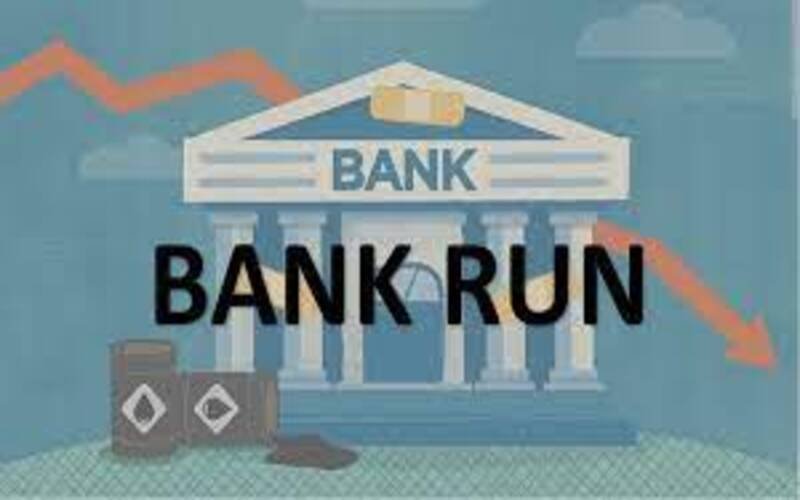
Is a bank run a real thing?
Customers of a bank or other financial institution withdraw their deposits simultaneously out of concern for the bank’s ability to meet its financial obligations. This phenomenon is known as a “bank run.” There is a correlation between the number of individuals withdrawing their funds and the likelihood of default, which might lead to a rise in the number of people withdrawing their deposits. There is a possibility that the bank’s reserves will not be adequate to meet the withdrawals under extreme circumstances.
The Operation of the Bank Runs
The term “bank run” refers to the phenomenon that occurs when many individuals begin withdrawing money from a bank out of worry that the institution may lack sufficient funds. In most cases, panic rather than actual insolvency is the precipitating factor that leads to a bank run. On the other hand, a panic-driven bank run may force a bank to file for bankruptcy.
A daily restriction is often imposed on the amount of money that can be stored in the vaults of most institutions. For reasons of both need and safety, these restrictions have been established. In addition, several financial institutions maintain specific reserves with the national central bank to reduce the risks associated with bank runs and other problems. The Federal Reserve operates a program that it refers to as Interest on Reserve Balances (IORB), which is a program that pays them interest for doing so. Banks are incentivized through this scheme to maintain deposits in reserve.
Banks must improve their cash position to satisfy their clients’ withdrawal requests. Banks typically only hold a small percentage of deposits within their cash reserves. When a bank has to raise its cash on hand, one strategy it employs is to sell assets, and it does so at prices that are frequently much lower than they would be if it did not have to sell rapidly. Losses incurred due to selling assets at reduced prices might give rise to worries among customers, which can thus result in withdrawals.
Examples of Runs on the Banks
In the history of contemporary times, bank runs are frequently linked to the Great Depression. American depositors went into a state of panic and started taking their money out of their accounts after the stock market crash that occurred in 1929. At the beginning of the 1930s, a series of bank crashes affected hundreds of financial institutions, which had a domino effect on the economy.
Other examples of big bank runs that occurred in more recent times include those that occurred at Wachovia Bank, Washington Mutual Bank (WaMu), and Silicon Valley Bank.
The Bank of Silicon Valley
AA Bank was rumored in March 2023, leading to Silicon Valley Bank’s failure. Venture capitalists were the catalysts for this event. The financial institution disclosed that it required $2.25 billion to strengthen its balance sheet, and by the end of the next business day, consumers had withdrawn about $42 billion from their accounts. Consequently, the bank was shut down, and the authorities took possession of its assets.
As of the fourth quarter of 2022, Silicon Valley Bank had reported a total of $209 billion in assets, which placed it in the position of being the second-largest bank failure in the history of the world. JPMorgan Chase ultimately acquired Washington Mutual for a total price of $1.9 billion.
The Wachovia Bank
Additionally, Wachovia Bank was shut down because depositors withdrew more than $15 billion over two weeks in response to the bank’s dismal financial reports. Wells Fargo ultimately purchased Wachovia for fifteen billion dollars.
The majority of the withdrawals that were made at Wachovia were concentrated in business accounts that had balances that were higher than the maximum that was guaranteed by the Federal Deposit Insurance Corporation (FDIC). These balances were brought to a level below the FDIC limit.
It is not the case that a bank run was the cause of the downfall of enormous investment banks such as Lehman Brothers, AIG, and Bear Stearns. In actuality, derivatives, asset-backed securities, and subpar risk management techniques led to a credit and liquidity crisis that caused these banks to collapse.
Preventing Runs on the Banks
In response to the upheaval that occurred during the 1930s, governments enacted several measures to reduce the likelihood of bank runs occurring in the future. Perhaps the most significant was the establishment of reserve requirements, which dictated that financial institutions must have a specific proportion of their total deposits in the form of cash on hand. Because additional monetary policy instruments have been developed, the Federal Reserve has eliminated this requirement since it was first implemented.
The United States Congress established the Federal Deposit Insurance Corporation (FDIC) in 1933 as an additional measure in response to the numerous bank failures that had occurred in the years prior. Maintaining stability and public trust in the financial system of the United States is the aim of this organization.
The FDIC provides insurance coverage according to the type of ownership. The Federal Deposit Insurance Corporation (FDIC) recognizes several distinct ownership categories; nevertheless, generally, up to $250,000 is covered for each depositor.
In some circumstances, the FDIC may decide to extend its coverage. An illustration of this would be the Federal Deposit Insurance Corporation (FDIC) using monies from the Deposit Insurance Fund to repay depositors when Silicon Valley Bank collapsed in 2023. Fees that are levied on banks every quarter are what provide the fund with its liquidity.
If confronted with the possibility of a bank run, banks may need to adopt a more proactive strategy in certain circumstances. As an illustration, they may temporarily lock their doors to prevent many customers from withdrawing their money. Franklin D. Roosevelt used a different approach in 1933 when he called for inspections and declared a bank holiday to ensure that banks were solvent so they could continue to conduct regular business operations.
What Exactly Is a Stealthy Bank Run?
The term “silent bank run” refers to the phenomenon in which depositors withdraw vast amounts of money online without physically accessing the bank branches. Silent bank runs are comparable to other types of bank runs; however, the differences lie in the fact that monies are removed using ACH transfers, wire transfers, and other techniques that do not require the actual removal of cash.
What Exactly Does It Mean When Someone Runs Banks?
People experience this phenomenon when they attempt to withdraw all their cash out of concern that the bank will fail. If a large number of depositors do this simultaneously, the bank runs the risk of running out of funds, ultimately leading to the bank’s insolvency.
Is it a bad idea to run a bank?
Bank runs can potentially bring down banks and produce a more widespread situation. In most cases, a bank only has a limited amount of cash on hand, which is not the same as the total amount of customer deposits. Consequently, if many clients demand their money, the bank will not have sufficient funds to repay their depositors.
The term “bank run” refers to the phenomenon in which people rush to banks in person or online to withdraw their money because they have lost faith in the financial institution. They can bring about the failure of a bank in severe circumstances, such as when a bank run brought about the insolvency of Silicon Valley Bank in the year 2023.
By ensuring that the amount of money you deposit is less than the FDIC’s limit, which is $250,000 per depositor per insured bank, you can reduce the likelihood of losing money in the event of a bank run. You can open an account at a different bank and receive the same level of protection if you need to deposit additional money.
Conclusion
- When many depositors simultaneously remove their money from banks, this is known as a “bank run.”\
- Customers frequently fear that a financial failure will occur at a bank when they withdraw money.
- As a result of an increase in the number of people withdrawing money, banks will exhaust their cash reserves and may reach the point of default.
- Throughout history, there have been instances of bank runs, notably those that took place during the Great Depression and the financial crisis of 2008.
- It was in 1933 that the Federal Deposit Insurance Corporation (FDIC) was founded to reduce the number of bank runs that frequently occurred.

