

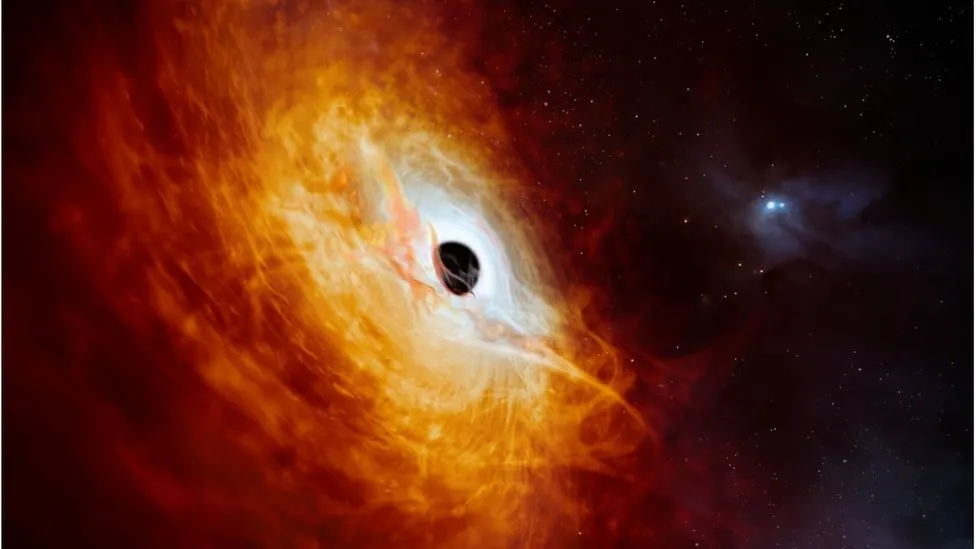
Discovery of the Brightest and Most Voracious Black Hole to Date
Scientists have identified the most luminous object ever observed in the distant Universe, classified as a quasar known as J0529-4351. This astronomical phenomenon is the bright core of a galaxy powered by a massive black hole with a mass approximately 17 billion times that of the Sun. The discovery, confirmed through observations by the Very Large Telescope in Chile, reveals the quasar’s extraordinary power, with the black hole consuming mass equivalent to one solar mass each day.
The quasar, J0529-4351, was initially recorded in data several years ago, but its significance has only recently been recognized. Researchers at the Australian National University (ANU) identified it using the European Southern Observatory’s Very Large Telescope.
Quasars are a type of Active Galactic Nucleus (AGN) that represents the highly energetic core of a galaxy, fueled by an immense black hole pulling in matter at an extraordinary rate. As this material accelerates around the black hole, it emits significant amounts of light, making even distant objects like J0529-4351 visible to observers on Earth.
J0529-4351’s luminosity is described as equivalent to more than 500 trillion suns, and its emission took approximately 12 billion years to reach Earth. The rate at which this quasar consumes mass, around one solar mass per day, sets it apart and contributes to its remarkable luminosity.
The quasar’s brightness is attributed to a hot accretion disc measuring seven light-years in diameter, approximately 15,000 times the distance from the Sun to the orbit of Neptune. The discovery prompts further investigation into the role of supermassive black holes at the cores of galaxies and their significance in galaxy evolution.
Scientists are particularly intrigued by the rapid growth of these black holes early in the Universe’s history, leading to theories that they may have formed directly from the gas present after the Big Bang, possibly predating the formation of the first stars. Studying objects like J0529-4351 provides valuable insights into the fundamental processes shaping the cosmic landscape.

