

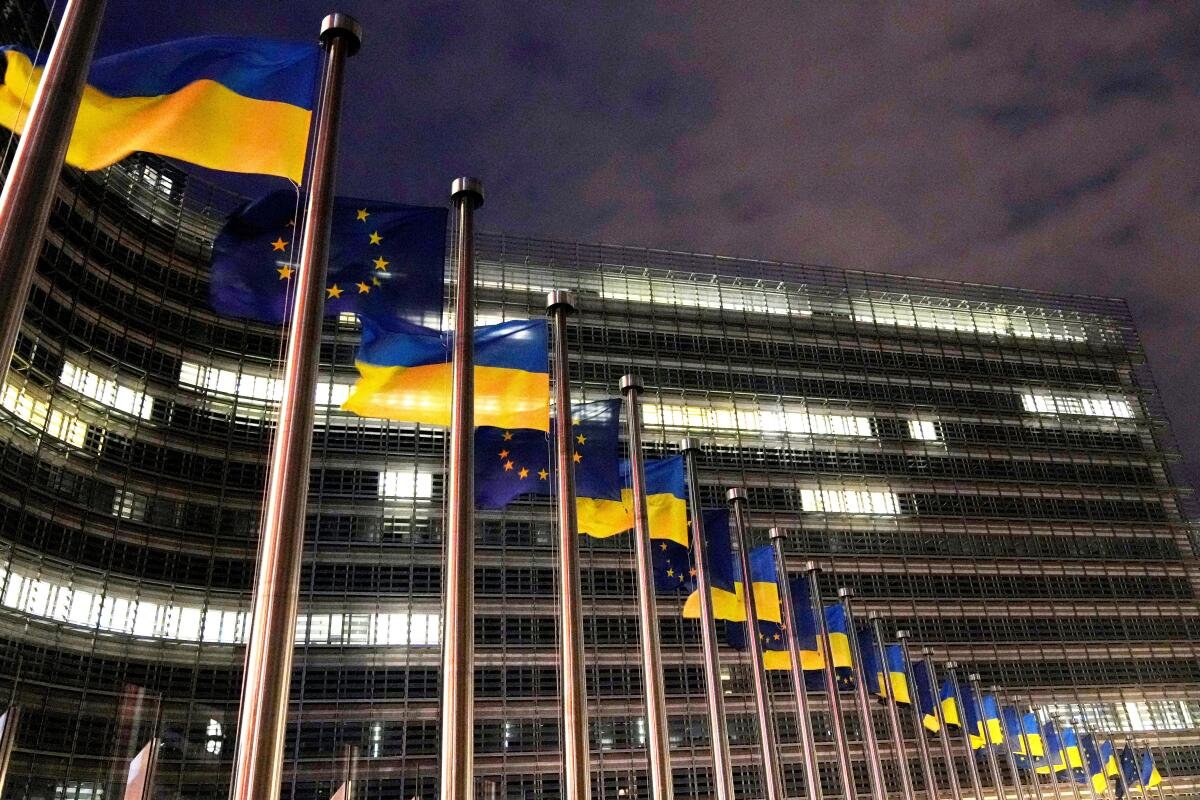
European Union governments have agreed to indefinitely immobilize up to €210 billion (£185 billion) in Russian assets frozen across the bloc since Moscow’s full-scale invasion of Ukraine in February 2022. The freeze, which mostly involves funds held by Belgian bank Euroclear, is intended to pave the way for a potential loan to support Ukraine’s military and economic recovery.
After nearly four years of war, Ukraine faces a funding shortfall of an estimated €135.7 billion ($159 billion) over the next two years. The EU aims to cover roughly two-thirds of that amount. Ukrainian President Volodymyr Zelensky described the plan as a form of “reparations loan,” asserting that it is only fair for Russia’s frozen funds to be used to rebuild what its forces have destroyed. German Chancellor Friedrich Merz added that these assets would help Kyiv defend against future attacks.
Russia has condemned the plan, accusing the EU of theft. The Russian Central Bank announced legal action against Euroclear in a Moscow court, though Brussels maintains EU financial institutions are protected under existing sanctions and international law. Euroclear itself has warned that repurposing the frozen assets could destabilize the global financial system. Belgium, in particular, is concerned about potential legal and financial risks, insisting on comprehensive guarantees before committing to the plan.
Until now, the EU has only used interest accrued from the frozen assets to support Ukraine, totaling €3.7 billion in 2024. With U.S. funding for Ukraine declining in 2025, European leaders are exploring more direct measures. Two proposals are under discussion: raising funds on capital markets backed by the EU budget, or using the frozen Russian assets directly. Belgium favors the market-based approach but faces opposition from countries such as Hungary and Slovakia.
A key development this week saw EU ambassadors agree to freeze Russia’s central bank assets indefinitely using an emergency clause under Article 122 of the EU Treaties. Previously, the freeze required a unanimous six-month renewal vote. The indefinite freeze ensures assets remain blocked until Russia pays war reparations in full or the economic threat subsides.
Despite widespread EU support, legal and political tensions persist. Belgian Prime Minister Bart De Wever emphasized the need for “water-tight guarantees” to shield Belgium from liability. Swedish Finance Minister Elisabeth Svantesson called the move a crucial step in “enabling more support for Ukraine and protecting our democracy.” Meanwhile, Russia and some EU members continue to challenge the legality and fairness of repurposing sovereign assets amid complex international negotiations involving the U.S. and reconstruction plans.
The EU’s push to utilize Russian assets signals both a pragmatic approach to financing Ukraine’s defense and a significant test of European unity and legal safeguards in handling frozen foreign funds

