

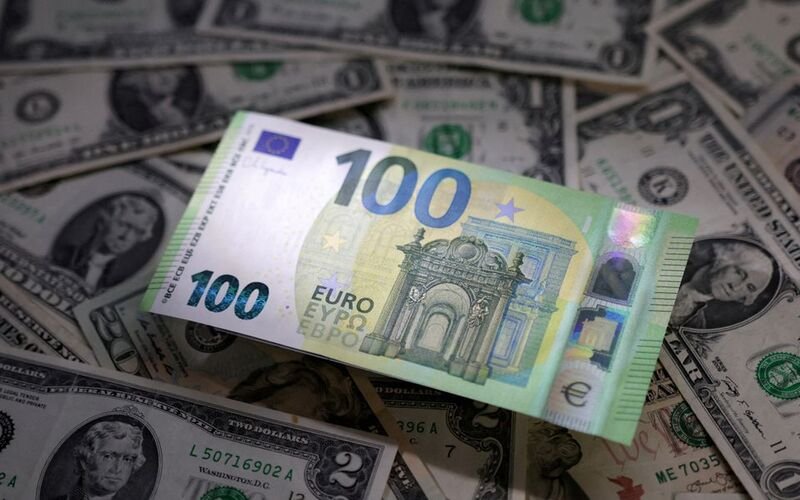
The euro is facing increased headwinds due to rising oil costs harming a faltering economy and fresh worries about Italy’s budgetary situation, increasing the possibility of a move back towards the psychologically significant $1 level.
The euro lost 3% against the dollar in the third quarter, trading at its lowest level of the year, close to $1.05. It is anticipated to post losses for the third year in a row. Given the robustness of the U.S. economy and the money drawn in from overseas as 10-year Treasury rates inch closer to 5%, a large portion of this may be attributed to a generally solid currency.
However, factors peculiar to the eurozone, notably sensitivity to rising oil costs, raise the possibility of additional weakening in the already-stagnant economy and the euro.
Over 90% of the oil products accessible in the European Union are net imported, making the euro particularly sensitive to rising oil costs.
High oil prices are affecting the terms of trade in the euro area, and according to Nomura’s G10 FX analyst Jordan Rochester, it will be challenging for the euro to escape parity if oil prices rise over $100 per barrel to $110 per barrel.
Oil prices increased by about 30% in the most recent quarter alone, approaching $98 last week as OPEC and its partners tightened the supply of petroleum. Several institutions, including Barclays, predict oil will hit $100 shortly.
Nomura now projects that the euro will lose value by the end of the year, falling further 3% from present levels to reach $1.02.
In addition to being more vulnerable to energy shocks than the U.S., the euro area is also more vulnerable to geopolitical risk, according to Jens Eisenschmidt, head economist for Europe at Morgan Stanley. The former economist of the European Central Bank said, “This damages the bloc’s competitiveness and dims the prospects for the euro over the long term.”
Although Morgan Stanley did not anticipate a decline to parity, it did anticipate a further decline to $1.03. A weak euro increases the competitiveness of exporters. However, it also increases pricing pressures by increasing import costs, amplifying rising oil prices’ effects. Although it doesn’t now appear to be very concerned, this signals the ECB may need to pay closer attention.
The euro only dropped 0.9% last quarter on the carefully watched trade-weighted index and is now around 2% higher than where it was at the end of 2022. The ECB declared it was monitoring the euro because it influenced inflation when it reached parity with the dollar last year for the first time in 20 years, but it did not set a target level.
AMERICA WATCH
Another red flag, according to Francesco Pesole of ING, is Italy. Last week, the carefully monitored yield premium that Italian debt pays over German debt reached 200 basis points. According to him, this level is usually marked by an increase in the link between that premium and the euro.
“Should we see a material deterioration in the Italian bond market, and barring a swift reaction by the ECB to calm investors, downside risks on the euro/dollar would extend to the $1.00/$1.02 area,” Pesole said. He continued by saying that a backdrop of strong American statistics and a hawkish Federal Reserve were also crucial.
Without a doubt, if the U.S. economy and inflation slow down, the dollar’s 10-month highs versus a basket of peers may lose some of its luster.
Athanasios Vamvakidis, global head of G10 FX strategy at Bank of America, stated, “if we have a combination of higher (U.S.) unemploymU.S.and lower inflation, that’s negative for the dollar.” However, “you can see the euro-dollar at parity if the U.S. economy stU.S. to weaken but inflation is sticky – though that is a risk not our baseline,” he said. The short-term picture points to more difficulties for the euro.
For a while now, investors have placed wagers on the euro’s rise, and the most recent positioning data reveals a net long position of $13 billion. A further unwind may accelerate the downward trend.
The benefit of higher rates has also diminished due to the ECB’s announcement that its most ferocious tightening cycle in history is likely ending. While the ECB’s September rate rise would typically have been a positive for the euro, projections for considerably lower economic growth predominated, according to Gilles Moec, chief economist at AXA Investment Managers.
The eurozone is “definitely not in a good place right now,” said Moec, who added that he had not ruled out a step toward parity for the single currency.

