

During the war in Ukraine, the number of billionaires in Russia has reached an all-time high. Yet over Vladimir Putin’s 25 years in power, the country’s wealthiest—its oligarchs—have seen their political influence almost completely eroded.
For Putin, this is advantageous. Western sanctions have failed to turn the ultra-rich into opponents, while a mix of incentives and pressure has ensured their quiet support.
Take former banking billionaire Oleg Tinkov. After publicly criticising the war as “crazy” on Instagram, Kremlin officials contacted his executives, warning that Tinkoff Bank—then Russia’s second-largest—would be nationalised unless he severed all ties to it.
“I couldn’t discuss the price,” Tinkov told The New York Times. “It was like a hostage—you take what you are offered. I couldn’t negotiate.” Within a week, a company linked to Vladimir Potanin, Russia’s fifth-richest businessman, bought the bank for only 3% of its true value. Tinkov ultimately lost nearly $9bn (£6.5bn) and left Russia.
This contrasts sharply with the early post-Soviet era, when oligarchs amassed vast wealth by acquiring former state enterprises, gaining both riches and political influence. Boris Berezovsky, Russia’s most powerful oligarch at the time, claimed to have helped Putin rise to the presidency in 2000—though he later expressed regret. By 2013, Berezovsky had died under mysterious circumstances in the UK, and the Russian oligarchy as a political force had effectively ended.
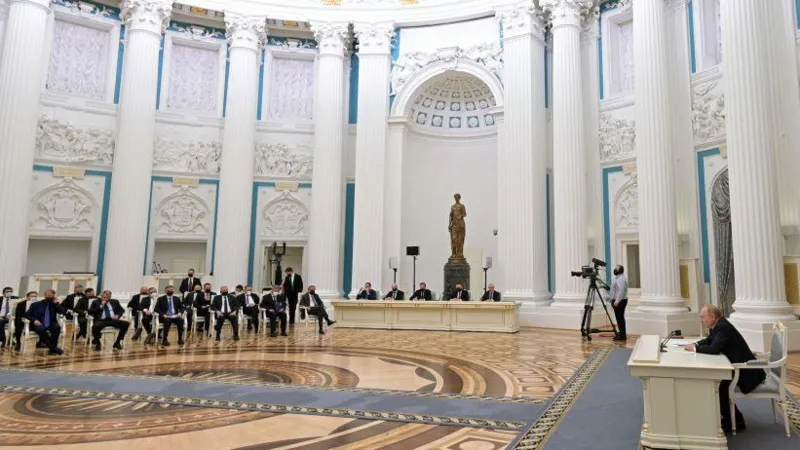
On 24 February 2022, the day Putin ordered the full-scale invasion of Ukraine, he summoned the nation’s richest to the Kremlin. With their fortunes at risk, few dared oppose him. Observers described the assembled billionaires as “pale and sleep-deprived.”
The invasion initially hit Russian billionaires hard. Forbes reported that from April 2021 to April 2022, their number fell from 117 to 83 due to sanctions, the war, and a weakened rouble, collectively losing $263bn—around 27% of their wealth on average.
Yet those aligned with Putin’s war economy soon benefited. Lavish military spending helped Russia’s economy grow more than 4% annually in 2023 and 2024. By 2024, over half of Russian billionaires either contributed to military efforts or profited indirectly, says Giacomo Tognini of Forbes.
“This doesn’t even include those who aren’t directly involved but maintain relationships with the Kremlin,” he notes. “Anyone running a business in Russia needs ties with the government.”
In 2025, Russia saw 140 billionaires, collectively worth $580bn, just shy of the pre-war record. Putin has rewarded loyalists while punishing dissenters. History remembers Mikhail Khodorkovsky, once Russia’s richest man, who spent 10 years in jail after promoting pro-democracy initiatives.
Since the invasion, nearly all mega-rich Russians have remained silent; those who publicly opposed it, like Tinkov, fled the country. Western sanctions, intended to punish these billionaires, instead reinforced their reliance on the Kremlin.
“The West did everything possible to ensure Russian billionaires rallied around the flag,” says Alexander Kolyandr of the Center for European Policy Analysis. Sanctions froze assets and seized property, leaving no viable path to defect.
Meanwhile, the exit of foreign companies opened opportunities for Kremlin-friendly businessmen to acquire profitable assets cheaply, creating a “new army of loyalists,” says Alexandra Prokopenko of the Carnegie Russia Eurasia Center. In 2024 alone, 11 new billionaires emerged this way, according to Tognini.
Putin has successfully maintained control over Russia’s key economic players, in part because of the war and the sanctions designed to weaken him.

