

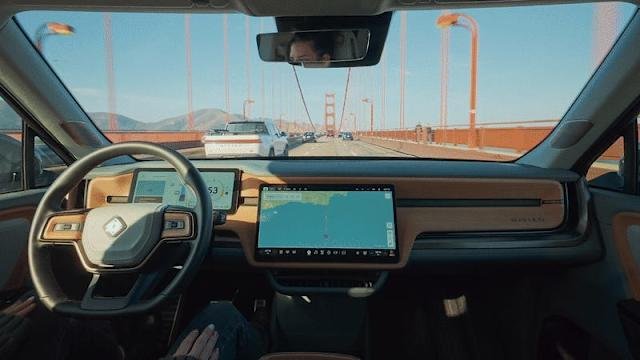
Rivian’s new AI-powered driver-assistance system, priced at $2,500, aims to help the company reach Level 4 autonomy.
Rivian Automotive has unveiled its first in-house self-driving chip and a new paid driver-assistance package called Autonomy+. This marks a significant step toward using artificial intelligence for autonomous driving and boosting revenue. The news was shared at Rivian’s first Autonomy and AI Day, highlighting the company’s focus on next-generation EV technology.
Rivian says its goal is to achieve Level 4 autonomy, where vehicles can drive themselves without human input under certain conditions. This plan relies on the Large Driving Model, an AI system trained on both real and simulated driving data. With the new Rivian Autonomy Processor, vehicles will process data from cameras, LIDAR, and other sensors needed for advanced self-driving features.
The Autonomy+ package is available for a one-time fee of $2,500 or a monthly payment of $49.99. It includes Universal Hands-Free, which works on more than 3.5 million miles of roads in the U.S. and Canada. This is much cheaper than Tesla’s Full Self-Driving, which costs $8,000 or $99 per month.
Rivian confirmed that its next-generation R2 models will include LIDAR sensors, which help the vehicles map their surroundings in 3D and better detect obstacles and road conditions. This approach is similar to the technology used by Waymo, Alphabet’s autonomous driving division.
AI assistant and future plans
CEO RJ Scaringe said the new chip and driving model will enable broader hands-free driving later this month, with point-to-point autonomous driving expected next year. The company plans to introduce eyes-off driving in 2026. Rivian also launched an AI Assistant to control some vehicle functions, integrate with apps, and identify possible repair issues.
These announcements come as the U.S. EV market may be slowing down after the end of the $7,500 federal tax credit. Rivian has reduced its annual delivery forecast to between 41,500 and 43,500 vehicles, though it has already lowered its losses this year. Analysts say the more affordable R2 SUV, which will compete with the Tesla Model Y, could help attract price-sensitive buyers.
By combining its own AI technology, LIDAR sensors, and hands-free driving, Rivian aims to become a leader in self-driving electric vehicles and make advanced driving systems more accessible to customers.

