

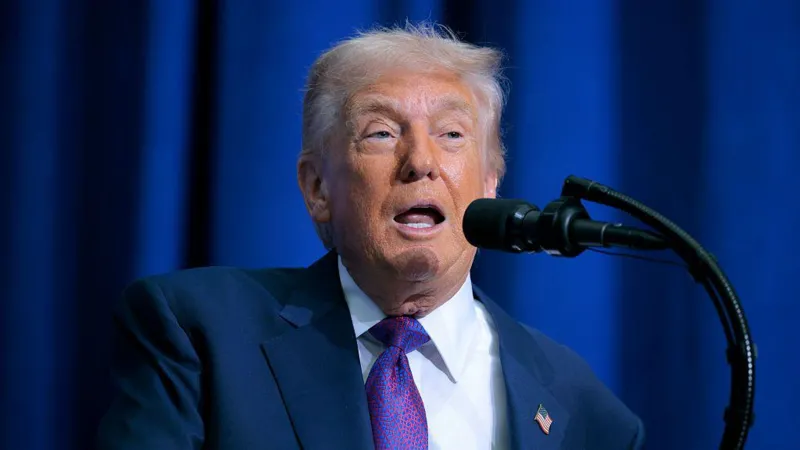
President Donald Trump says the world will know within the next 10 days whether the United States reaches an agreement with Iran or moves toward military action.
Speaking at the inaugural meeting of his newly formed Board of Peace in Washington DC, Trump described ongoing talks with Tehran as positive but historically challenging. He said negotiations over Iran’s nuclear programme remain incomplete, adding that “we have some work to do,” and warned that the situation could require escalation if diplomacy fails.
Over the past several days, the US has significantly increased its military footprint in the Middle East. At the same time, American and Iranian negotiators reported progress during talks held in Switzerland, suggesting diplomacy is still actively underway despite heightened tensions.
Any potential military action has sparked concern on Capitol Hill. Democratic lawmakers, along with a number of Republicans, have publicly opposed the idea of striking Iran without congressional approval.
During his remarks, Trump highlighted the role of Special Envoys Steve Witkoff and Jared Kushner, noting that both had held what he described as “very good meetings” with Iranian officials. Kushner, Trump’s son-in-law, has remained involved in sensitive diplomatic efforts despite no longer holding an official White House role.
Trump acknowledged the difficulty of negotiating with Tehran, saying that reaching a meaningful agreement with Iran has “never been easy” and warning that failure to do so could lead to serious consequences.
A day earlier, White House press secretary Karoline Leavitt issued a pointed message, stating that Iran would be “very wise” to make a deal. She added that the administration still hopes to resolve the nuclear standoff through diplomacy rather than force.
When Trump first announced the creation of the Board of Peace, it was widely believed the body would focus on ending the two-year conflict between Israel and Hamas in Gaza and managing post-war reconstruction. However, in recent weeks, its scope appears to have expanded well beyond a single conflict.
The board, chaired by Trump and made up of representatives from around two dozen countries, has prompted speculation that it may be designed to sideline the United Nations in global conflict resolution.
Military tensions have already escalated. US missiles and aircraft struck three Iranian nuclear facilities in June last year, and reports suggest the White House has been reviewing additional strike options this week.
American forces have continued to reinforce their presence in the region, including the deployment of the aircraft carrier USS Abraham Lincoln.
Despite this buildup, the United Kingdom has not authorised the US to use British military bases for any potential strikes on Iran, according to sources familiar with the matter.
In previous Middle East operations, the US relied on RAF Fairford and Diego Garcia, both of which remain strategically significant but currently unavailable for this purpose.
Satellite imagery indicates Iran has strengthened its military infrastructure, while the country’s Supreme Leader, Ayatollah Ali Khamenei, has issued direct warnings to the US via social media.
In one post, Khamenei responded to Trump’s comments about US naval deployments, writing that while warships are dangerous, “more dangerous than that warship is the weapon that can send that warship to the bottom of the sea.”
Opposition within the US Congress has continued to grow. California Democrat Ro Khanna and Kentucky Republican Thomas Massie have announced plans to force a vote next week under the War Powers Act.
The act allows Congress to limit the president’s authority to commit US forces to armed conflict without legislative approval.
Khanna warned that a war with Iran would be “catastrophic,” describing the country as a complex nation of roughly 90 million people with significant air defences and military capabilities. He added that thousands of US troops currently stationed in the region could face retaliation.
Despite these concerns, the likelihood of the resolution passing both chambers of Congress remains low.
Earlier this year, Senate Republicans blocked a similar war powers measure that would have required congressional approval before further US military operations in Venezuela following the capture of Nicolás Maduro.

