

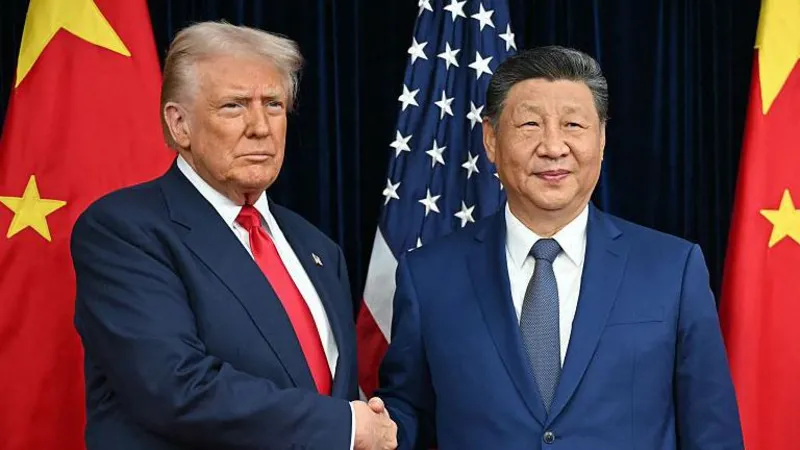
President Donald Trump has said he wants to push back a planned trip to China by about a month, citing the Iran war as the reason he needs to stay close to home.
“We’ve requested that we delay it a month or so,” he told reporters at the White House on Monday, adding that it was important he remained available to oversee the ongoing conflict. The visit had been scheduled for 31 March to 2 April — what would have been the first face-to-face meeting between Trump and Chinese President Xi Jinping since their talks last October.
Beijing confirmed the two sides are in discussions over the new timing, with Chinese foreign affairs spokesman Lin Jian saying Washington and Beijing are in talks over “the timing and related matters” of the visit. China also pushed back firmly on reports suggesting the delay was connected to disputes over the Strait of Hormuz, the critical waterway through which a significant portion of the world’s energy supply passes. Jian said the US side had itself publicly dismissed those reports as “completely wrong.”
The denial comes after Trump told the Financial Times on Sunday that he might postpone the visit if China didn’t help unblock the strait. By Monday, he appeared to walk that back, insisting the delay was simply about the war and nothing else. “There’s no tricks to it,” he said. “It’s very simple. We’ve got a war going on. I think it’s important that I be here.” He also went out of his way to emphasise the warmth of his relationship with Xi, saying he was “looking forward to being with him.”
Treasury Secretary Scott Bessent echoed that line, saying the delay had nothing to do with Washington’s request for Beijing’s help in the Gulf or any trade disagreements. “The President wants to remain in DC to coordinate the war effort,” Bessent said. “Travelling abroad at a time like this may not be optimal.”
The backdrop to all of this is a relationship under considerable strain. China is a major buyer of Iranian energy and has openly criticised the US and Israeli strikes. Washington, meanwhile, is pursuing a trade investigation into China and a list of other countries after Trump’s tariff policy was struck down by the Supreme Court in February. Representatives from both sides met in Paris in recent days to negotiate on investments, tariffs and sanctions. Chinese trade representative Li Chenggang said the two sides reached consensus on some issues and would continue talking, though Chinese negotiators also made clear they were deeply unhappy about Washington’s plans to probe their trade practices, urging the US to keep economic relations stable.
For now, the summit is on hold — delayed, Trump insists, for one reason only. Whether that’s the whole story is another matter.

