

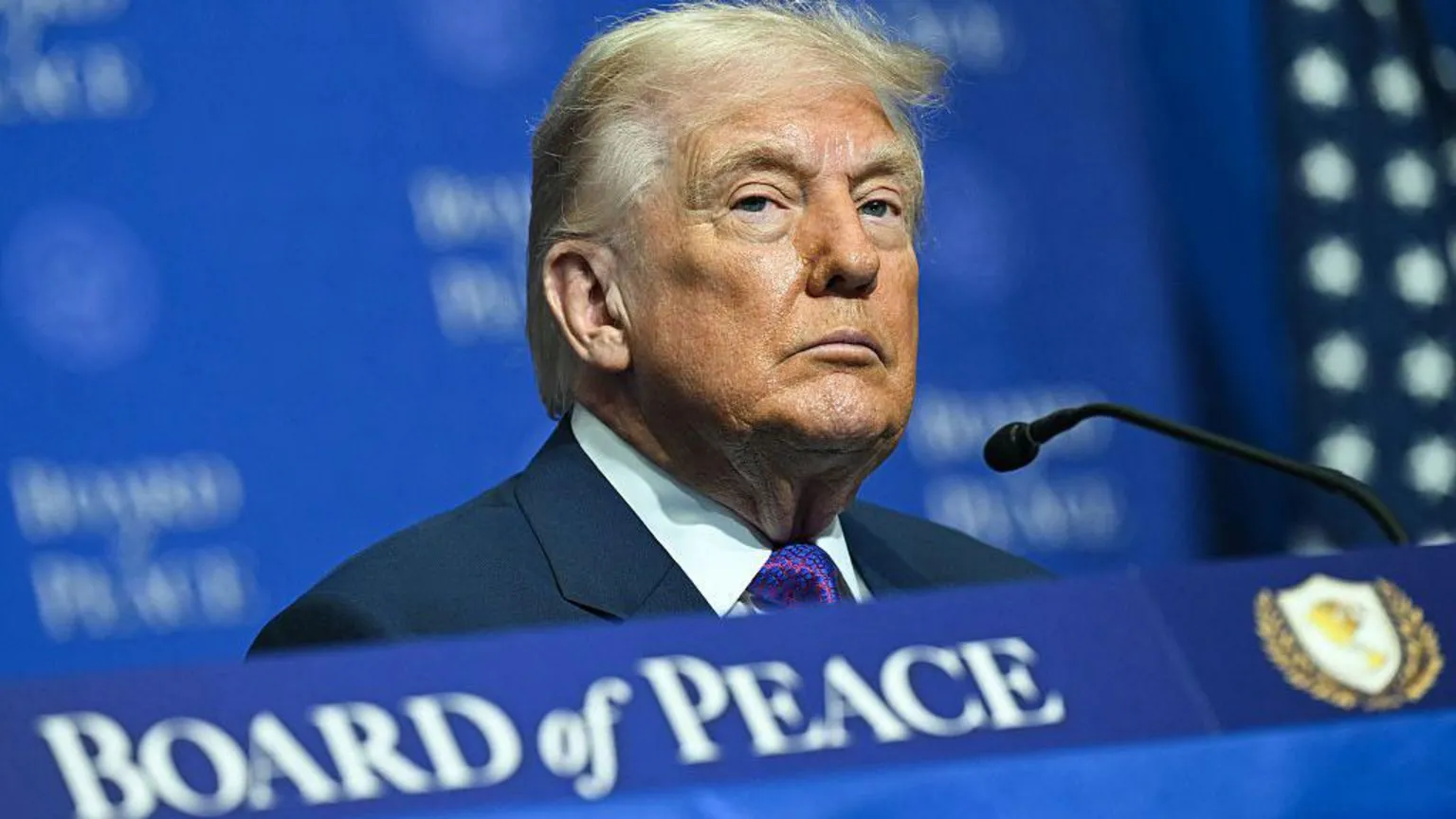
US President Donald Trump issued his latest warning to Iran on Thursday during a meeting of the Board of Peace, the Middle East coalition he created with the stated goal of stabilising a region that now appears increasingly close to another major conflict.
The moment captured the central tension in Trump’s second-term foreign policy: a call for peace delivered alongside threats of military action. That contradiction has become especially visible in the deepening standoff between Washington and Tehran—one that has escalated rapidly and could soon trigger the largest US air operation in years.
Trump has repeatedly said he favours diplomacy and wants a deal that would permanently halt Iran’s nuclear weapons ambitions. A senior White House official echoed that position on Wednesday, saying Iran would be “very wise” to reach an agreement.
Despite this rhetoric, the president has sharply intensified his language toward the Islamic Republic in recent weeks and authorised what defence analysts describe as the largest US military buildup in the Middle East since the 2003 Iraq War. The move highlights Trump’s increasing readiness to use force—more frequently than many of his supporters anticipated—and to do so without seeking advance approval from Congress.
Given Trump’s recent track record, his threats toward Iran are not easily dismissed as bluff. Earlier this year, after issuing similar warnings, the US followed through with a military operation against Venezuela in January.
That operation, according to the administration, had a limited objective and concluded with the capture of Venezuela’s former president, Nicolás Maduro.
The situation with Iran is far more complex. While Trump shares a widely held international goal of preventing Tehran from acquiring nuclear weapons, the justification for launching another military campaign remains unclear.
Iran has been weakened by years of economic sanctions and sustained domestic unrest, including large-scale protests against the regime led by Supreme Leader Ayatollah Ali Khamenei. Tehran has indicated a willingness to negotiate limits on uranium enrichment, but indirect talks with Washington have stalled. The deadlock centres on the US demand that Iran also rein in its ballistic missile programme and reduce its support for proxy militias across the region.
Even so, Trump has yet to explain why military action is necessary now—less than a year after US strikes on Iran in June—or how another attack would achieve different results. He has insisted that last year’s operation “obliterated” Iran’s nuclear facilities, yet has not clarified why further strikes would be required, or what new targets might be involved.
Unlike in Venezuela, the administration’s broader objectives in Iran remain opaque. It is unclear whether Washington seeks regime change, whether it is prepared for retaliatory strikes on US military bases in the region, or how an extended conflict might affect other strategic priorities—such as the Board of Peace-led initiative to rebuild Gaza.
Trump has provided little insight into how the administration is planning for potential post-conflict scenarios.
The role of Israel in any future military action also remains uncertain. Israel participated alongside the US in strikes on Iran last year and is widely expected to do so again if Trump authorises a new campaign. Israeli Prime Minister Benjamin Netanyahu met Trump at the White House last week to discuss the evolving situation.
Domestically, the president faces growing pressure to explain how a potential confrontation with Iran aligns with his political agenda, particularly with his first official State of the Union address of his second term scheduled for next week.
Trump campaigned in 2024 on a promise to pull the US out of overseas conflicts—a position popular with his Maga base and many Republicans in Congress who oppose foreign interventions, including support for Ukraine. However, since returning to office, Trump has authorised multiple military actions, including strikes in Syria, Venezuela, Iran, and operations targeting suspected drug-smuggling vessels in the Caribbean.
A sustained air campaign against Iran could alienate some supporters ahead of the US midterm elections, especially as opinion polls suggest growing voter dissatisfaction with Trump’s handling of domestic issues such as immigration and the economy. Critics have also questioned his focus on foreign policy amid those concerns.
Military escalation would also clash with Trump’s ongoing push for the Nobel Peace Prize. He has claimed credit for ending eight wars since the start of his second term—a claim that remains contested. There is no historical precedent for a US president actively seeking the world’s most prestigious peace award while simultaneously expanding military operations abroad.
As uncertainty mounts, global leaders continue to speculate about Trump’s true intentions in moving the US closer to another confrontation with Iran. Yet that ambiguity may be intentional.
Since his return to the White House, Trump has embraced his self-styled role as the world’s chief dealmaker, presiding over high-profile signing ceremonies and international summits, including the Board of Peace meeting in Washington.
His aggressive tariff policies have forced other nations into renegotiating trade agreements with the US, placing Trump at the centre of global economic negotiations. Last month, he again commanded worldwide attention with the strike on Venezuela and his controversial call for the US to seize control of Greenland—another episode that left allies and adversaries struggling to interpret his intentions.
When asked directly about Iran on Thursday, Trump offered little clarity, saying only that the world would have to wait and see.
“We have to make a meaningful deal,” he warned, “otherwise bad things happen.”

