

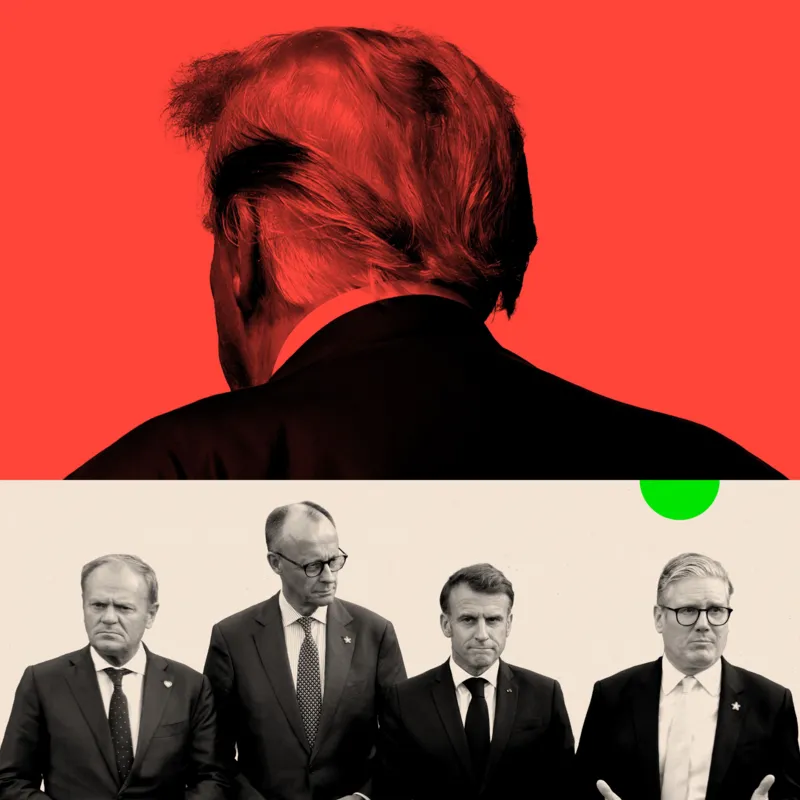
For eight decades, the bond between the United States and Europe rested on two pillars: a shared defence commitment and a common belief system rooted in democracy, human rights, and the rule of law.
That relationship was formalised in March 1947, when President Harry Truman delivered an 18-minute address pledging American support to protect Europe from the expanding influence of the Soviet Union.
From that moment, the US spearheaded the creation of Nato, the World Bank, the International Monetary Fund and the United Nations. It embedded itself in what later became known as the “rules-based international order” — a system of mutual obligations and collective responsibility designed to shield democratic states from authoritarian threats.
But a newly released US National Security Strategy (NSS), published in December, signals a sharp departure. According to the document, the White House no longer sees itself as part of that shared project. Many of the assumptions that have shaped global politics since the end of World War Two, it suggests, no longer apply.
The NSS refers pointedly to the “so-called ‘rules-based international order’”, placing the phrase in quotation marks — a subtle yet unmistakable attempt to undermine its legitimacy.
That shift was previewed earlier by Vice-President JD Vance in a speech to the Munich Security Conference in February 2025.
Addressing America’s European partners, Vance argued that Europe’s greatest threat was not Russia, but internal decay. He accused governments of censoring speech, suppressing political opposition and weakening democracy from within. He also took aim at what he described as a “leftist liberal network”.
France’s Le Monde newspaper described the speech as a declaration of “ideological war” against Europe.
The December NSS turns those remarks into formal doctrine.
“America is no longer the country that promoted the global values established after the Second World War,” says Karin von Hippel, a former senior US State Department official and past director of the Royal United Services Institute in London. “The country is moving somewhere fundamentally different.”
If the world is indeed moving away from the post-war order, the question becomes: what replaces it — and what does that mean for Europe?
‘We have a different world today’
Victoria Coates, vice-president of the Heritage Foundation and a former deputy national security adviser to Donald Trump, argues that change is unavoidable.
“International institutions — particularly the United Nations — have become deeply anti-American and have failed to serve our interests, or anyone else’s,” she says.
She points out that when the current international system was established 80 years ago, China was not a strategic rival.
“We’re dealing with a completely different global landscape now.”
The post-war order, shaped by leaders who had lived through catastrophic great-power conflict, was an attempt to prevent history from repeating itself. While flawed, it was born of hard-won experience.
The NSS, however, argues that US foreign policy lost its way after those early decades — and places blame squarely on what it calls “American foreign policy elites”.
“They tied American strategy to international institutions driven by outright anti-Americanism or transnational ideologies that seek to erode national sovereignty,” the document states.
It makes clear that Washington intends to reduce the influence of supranational bodies going forward.
“The nation-state is and will remain the fundamental political unit,” the strategy declares. “We stand for the sovereign rights of nations against the sovereignty-sapping incursions of intrusive transnational organisations.”
The document also embraces a realist view of global power, stating that the dominance of “larger, richer and stronger nations” is an enduring feature of international relations.
Moscow responded favourably, with Kremlin officials saying much of the strategy aligned with Russian thinking.
Field Marshal Lord Richards, former head of the UK’s armed forces, believes this reflects a broader shift.
“Trump, Xi and Putin — along with their authoritarian allies — are pushing us back toward an era of great-power politics,” he says.
Sir Lawrence Freedman, emeritus professor of war studies at King’s College London, offers a note of caution.
“The term ‘rules-based international order’ only gained real traction in the last decade,” he says. “And the historical record is full of rule-breaking — Vietnam being a prime example. Nostalgia can obscure how complicated that past really was.”
A forceful revival of the Monroe Doctrine
Washington’s recent military operation in Caracas — which resulted in the capture of Venezuelan leader Nicolás Maduro and his wife, Cilia Flores — offers an early illustration of this more assertive approach.
Some international law experts have questioned whether the operation violated legal norms governing the use of force. The US insists it acted lawfully.
“Under American law, it absolutely was legal,” says Robert Wilkie, a former US undersecretary of defence. “Maduro is an illegitimate leader not recognised by many European governments, and therefore not entitled to the usual protections.”
The NSS asserts the US’s right to remain the dominant power in the Western Hemisphere and to bring Latin American and Caribbean nations into alignment with its interests — a clear revival of the 1823 Monroe Doctrine.
Panama, Colombia and Cuba are all explicitly within Washington’s strategic focus.
“Control of the Panama Canal is absolutely vital to the United States,” says Coates.
China has become Latin America’s largest trading partner and a major investor in infrastructure projects. Rolling back Beijing’s influence is a central goal of the strategy.
When the canal was transferred to Panama in 1999, Coates says, Washington believed China was a responsible global actor. “That assumption proved wrong.”
Sir Lawrence Freedman, however, argues that American power has limits.
“Removing Maduro doesn’t mean the US runs Venezuela,” he says. “The old structures remain.”
No more democracy lectures
Under the new strategy, the US will no longer pressure authoritarian governments over human rights.
“All nations are entitled by the laws of nature and nature’s God to a separate and equal station,” the document states, echoing the US Declaration of Independence.
In the Middle East, Washington says it will abandon what it calls the “misguided experiment” of pressuring Gulf monarchies to change their political systems.
But that tolerance does not extend equally to Europe.
While the NSS acknowledges America’s emotional ties to the continent, it sharply criticises Europe’s “current trajectory”, warning of economic decline and even “civilisational erasure”.
It suggests some Nato members may soon become majority non-European, casting doubt on their reliability as long-term security partners.
“This is an overtly nativist document,” says von Hippel. “It reflects anxiety about the erosion of white Christian dominance, even if that is never stated outright.”
Coates counters that sovereignty lies at the heart of the debate.
“After Brexit, many European countries are questioning whether ceding national authority to Brussels is a winning strategy,” she says.
This view aligns closely with the interests of US tech companies opposed to EU regulation. Elon Musk recently posted on X that the EU should be dismantled entirely.
‘Cultivating resistance’
The NSS states that the rise of nationalist political parties across Europe is a source of optimism for Washington.
“Our goal should be to help Europe correct its trajectory,” it says — including by “cultivating resistance” within European societies.
What that entails remains unclear.
Some European leaders now openly question whether the US can still be relied upon. After Vance’s Munich speech, German Chancellor Friedrich Merz said Europe must work toward strategic independence.
But that process will be long and costly.
“Europe has chosen dependence because it was cheaper,” says Sir Lawrence Freedman. “Untangling that relationship will take years.”
Lord Richards warns that Europe risks being squeezed between competing powers.
“The EU is not a great power,” he says. “It must decide under whose protection it will shelter.”
At the same time, defence spending must rise. Trump’s push for Nato members to commit 5% of GDP to defence may, paradoxically, strengthen Europe in the long run.
“There has been real movement, especially in Germany,” says Freedman.
A shared revolt
Ultimately, the divide is not simply transatlantic, argues journalist Victor Mallet.
“There’s a cultural fault line running through both Europe and America,” he says. “Immigration, inequality, identity — this is a popular revolt against established elites.”
Economic frustration plays a major role. Despite unprecedented wealth, many people struggle to get by on both continents.
The NSS also reflects America’s internal culture wars, including a rejection of diversity and inclusion policies.
Russia, notably, is not labelled a hostile power.
For some within Trump’s base, Vladimir Putin is viewed not as an enemy, but as a defender of traditional, nationalist values — qualities they admire in their own president.

