

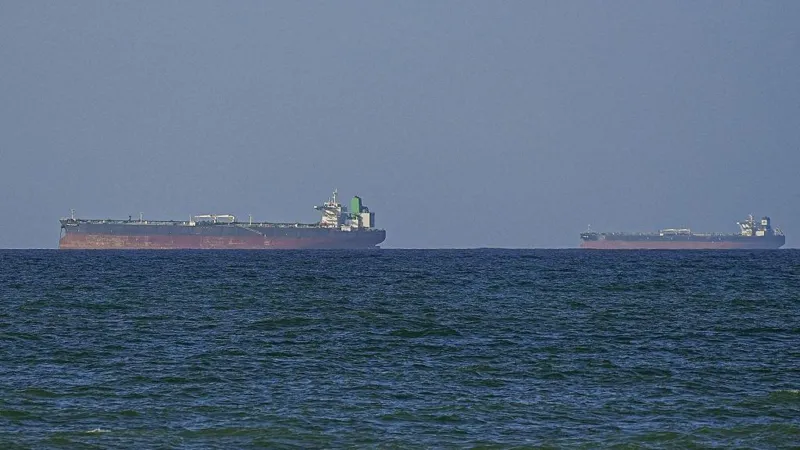
Oil prices surged by more than 7% back above $100 a barrel on Monday after US President Donald Trump ordered the blockading of Iranian ports following the failure of peace talks between Washington and Tehran.
Brent crude, the global benchmark for oil prices, jumped to $102.02 a barrel (£75.91), while West Texas Intermediate rose by 7.5% to $103.78.
The cost of a barrel of oil had plunged well below $100 last Wednesday after the US and Iran struck a conditional two-week ceasefire deal that included opening the Strait of Hormuz, a key shipping route for global oil and gas supplies.
However the failure of negotiations has raised concerns that the global energy crisis will deepen.
The strait, through which a fifth of the world’s energy shipments pass, has become a flashpoint of the conflict after Iran retaliated against US-Israeli strikes by threatening to attack vessels that try to use the waterway.
Shipments have largely been at a standstill since the US-Israel war with Iran started on 28 February, leading to energy prices surging around the world and pushing up costs for consumers, in particular making petrol and diesel more expensive.
However, Iran has continued to export oil.
Windward, the maritime intelligence firm, said that since 1 March more than 58 million barrels of oil have left Kharg Island, Iran’s main outlet for crude exports. It said more than 90% of these have been directed toward China.
Markets, for now, are caught between fear and Prices have surged, but not as dramatically as one might expect given the scale of disruption—largely because traders still believe a diplomatic resolution is possible. That optimism, however, is fragile. Should the blockade tighten or the ceasefire collapse entirely, prices could climb far higher.
The global economic response is already visible. Stock markets across Europe and Asia have dipped, while U.S. indices opened lower, reflecting investor unease. For countries heavily dependent on Middle Eastern energy—particularly in Asia—the stakes are even higher.
Ultimately, this is not just an energy story. It is a geopolitical gamble. The blockade may be intended to force negotiations, perhaps even draw in global powers like China as mediators. But such strategies come with risks that extend beyond politics into the everyday lives of millions.
For consumers, the consequences will be immediate—higher fuel costs, rising prices, and economic pressure. For governments, the challenge will be managing both inflation and instability. And for the global system, the crisis is yet another reminder of how deeply interconnected—and vulnerable—it has become.
Oil may have crossed $100, but the real cost of this conflict is still unfolding.

