

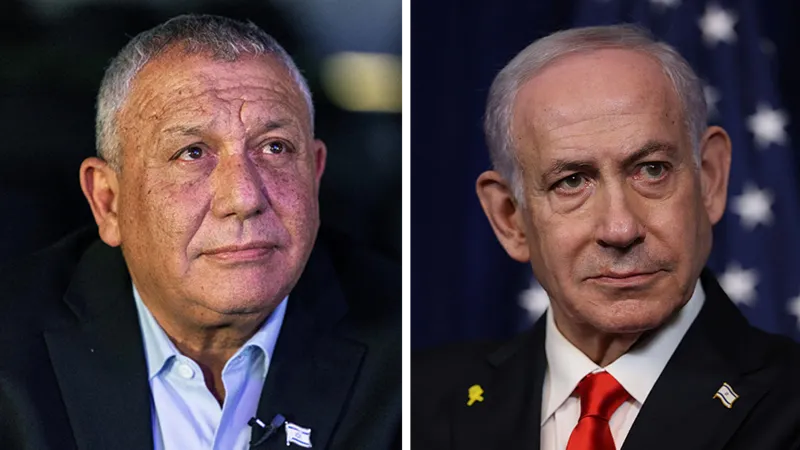
Israel has recorded its highest voter turnout since 1981 in a closely contested election that could reshape the country’s political leadership, with incumbent Prime Minister Benjamin Netanyahu facing a major challenge from former military chief Gadi Eisenkot.
Polling published on Friday suggests the two candidates are running nearly neck and neck. However, neither their political blocs is projected to secure the 61 parliamentary seats needed to form a majority government, raising the prospect of lengthy coalition negotiations.
The election has centred on national security, democratic institutions and Netanyahu’s record in office, making the outcome a significant moment in Israeli politics.
Eisenkot, who leads the newly formed Yashar Party, has emerged as the central figure in the so-called “change bloc”—a coalition of parties with differing ideologies but a shared objective of ending Netanyahu’s rule.
The alliance includes former prime minister Naftali Bennett, right-wing politician Avigdor Lieberman and left-leaning former general Yair Golan.
Netanyahu, who first became prime minister in 1996, is seeking to retain power through an alliance with far-right and ultra-Orthodox parties that currently support his government.
Far-right politicians Itamar Ben Gvir and Bezalel Smotrich have been influential figures in the coalition, which has been described as the most right-wing government in Israel’s history.
Arab political parties are also contesting the election. Arab citizens account for about one-fifth of Israel’s population, and many identify as Palestinian citizens of Israel. Although these parties could potentially influence the balance of power, most leading Jewish parties have ruled out cooperating with them.
Opposition parties have criticised Netanyahu over the security failures preceding the Hamas-led attacks of 7 October, in which nearly 1,200 people were killed and 251 people were taken hostage to Gaza.
They are calling for an independent commission of inquiry into the attacks, a proposal Netanyahu has resisted, arguing that such an investigation would be biased against him.
The opposition has also raised concerns about Netanyahu’s ongoing corruption trial, in which he denies wrongdoing, and his proposed judicial reforms. Those reforms previously sparked widespread protests before the October 2023 attacks.
Netanyahu has countered the criticism by presenting himself as the candidate best equipped to protect Israel. He has pointed to what he describes as strategic achievements in the country’s regional military campaigns and his close relationship with US President Donald Trump.
Reports published shortly before election day alleged that Netanyahu had sought additional military action involving Iran. Netanyahu denied the reports, which included claims that he had advocated a last-minute operation and attempted to persuade Trump to authorise further strikes.
He also attracted attention after sharing an AI-generated image depicting a nuclear bomb striking Tel Aviv, warning about the possibility of Iran acquiring nuclear weapons. Eisenkot criticised the move.
Military conscription has emerged as another major dividing line.
Netanyahu’s government has failed to enforce a Supreme Court ruling requiring ultra-Orthodox Jewish men engaged in full-time religious study to serve in the military. The issue has fuelled public frustration, particularly as thousands of other Israelis have been called up to serve in recent conflicts.
The ultra-Orthodox parties in Netanyahu’s governing coalition have opposed the conscription measures, making the issue a potential obstacle in negotiations over the next government.
Despite their political rivalry, Eisenkot and Netanyahu hold broadly similar positions on Gaza.
Eisenkot has pledged to end Hamas rule in the territory within 18 months, either through a US-led peace plan or, if necessary, military action.
Israel has continued striking Gaza since a ceasefire was agreed last year, saying its operations target Hamas operatives. Gaza’s Hamas-run health ministry has reported more than 74,000 deaths since the war began, figures the United Nations considers reliable.
Israel has faced growing international criticism over its military campaign, contributing to deteriorating relations with several international partners.
On the occupied West Bank, Eisenkot broadly supports Israeli settlements, which are considered illegal under international law. However, he has called for action against extremist Jewish settlers amid record levels of settler attacks reported by the United Nations.
He has also discussed creating conditions for Palestinian “autonomy or a state-minus,” while Israel retains ultimate security control. The prospect of a two-state solution—an independent Palestinian state existing peacefully alongside Israel—has become increasingly marginal in mainstream Israeli political debate.
The Arab party blocs could influence the formation of the next government if neither major political camp wins a majority.
Some observers have suggested Arab parties might provide informal support to an Eisenkot-led minority government. However, Lieberman, a potential member of the opposition coalition, has ruled out participating in such an arrangement.
These competing positions could complicate negotiations, forcing parties to consider concessions and potential alliances that have been rejected during the campaign.
Reports indicate that approximately 70,000 Israelis travelled home from abroad to vote, while hundreds of thousands are participating in an election for the first time.
Israeli broadcasters are expected to publish exit polls at 22:00 local time on Tuesday. The projections may offer an early indication of the result, although exit polls can differ significantly from the final count.
Votes cast by soldiers and reservists may also affect the outcome, as many of those ballots are not expected to be counted until Wednesday.
Although the contest has largely been presented as a showdown between Netanyahu and Eisenkot, another political leader could emerge as prime minister if a party makes its support for a coalition conditional on receiving the top job.
The possibility of political deadlock remains a central concern. If neither bloc can assemble a majority and no minority government can be formed, Israel could be forced into another election, with Netanyahu remaining interim prime minister.
The country has experienced repeated electoral stalemates in recent years. Between 2019 and 2022, Israel held five elections as political parties repeatedly struggled to form stable governing coalitions.
With security, military service, democratic institutions and the future of the Palestinian territories all featuring prominently in the campaign, the immediate result may not settle the question of who will govern. The decisive negotiations could begin only after the votes have been counted.

