
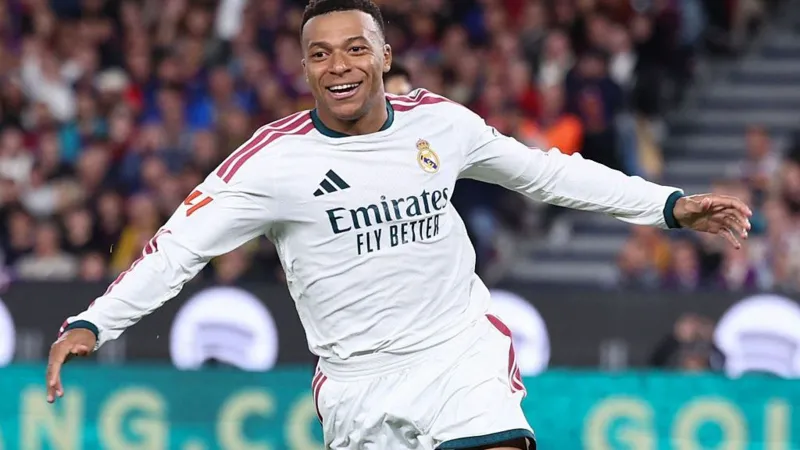
French football superstar Kylian Mbappé is facing a growing backlash in China after remarks about the late Chinese leader Mao Zedong circulated online, prompting several major Chinese brands to cut ties with the Real Madrid forward.
The controversy reportedly began after Mbappé discussed an internet meme during an appearance on The Bridge, a talk show hosted by his Real Madrid teammate Aurélien Tchouaméni. In an unverified clip circulating online, Mbappé refers to a “Chinese dictator” before a meme featuring his face superimposed on an image resembling Mao appears.
The original video is not available on the show’s YouTube channel, and the date it was first broadcast remains unclear. Mbappé does not name Mao in the circulating clips, although he reportedly says he regularly shares the meme with friends.
They said it had contacted Mbappé and Real Madrid for comment.
The backlash intensified after Chinese football platform Dongqiudi criticised the reported remarks, describing them as inappropriate and offensive to Chinese people.
Screenshots and clips subsequently spread across Chinese social media, with some users calling for a boycott of Mbappé and Real Madrid.
Several users accused the footballer of benefiting financially from Chinese consumers while making comments they considered disrespectful. Others questioned what he had actually said, particularly after some posts circulated with the meme blurred and references to the “Chinese dictator” removed.
As criticism grew, major Chinese companies issued statements distancing themselves from behaviour they said offended national sentiment.
Mengniu, one of China’s largest dairy producers, said it had a zero-tolerance policy towards words or actions that hurt the feelings of the Chinese people.
Drinks company Dongpeng issued a similar statement, saying it opposed behaviour that offended national sentiment. Neither company’s statement explicitly referred to the circulating video.
According to Chinese media reports cited by the, state broadcaster CCTV’s news applications would stop featuring content related to Mbappé, while broadcasts of Spain’s La Liga matches would also be halted.
China’s foreign ministry weighed in on the controversy. Spokesperson Lin Jian said that remarks or actions that hurt the feelings of Chinese people would naturally face opposition from across Chinese society.
The controversy quickly became a major topic on Weibo, China’s popular social media platform.
By 14:00 local time on Tuesday, five of the platform’s ten leading trending topics were focused on Mbappé. The hashtag reporting that multiple brands had ended partnerships with the footballer topped the list.
One widely circulated comment urged the player never to visit China.
The reaction comes despite Mbappé’s popularity in the country and his substantial commercial presence there. China is an important market for international sports stars, with local companies signing lucrative endorsement agreements with athletes including Mbappé, Norwegian striker Erling Haaland and NBA star Stephen Curry.
The latest controversy illustrates how remarks about politically sensitive historical figures can create commercial consequences for international celebrities operating in the Chinese market.
Mao Zedong founded the People’s Republic of China in 1949 and led the country through decades of sweeping political and economic change.
His rule included the Great Leap Forward, a campaign intended to accelerate industrialisation that contributed to a catastrophic famine in which tens of millions of people died.
The subsequent Cultural Revolution brought years of political persecution and violence against people considered threats to Communist Party ideology, including intellectuals, artists, landowners and political rivals.
Mao died in 1976, after which China gradually opened its economy to international trade and investment. Despite the country’s economic transformation, the Communist Party has continued to portray Mao as a foundational national figure.
As a result, jokes or memes involving Mao can be interpreted as challenges not only to the party’s authority but also to its official account of China’s history
The meme controversy draws on a running internet joke about Mbappé’s nickname, “the dictator”, a reference to his considerable influence within football.
The nickname has inspired numerous memes comparing the forward to authoritarian leaders. The precise origins of the Mao-related meme remain unclear.
Mbappé has previously become the subject of jokes linked to the nickname. In 2024, he sued a French influencer and kebab shop owner over the use of his name in the description of a sandwich, generating further online discussion.
During the 2026 World Cup, France teammate Ousmane Dembélé also joined the trend, calling Mbappé “Mobut”, a reference to Mobutu Sese Seko, who ruled the Democratic Republic of Congo, then known as Zaire, for three decades.
Mbappé has acknowledged that many of the jokes are intended to be light-hearted, but has also expressed reservations about comparisons with historical figures responsible for mass suffering.
In a September interview with France Football, he said such comparisons could reveal a lack of political and human awareness, adding that being likened to people who had caused immense suffering was not something he considered funny.
It remains unclear how far the controversy will affect Mbappé’s commercial partnerships and his relationship with Chinese fans.
The companies’ statements did not explicitly identify the interview as the reason for their decisions, while the original footage remains unavailable for independent confirmation of the full context.
Nevertheless, the episode has developed into a significant public relations challenge for one of football’s most recognisable figures, highlighting the sensitivity surrounding China’s political history and the potential consequences for international celebrities whose remarks become controversial online.

