

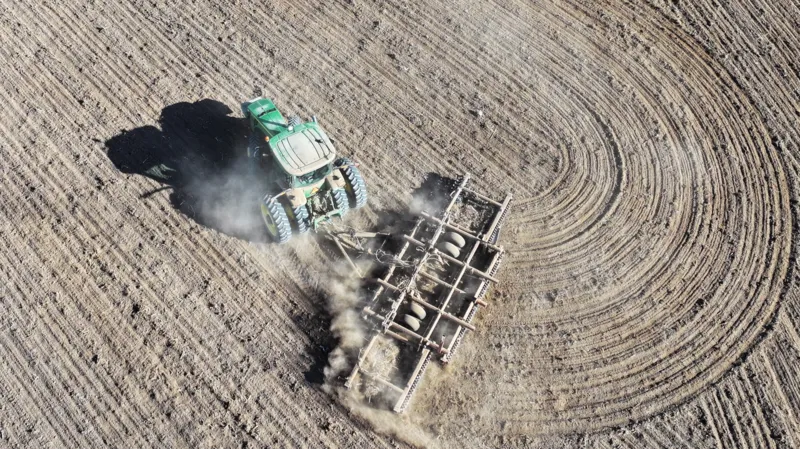
Jake Leguee is a third-generation farmer in Saskatchewan, Canada, working land his grandfather first bought in 1956. Across 17,000 acres, the Leguee family grows canola, wheat, flax and green lentils, continuing a farming legacy that has spanned nearly seven decades.
As a child, Leguee watched his father and grandfather spend long days riding tractors to sow seeds and spray crops, often returning home drenched in sweat after hours in the fields. Farming, he says, was far less efficient then than it is today.
Technology has now transformed much of his daily work. To keep his operation competitive, Leguee has adopted several innovations, particularly in crop spraying. His John Deere tractor is equipped with software and remote cameras that identify weeds in real time, allowing the machine to spray only where necessary.
As the tractor moves across the field at roughly 15 miles an hour, sensors detect weeds and activate individual spray nozzles. This targeted approach has significantly reduced the amount of pesticide used, replacing the blanket spraying methods of the past.
Leguee says the return on investment from these technologies is often high, though not all innovations require major spending. Some improvements, he notes, can be as simple as using apps to improve record-keeping and farm management.
His experience reflects a broader shift across North America. A 2024 survey by McKinsey found that 57% of farmers in the region expect to adopt new yield-enhancing technologies within the next two years. A separate report by the US Department of Agriculture in 2022 showed that while the number of farms in the US is declining, those that remain are becoming increasingly “tech dense”.
Norah Lake, who owns and operates Sweetland Farms in Vermont, says successful crop farming requires constant analysis of past and future outcomes. For years, she relied on spreadsheets to track harvest yields and compare results across seasons.
She wanted to know exactly how much produce resulted from a specific planting area, such as 100 feet of broccoli beds. More recently, she has switched to specialised farm management software provided by a company called Tend.
The system allows her to digitise labour-intensive tasks and access information from her phone or computer. By entering harvest data into the software, she receives guidance on how best to manage crops for future seasons, including how much seed to order based on targeted yields.
A growing number of technology providers are offering similar tools. Swiss-based agribusiness Syngenta offers a platform called Cropwise, which uses artificial intelligence, satellite imagery and historical weather data to monitor crops and identify potential problems.
According to Syngenta’s chief information officer, the system can alert farmers to issues such as pest outbreaks in specific sections of a field and advise when intervention is needed. By analysing two decades of weather patterns through machine learning models, the software can also help farmers anticipate risks such as frost and take preventive action.
In Germany, a start-up called NoMaze is developing software designed to help farmers understand how crops perform under different climate conditions. After conducting field tests in various environments, the company created computer simulations that offer guidance on water usage and yield optimisation. The platform is expected to roll out this year.
Experts say the benefits of these technologies could extend beyond farms to consumers. Heather Darby, an agronomist and soil specialist at the University of Vermont, says improved crop reliability could help stabilise food supplies and reduce prices.
By helping farmers avoid crop failures, technology can contribute to a more controlled agricultural environment and a more secure food system, she says.
Darby notes that younger farmers are generally more willing to embrace new tools, while older generations may be more hesitant to adopt major changes. Still, she argues that adaptation is essential.
Many modern farms, she says, are multi-million-dollar operations supporting multiple families. Treating farming as a business, rather than relying solely on tradition, is key to long-term success.
As one saying goes, she adds, farming can be a great way of life when managed like a business, but a difficult business when treated only as a way of life.

