

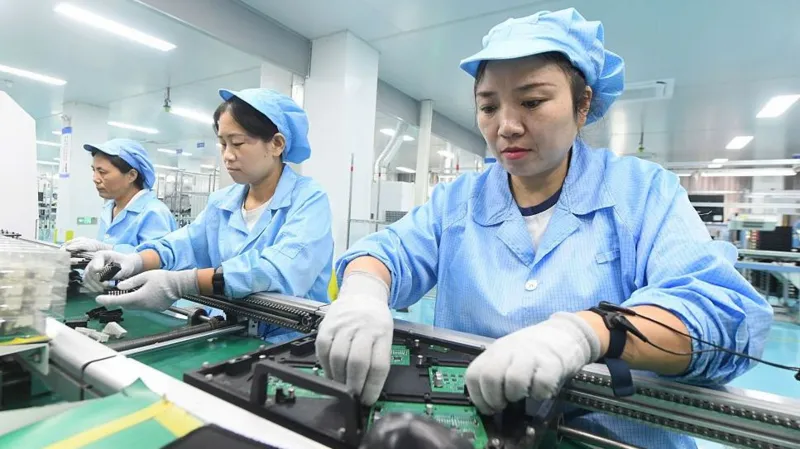
China’s economy expanded more than expected in the third quarter of 2026, supported by strong exports of artificial intelligence-related technology and electronic components. However, persistent weakness in domestic consumption, investment and the property market continues to weigh on the country’s economic outlook.
China’s National Bureau of Statistics reported on Monday that gross domestic product grew 4.5% year over year in the quarter ending September. The pace improved from 4.3% in the previous quarter, which marked the weakest growth in more than three years, and reached the lower end of Beijing’s annual growth target of 4.5% to 5%.
For the first nine months of 2026, the economy grew 4.6%.
The latest figures highlight China’s ability to withstand external economic pressures, including US tariffs and the economic effects of the US conflict with Iran. Yet the recovery remains uneven, with strong overseas demand for advanced technology contrasting with subdued spending and investment at home.
A Two-Speed Economy
China’s economy increasingly reflects what economists describe as a “two-speed” recovery. High-tech manufacturing and exports continue to perform strongly, while domestic consumption, investment and the property sector struggle to regain momentum.
The real estate downturn, now in its fifth year, remains a significant concern because property accounts for an estimated 70% of household wealth in China. Property investment fell 20.2% during the first nine months of 2026, underscoring the continuing strain on the sector.
Broader investment was also weak. Fixed-asset investment, which includes spending on infrastructure, factories and property, declined 7.2% year over year in the first three quarters, matching the pace of decline recorded through August.
Consumer spending, however, showed signs of improvement. Retail sales rose 1.1% in September, up from 0.4% growth in August and marking the strongest increase since March.
At a press conference, Mao Shengyong, vice-minister of the National Bureau of Statistics, said the economy continued to advance despite mounting pressures and that key indicators showed positive developments. He also warned that insufficient domestic demand remained a prominent challenge and that the foundations for sustained growth needed strengthening.
Beijing Faces Pressure to Boost Demand
Chinese policymakers have made expanding domestic demand a priority for 2026. Last month, the government announced targeted support measures, including mortgage subsidies for first-time homebuyers and selected interest-rate cuts, following pledges to provide additional assistance to meet the annual growth target.
Economists say further intervention may be necessary if economic momentum weakens in the fourth quarter.
The International Monetary Fund recently lowered its forecast for China’s economic growth in 2026 from 4.6% to 4.5%. It also reduced its projection for 2027 from 4.1% to 4%, citing persistent weakness in domestic demand.
The IMF said strong export performance had only partly offset sluggish consumption, weakening investment and continued pressure from the property sector.
Meanwhile, the organization raised its forecast for global economic growth this year from 3% to 3.1%.
AI and Green Technology Drive Exports
Exports remained a major engine of China’s growth in the third quarter, supported by worldwide demand for AI-related technology, electronic components, batteries and other green-technology products.
Chinese exports surged 36.3% in September compared with a year earlier, marking the largest increase since early 2021. Shipments to the United States also rose 39.6% year over year, according to the latest customs data.
The export boom helped China record a trade surplus of $938.1 billion in the first nine months of 2026, up from $875.1 billion during the same period in 2025.
However, China’s growing export strength has attracted criticism from trading partners concerned about competition with domestic manufacturers and the effects of Chinese industrial overcapacity.
Trade Truces Ease External Pressure
Despite these tensions, Beijing has so far managed to contain some of its trade disputes with major economies, including the United States and the European Union.
Chinese leader Xi Jinping and US President Donald Trump agreed last month to extend their trade truce until January 2027 and reduce tariffs on $60 billion worth of goods. The leaders are expected to meet again in November at the Asia-Pacific Economic Cooperation summit in Shenzhen.
China and the European Union also reached an initial trade agreement this month that includes a cap on Chinese hybrid vehicle exports to the bloc and improved market access. The arrangement helped avert a broader trade confrontation, although analysts warn that restrictions could slow China’s expanding automotive exports.
China’s latest growth figures demonstrate the strength of its technology-driven export sector, but the persistent weakness of domestic demand remains a central challenge. Whether Beijing can revive household spending and investment while sustaining export momentum will be critical to the economy’s performance in the final quarter of 2026.

