

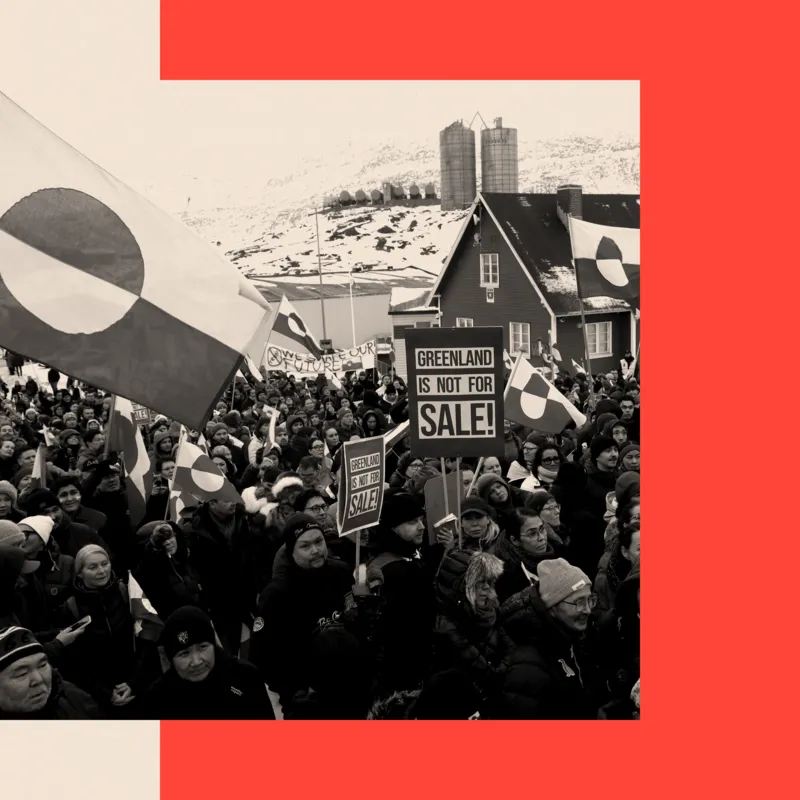
Something has shifted in Europe’s response to Donald Trump. The US president once again insisted this week that the United States needs Greenland for national security reasons, refusing to rule out the use of force when pressed by journalists. His remarks have sent renewed shockwaves through Greenland and across Europe, where leaders now appear increasingly unwilling to respond with caution alone.
Greenland is a semi-autonomous territory of Denmark, a Nato member and part of the European Union. Trump is now pressuring Denmark’s allies to step aside and allow Washington to take control of the island, warning that refusal could lead to punitive tariffs on European exports to the United States. For economies already under strain, especially export-heavy sectors such as Germany’s automotive industry and Italy’s luxury goods market, the threat is deeply unsettling.
European leaders reacted with unusual bluntness. Germany’s finance minister said Europe would not allow itself to be blackmailed, while his French counterpart warned that tariffs were being weaponized geopolitically by a long-standing ally. The language marked a sharp departure from the cautious tone Europe has largely adopted since Trump’s return to the White House for a second term.
The diplomatic strategy appears to be shifting. Rather than relying solely on appeasement or personal diplomacy, European officials are signaling a readiness to combine engagement with credible retaliation. While leaders continue to stress their willingness to cooperate on Arctic security, EU diplomats have also floated the possibility of imposing tens of billions of euros in tariffs on US goods or limiting American companies’ access to the EU’s single market if Washington follows through on its threats.
The European Union may struggle to speak with a single political voice, but economically it wields considerable power. As the world’s largest trading bloc, it accounts for a significant share of global trade and provides millions of jobs in the United States through European investment. Any serious trade retaliation would likely affect American consumers as well as businesses.
Despite this leverage, Europe remains constrained. The continent is still heavily dependent on the US for defence, intelligence and support for Ukraine. While European governments have pledged to increase defence spending, reliance on Washington remains a strategic reality. This dependence has made leaders wary of pushing too hard, even as concerns grow over the reliability of US security guarantees under Trump’s leadership.
The dilemma is stark. Failing to respond risks making Europe appear weak and unwilling to defend the sovereignty of a Nato ally. Responding forcefully risks deepening a transatlantic rift at a moment when cooperation is essential for European security. British Prime Minister Keir Starmer acknowledged this tension, stressing the UK’s national interest in maintaining strong defence and intelligence ties with Washington while also affirming support for Danish and Greenlandic sovereignty.
The broader geopolitical context adds urgency. Russia and China are watching closely as tensions strain the Western alliance. Beijing, in particular, may benefit from perceptions of instability among traditional US allies, presenting itself as a more predictable partner. Canada, which has also faced Trump’s pressure, has already taken steps to diversify its trade relationships.
Trump’s scepticism toward multilateral institutions is also fuelling unease. His administration has shown little regard for bodies such as Nato and the United Nations, and his proposed “Board of Peace” has raised concerns in Europe about undermining established international structures. The reported invitation of leaders such as Vladimir Putin has only intensified scepticism about the initiative’s credibility and intent.
While some argue that Trump’s disruptive approach may force outdated institutions to reform, others warn that the damage to trust could be long-lasting. Europe has already accepted that it must take greater responsibility for its own defence, but questions remain about how much faith it can place in US guarantees if economic coercion and territorial pressure become tools of American policy.
Public opinion in the United States complicates the picture. Polls suggest most Americans oppose acquiring Greenland, particularly by force. European governments have been lobbying lawmakers in Washington to reinforce the importance of respecting Danish and Greenlandic sovereignty, hoping domestic resistance may temper Trump’s stance.
For now, transatlantic relations remain strained but intact. Communication channels are still open, and European leaders continue to seek dialogue. Yet there is growing recognition that managing Trump quietly from behind the scenes may no longer be enough. If Europe wants to influence Washington’s course, unity will be essential—across EU member states, within Nato, and with partners such as the UK.
Balancing principle, security and economic self-interest will not be easy. A prolonged dispute over Greenland risks exposing Europe’s internal divisions and testing its resolve. Whether the continent can maintain a united front long enough to shape the outcome may determine not only the fate of Greenland, but the future of Europe’s relationship with the United States.

