

Allocational Efficiency: What Is It?
Allocational efficiency, often called allocative efficiency, is a market property where the best distribution of goods in an economy satisfies societal requirements and desires. Allocative efficiency utilizes resources to balance their marginal cost and marginal value to society.
Allocational Efficiency: An Overview
Allocational efficiency happens when public and private businesses invest their funds in initiatives that will benefit the community and the economy the most. This encourages economic growth.
When all of the market data is available, businesses can make informed decisions about which initiatives might be the most profitable, and producers can focus on creating the things that the general public is most likely to want.
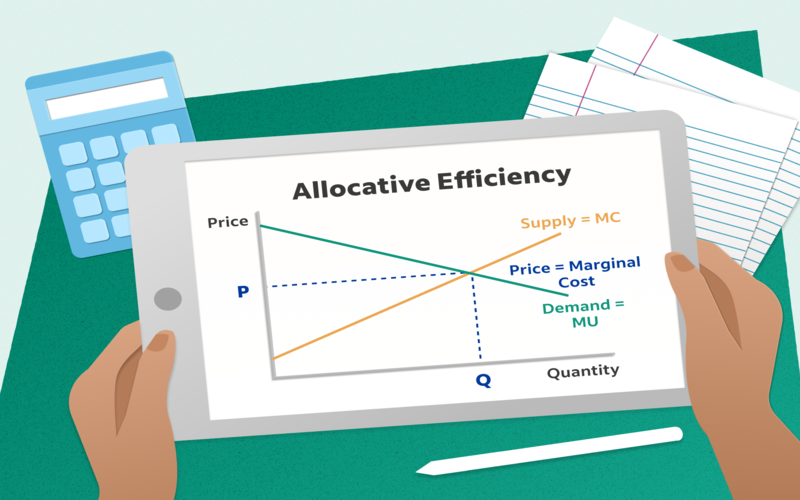
In economics, the supply and demand curves’ junction is where allocative efficiency manifests. For a firm producing the output for which the price is equal to the marginal cost of production at this equilibrium point, allocative efficiency is present.
Conditions for Allocational Effectiveness
All relevant information about the market and its activities must be available to all market participants and must constantly be reflected in market pricing for there to be an effective market.
The market must be effective from both an informational and a transactional or operational standpoint. When a market is informationally efficient, all players involved have easy access to all necessary and relevant information about the market. In other words, neither party has a competitive edge over any other regarding information.
When a market is transactionally efficient, all transaction costs are reasonable and fair. By doing this, all transactions are made sure to be equally executable by all parties and affordable for all. If the market is efficient and these standards of fairness are upheld, capital flows will go where they will be most useful and offer the most potential for risk and reward for investors.
What Sets Allocational Efficiency Apart from Distributive Efficiency?
The best possible distribution of goods within an economy that satisfies societal needs and desires is known as allocational efficiency. Distributive efficiency concentrates on the equal allocation of resources and happens when goods and services are used by those who need them the most.
What Factors Affect Allocative Efficiency?
Because it guarantees that resources are used to satiate the greatest number of wants, allocation efficiency is crucial.
Allocative Efficiency: When Does It Occur?
When a company produces an output for which the price is equal to the marginal cost of production, it is said to be in a state of allocative efficiency.
The conclusion
Resource allocation that maximizes overall economic happiness is referred to as allocational efficiency. Allocation efficiency ensures that resources are utilized to balance their marginal costs and benefits to society. Allocative efficiency for a company or producer occurs when the output price equals the marginal cost of production.
Revision for July 31, 2023: This article previously made an erroneous comparison between distributive efficiency, the equitable distribution of resources, and allocational efficiency. The article was revised to clarify that allocation efficiency refers to the best way to distribute goods within an economy to satisfy societal needs and desires while maintaining a marginal social cost equal to a marginal social benefit.
- All commodities and services must satisfy the needs and desires of society in order for a market to be considered allocational or allocatively efficient.
- Allocation efficiency ensures that resources are utilized to balance their marginal costs and benefits to society.
- Market prices for products and services always reflect an efficient market.

