

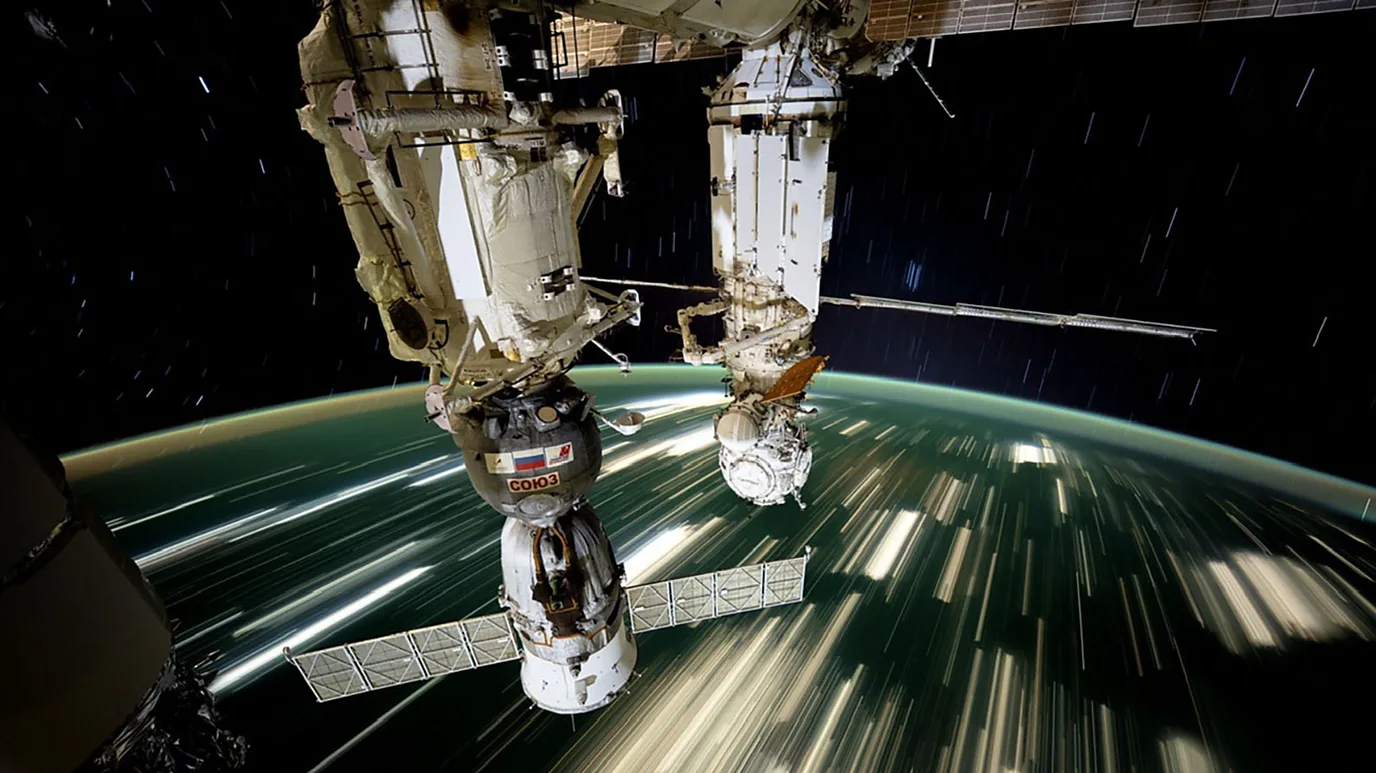
The International Space Station (ISS) has reached a major milestone, marking 25 years of continuous human presence in space since the first long-duration crew arrived aboard in November 2000. This quarter-century of unbroken occupancy above Earth highlights not just scientific achievement but also a rare, sustained partnership among nations that has advanced research and international cooperation.
Since November 2, 2000, when the Expedition 1 crew NASA astronaut William Shepherd and Russian cosmonauts Yuri Gidzenko and Sergei Krikalev first set foot aboard the station, the ISS has been home to people from across the globe without interruption. Across more than two decades, it has hosted nearly 290 astronauts and cosmonauts from 26 countries, turning what was once a futuristic concept into a daily reality.
At its core, the ISS is a microgravity laboratory orbiting roughly 400 kilometres above Earth, where scientists from space agencies and research institutions leverage unique conditions to explore everything from human physiology to advanced materials, biology and physics. Unique experiments conducted in this setting cannot be duplicated on Earth, making the station an irreplaceable platform for discovery.
The station’s continuous presence has been a testament to human ingenuity and international teamwork. Over 25 years, it has operated with contributions from NASA (United States), Roscosmos (Russia), ESA (European Space Agency), JAXA (Japan Aerospace Exploration Agency), and CSA (Canadian Space Agency). Multiple launch vehicles and spacecraft including Russian Soyuz capsules and U.S. commercial crew vehicles like SpaceX’s Crew Dragon have kept crews rotating and research ongoing.
A Hub for Scientific Discovery
Over its lifetime, the ISS has acted as a catalyst for thousands of scientific investigations. Researchers aboard the station have conducted experiments on how microgravity affects everything from protein crystallization and fluid dynamics to human biology and plant growth. These experiments often have direct applications on Earth including medical research that may lead to improved treatments for diseases, insights into human health and aging, and advancements in materials science.
Some studies harness the lack of gravity to grow tissues or pursue breakthroughs in regenerative medicine. For example, research aboard the ISS has explored bioprinting human heart tissue in microgravity, where the absence of gravity allows printed structures to hold shape without artificial scaffolding work that could one day aid treatments for heart disease.
Beyond the life sciences, the orbiting lab has helped scientists better understand fundamental physics and chemistry, and how fluids behave without the interference of gravity. These insights feed back into improvements in industrial manufacturing and materials design on Earth.
Human Endeavors and Life in Space
Living aboard the ISS is far from easy. Conditions are tight, meals are freeze-dried or packaged, and astronauts adapt to weightlessness for months at a time. Crews aboard the station experience 16 sunrises and sunsets every day as it circles Earth at approximately 28,000 kilometres per hour.
Yet life in orbit has also produced remarkable human moments. Astronauts have marked personal milestones from space, such as attending life events back home via communication links, and even getting married while in orbit. The ISS has become not just a place of research but one of symbolic meaning for the human presence beyond our planet.
Crew members train extensively before their missions, and station life demands a blend of physical fitness, scientific acumen and cooperation. The experience of living for months in microgravity teaches us about how the human body adapts vital knowledge for future deep-space missions to the Moon and Mars.
A Model of Global Partnership
The ISS stands as one of the most enduring international collaborations in history. Its partners have navigated not only complex engineering challenges but also geopolitical tensions to keep the station running. Scientists and engineers from multiple continents have contributed modules, experiments and operational support, demonstrating that scientific goals can bridge political divides.
This collaboration extends to commercial involvement as well. In recent years, commercial astronauts and private research missions have visited the station, helping to kickstart a broader low Earth orbit economy where companies can conduct research and build new space-based businesses.
The Future Beyond 25 Years
Despite its monumental achievements, the ISS is nearing the end of its planned operational life. Current planning anticipates the station will be retired and deorbited in the early 2030s, with commercial space stations and new international platforms taking its place.
NASA and its partners are already investing in next-generation systems that build on the ISS’s legacy. This includes supporting commercial space station companies that could provide more routine access to orbit for research, manufacturing, tourism and even educational opportunities.
The transition to private and commercial platforms reflects a shift in how humanity utilises orbit, aiming to maintain a continuous human presence in space while enabling broader participation beyond government space agencies.
What 25 Years Tell Us
Reaching 25 years of continuous human presence in space is a milestone that underscores both what humanity can achieve together and how much potential remains. The ISS has delivered scientific discoveries, fostered international cooperation, trained generations of astronauts and helped pave the way for future exploration beyond Earth orbit.
As we look to future missions to the Moon, Mars and perhaps farther, the lessons learned aboard the ISS from scientific insights to the practical realities of life in space will serve as a foundation. The orbiting laboratory’s legacy is not simply in its modules or missions, but in the inspiration it provides to those who imagine humanity as a multiplanetary species.
In sum, the International Space Station’s first 25 years reflect an era of space history defined by cooperation, discovery and enduring human ambition a chapter that continues to evolve as we reach for the stars.

