

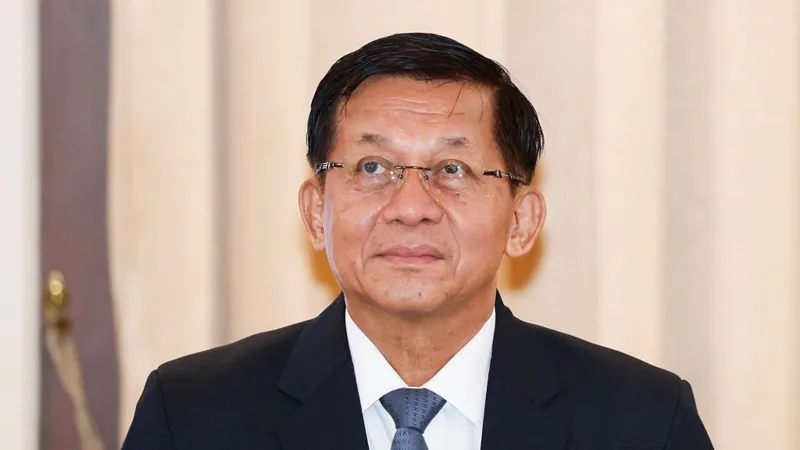
A high-level meeting with Myanmar’s leader, the easing of some sanctions and growing interest in the country’s mineral resources point to a possible change in Washington’s approach, although experts say major obstacles remain.
The Trump administration appears to be reconsidering the United States’ long-standing policy of isolating Myanmar’s military government, following a high-level meeting with its leader and the removal of some business figures from the US sanctions list.
The developments suggest Washington may be moving towards greater engagement with Min Aung Hlaing, who seized power in a 2021 coup that ousted democratically elected leader Aung San Suu Kyi and plunged the country into a devastating civil war.
For years, the United States maintained limited official contact with the junta and imposed targeted sanctions on individuals and businesses accused of supporting it.
However, that approach may be changing. On 15 and 16 September, US Assistant Secretary of State for Intelligence and Research Michael Vance met Min Aung Hlaing in Myanmar’s capital, Nay Pyi Taw. The meeting was officially intended to secure the release of Adam Castillo, a US citizen detained in June following a dispute involving the local American Chamber of Commerce.
Vance’s visit marked the most senior-level US engagement with Min Aung Hlaing since the coup. The two sides are also believed to have discussed broader issues of mutual interest.
Vance had previously met Myanmar officials in Tokyo in June and again earlier this month, while also holding discussions with representatives of groups opposed to military rule.
Trump’s tariff letter opened a door to closer ties
Signs of a possible shift in US policy emerged during President Donald Trump’s tariff campaign last year.
In July, Trump sent Min Aung Hlaing a letter warning that Myanmar would face tariffs of 40% on its exports to the United States. While other regional leaders were alarmed by the proposed levies, Myanmar’s military chief responded with enthusiastic praise for the US president.
Min Aung Hlaing expressed appreciation for the opportunity to continue trading with what he described as the world’s leading market. He also commended Trump’s leadership and portrayed him as a patriot guiding the United States towards prosperity.
The response reflected more than an attempt to flatter the US president. Following the coup and the civil war that followed, Min Aung Hlaing had become an international pariah, with his government receiving limited diplomatic recognition.
He has faced accusations of war crimes, while legal cases concerning Myanmar have been brought before international courts. Apart from Russia and, more recently, China, his government has largely been shunned by other countries.
Trump’s correspondence made no reference to the humanitarian consequences of the coup, the imprisonment of Aung San Suu Kyi or the destruction of Myanmar’s democratic institutions.
The same month, Myanmar’s military government signed a $3m contract with Washington lobbying firm DCI to improve its standing in the United States. The firm had previously worked for an earlier Burmese military government in 2002.
The junta has also hired Roger Stone, a controversial lobbyist and longtime Trump ally, reportedly at a monthly fee of $50,000.
Rare earth minerals could drive US interest
Adam Castillo, a former US Marine and supporter of Trump, has also advocated for renewed engagement with Myanmar. After stepping down as president of the American Chamber of Commerce in Yangon, he travelled to Washington to argue that sanctions had failed to isolate the military government effectively.
In his book, Finding Our Voice: A Story of Leadership in Crisis and the American Spirit Abroad, Castillo argued that Myanmar should be viewed not only as a question of human rights but also as a strategic concern for the United States.
He suggested that Washington could engage with the country without resorting to military intervention or continued isolation, potentially reducing China’s influence over critical mineral supplies while pursuing American interests.
The argument gained relevance after China restricted rare earth exports in April in retaliation for Trump’s tariffs, exposing the United States’ dependence on Chinese supplies.
Myanmar possesses substantial rare earth deposits, but much of the industry is controlled by Chinese companies operating in areas affected by conflict. The minerals are extracted in contested border regions and transported to China for processing.
Analysts remain sceptical that the United States could gain meaningful access to these resources, given the security challenges and China’s established presence.
Washington’s position on Myanmar’s election also changes
A broader shift in US policy became apparent when the State Department issued new guidance instructing American embassies to avoid making judgements about the fairness, legitimacy or democratic character of elections in other countries.
The guidance marked a departure from Washington’s longstanding practice of publicly assessing electoral processes abroad.
When Myanmar held its widely criticised general election across December and January, the United States did not join many Western governments in condemning the vote as neither free nor fair.
The election provided Min Aung Hlaing with an opportunity to transition from military coup leader to a nominally civilian president.
Washington’s decision to remove sanctions against some individuals targeted under the previous Biden administration has further fuelled speculation about a change in direction.
DCI has welcomed the apparent shift, arguing that the United States’ previous reliance on sanctions, diplomatic distance and isolation had run its course.
However, experts caution that the practical implications may be more limited than the headlines suggest.
Richard Horsey, a Myanmar adviser at the International Crisis Group, said the most significant development was the increased level of contact and the decision by senior American officials to visit Nay Pyi Taw.
Min Aung Hlaing remains under US sanctions, Horsey noted, and securing broader sanctions relief is likely to prove considerably more difficult.
Cuts to US aid have weakened Myanmar’s opposition
Other Trump administration decisions may have had a more immediate impact on Myanmar than the renewed diplomatic contacts.
The dismantling of the US Agency for International Development (USAID) sharply reduced assistance to opposition groups, independent media organisations and refugees, cutting support by more than half.
The administration also withdrew Temporary Protected Status from approximately 4,000 Burmese nationals living in the United States. Human rights organisations criticised the move, warning that those affected could face deportation to Myanmar, where they risk imprisonment or further persecution.
These decisions have raised concerns that Washington’s changing priorities could weaken groups opposing military rule while easing diplomatic pressure on the junta.
Cooperation on cybercrime and regional security remains uncertain
The United States may also seek Myanmar’s cooperation in tackling the country’s scam industry, which has become a major regional security concern.
Authorities have announced several high-profile operations against large scam compounds, but the networks responsible have frequently relocated to smaller facilities in remote areas.
Many of the operations are believed to have links to militia groups aligned with Myanmar’s military, making meaningful cooperation with the government difficult to secure.
Horsey argued that engagement with Nay Pyi Taw is not inherently wrong, but Washington must carefully consider what it expects in return and what concessions it is prepared to make.
He said the United States should prioritise humanitarian access and an end to airstrikes against civilians, while maintaining contact with opposition groups and ethnic armed organisations that control substantial parts of the country.
On scam networks, he suggested that Washington would achieve more by coordinating with regional governments, including China, to target the financial flows supporting the criminal operations.
Can Trump challenge China’s influence?
Despite the recent diplomatic activity, it remains unclear whether the Trump administration can sustain its attention on Myanmar amid competing priorities, including domestic political pressures and the war involving Iran.
China retains a substantial economic and strategic presence in Myanmar, particularly in the rare earth sector, while the country’s ongoing civil war presents significant obstacles to outside investment and cooperation.
The emerging relationship between Washington and Myanmar’s military government therefore raises a broader question: whether closer engagement can deliver tangible strategic benefits for the United States without further undermining pressure for democratic reform and human rights.
For now, the renewed contacts suggest a more accommodating tone from Washington. But whether that translates into a fundamental transformation of US policy remains uncertain.

