

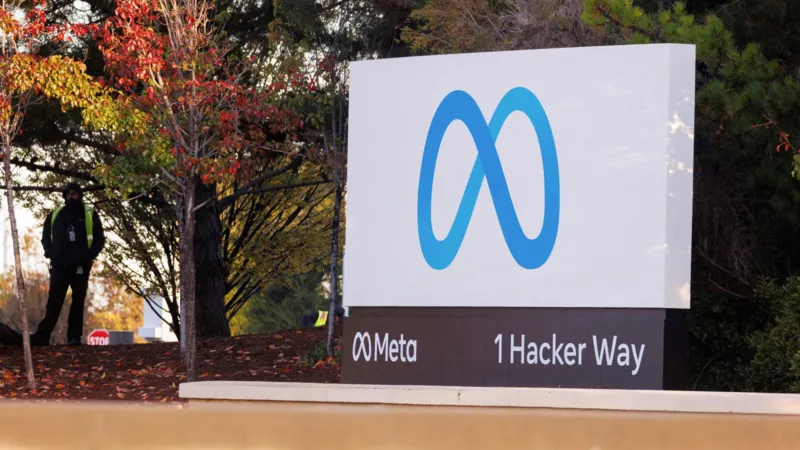
Social media giant Meta has agreed to a significant settlement with US states and territories to resolve claims that Facebook and Instagram harmed children.
If approved by a California judge, Meta will pay a maximum of $18bn (£13.3bn) to 48 states, plus the District of Columbia and three US territories, marking the company’s largest payment over child safety litigation to date.
Meta will also implement a host of changes to the platforms aimed at better protecting children online, which the states had demanded, including default daily time limits and night-time blocks.
“This is a major moment to clean up an industry that has been hurting our kids”, California Attorney General Rob Bonta said.
Meta has denied any wrongdoing as part of the settlement and said Wednesday that the payment it has agreed to “will be distributed in annual instalments over a 10-year period.”
While the settlement includes almost the entire US, the initial lawsuit was filed in 2023 by 29 states accusing the company ofnumerous violations of federal and state child privacy laws.
One of the states that is not part of the settlement is New Mexico. Last month, a federal judge there made an historic ruling against Meta, finding it to be a “public nuisance” on par with air pollution and ordering it to pay combined fines of almost $1bn.
As a jury trial kicked off last week in an Oakland, California federal courthouse, state lawyers argued the tech company knew that millions of 11 and 12 year-old users were on Instagram and Facebook over the years, yet “did little to keep them off” the platforms.
Although the trial had only gone on for five days, state lawyers relied heavily on information found in millions of internal Meta documents provided in the case. They included internal research, employee emails, and chat logs that went all the way up to chief executive Mark Zuckerberg.
One piece of internal research on Instagram stated: “Teens have an addict’s narrative about use.” Still, the states argued, Meta targeted young users.
“The trial did not go well for Meta”, Bonta said on Wednesday.
Meta maintained throughout the brief trial that it had worked extensively over the years to make its platforms safer for its youngest users, pouring resources into testing and research, and building new features.
“We’re always working on teen safety”, head of Instagram Adam Mosseri said during just an hour of court testimony on Tuesday.
The case was settled and court adjourned before he could reappear before a jury.
Prior to Mosseri’s testimony, a former researcher at Meta, George Volichenko, appeared and with lawyers went over various internal communications he had been a part of regarding Meta’s work on safety.
Volichenko said he struggled to understand when he was at the company in 2022 why the team he worked on wasn’t given more freedom to better test and implement new safety features. One of those was “quiet mode,” which muted notifications for teen users during the night. His team knew such a feature would be much more widely adopted if Meta turned it on by default.
He recalled his manager telling him he “shouldn’t worry too much about the adoption figures being low, because the team exists partially to protect the company against the upcoming lawsuits.”
As part of the Wednesday settlement, however, a feature called “night mode,” which blocks notifications between midnight and 6am, will now be on by default – meaning they will be turned on automatically. The settings are also designed to only be turned off by a parent or guardian.
“The framework we’ve negotiated will empower parents to easily manage how their children access our platforms”, C J Mahoney, Meta’s chief legal officer, said.
Other features for teen users being implemented as part of the deal include:
- A default two-hour daily time limit (cumulative across Instagram and Facebook) that teens can only turn off with a parent’s permission.
- Likes will be hidden, on teen’s profiles and those that they interact with.
- “School mode,” or a mute on notifications between 8am and 3pm during school days.
- Prompts noting when a teen has hit 15 minutes of continual use. Then notifications when cumulative use has hit 60 and 90 minutes.
- The ability to choose a feed that is not driven by an algorithm.
- The ability to turn off autoplay for videos and content.
- Extreme make up filters will no longer be accessible.
As for the new daily time limit for teen users, that will be reduced to one hour of total daily use should other social media platforms like TikTok, Snap, and YouTube also agree to implement new restrictions for young users.
Bonta urged such platforms to do so, saying the settlement with Meta “is a good blueprint” for other companies to follow. Should they not, he suggested on Wednesday that his office would now be “more focused” on bringing changes to the entire social media industry.
Meta also said TikTok and YouTube should implement the same safety features for their younger users.
“Our new Time Limit commitments, Night Mode features and usage limits during school hours set the right path forward for our whole industry, but this framework will only work if all our peers join us,” Meta’s Mahoney said.
YouTube and TikTok have been contacted for comment.
District of Columbia Attorney General Brian Schwalb called the Meta deal a “monumental public health victory”.
He added: “The safety features Meta is required to install will fundamentally and immediately change how young people use Instagram and Facebook.”

