

Pope Leo XIV has embarked on an 11-day tour of Africa, visiting four countries across 11 cities in what the Vatican describes as a deliberate effort to “turn the world’s attention to Africa,” a continent that is now home to more than a fifth of the world’s Catholics and one of the fastest-growing regions for the Church.
The trip, Pope Leo’s second major foreign visit since his election last May, will cover nearly 18,000 kilometers across Algeria, Cameroon, Angola and Equatorial Guinea. The Vatican says its latest survey shows a “remarkable increase” in the number of baptised Catholics on the continent, with some 288 million people identifying as Catholic across Africa as of 2024.
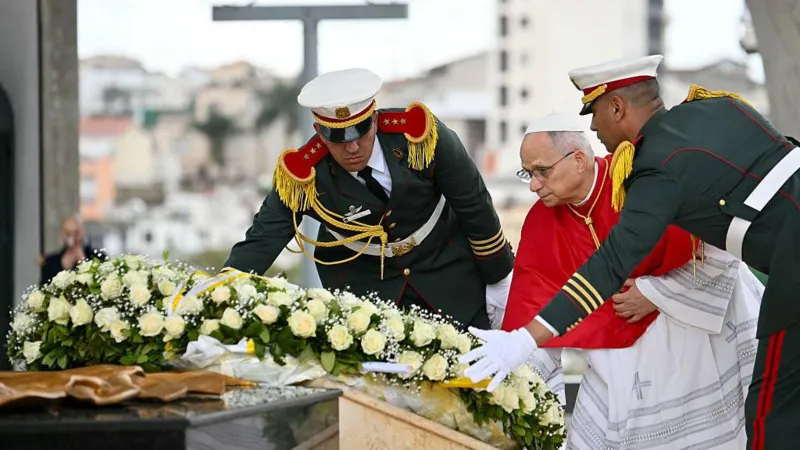
The tour began in Algeria, a predominantly Sunni Muslim country and an unusual first stop, but one of deep personal significance for the Pope. Algeria is the birthplace of St Augustine, and Pope Leo XIV is the first pontiff from the Augustinian order. He travelled to Annaba, formerly known as Hippo, where Augustine served as bishop, to celebrate Mass, and became the first pope ever to visit Algeria. In Algiers, he laid a wreath at the Martyrs’ Memorial in tribute to victims of Algeria’s independence war against France, and called for “forgiveness” as the only path to peace.
Interfaith dialogue is a central theme of the Algerian leg, with a visit to the Great Mosque of Algiers and a stop at the Basilica of Our Lady of Africa a site of pilgrimage for both Muslims and Christians—carrying particular symbolic weight. The basilica’s inscription behind its black Madonna statue reads: “Pray for us and pray for the Muslims.” Rights groups have raised concerns about Algeria’s treatment of religious minorities, including the imprisonment of Christians and Ahmadi Muslims for what courts described as “unauthorised worship.”
From Algeria, the Pope moves to Cameroon, where nearly a decade of conflict between English-speaking separatists and the francophone-dominated government has killed at least 6,000 people and displaced more than half a million, according to UN estimates. He will hold a Mass for peace and justice in Bamenda, the capital of the North-West region and the epicentre of the violence. For many displaced Cameroonians, the visit carries enormous emotional weight. Ernestine Afanwi, a 45-year-old woman who fled Bamenda after her home and shop were destroyed and has been living with her six children at an abandoned feed processing plant in Yaoundé for three years, told the BBC: “If I was face-to-face with the Pope, I would tell him all my problems and ask him to anoint the land.”
In Angola — where between 40% and 55% of the population identifies as Catholic and the Church has been present since Portuguese missionaries arrived in the late 15th century — the focus will be on peace and reconstruction after decades of civil war that ended in 2002. The Pope will celebrate Mass with some 200,000 faithful.
The final stop, Equatorial Guinea, is home to a population that is more than 70% Catholic. Social justice is expected to be prominent on the agenda in a country whose president has held power for nearly 50 years and whose government faces serious allegations of human rights abuses. Pope Leo is expected to visit a psychiatric hospital and a prison, as well as meeting young people.
Across the tour, the Pope will deliver around 25 speeches and hold interfaith events alongside meetings with political leaders and local communities. The Vatican says the visit is intended to reinforce Africa’s role in global Catholic life — as a place of faith, resilience and future growth. As Pope Leo was Cardinal Robert Prevost before his election, he is not new to the continent, having previously visited Kenya and Tanzania. But the scale and ambition of this tour signals something more deliberate: a papacy that sees Africa not as a peripheral concern but as central to the future of the Church.

