

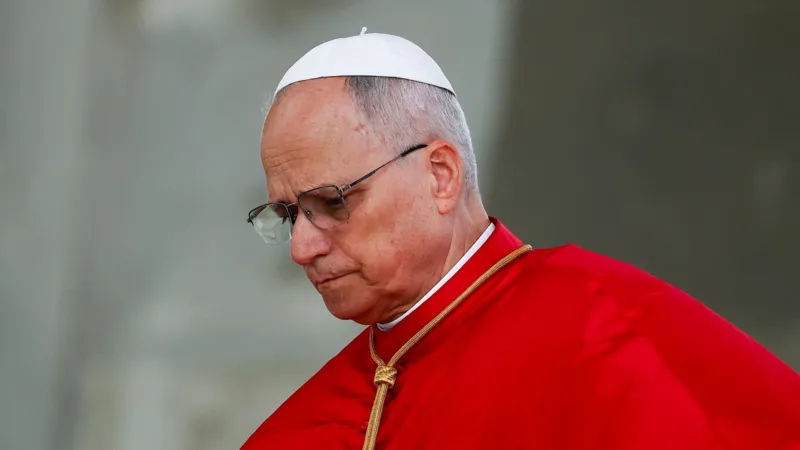
A rare and striking confrontation has emerged between spiritual authority and political power, as Pope Leo XIV publicly dismissed criticism from Donald Trump, declaring he has “no fear” of the US administration. The exchange marks an unusual moment in modern diplomacy, where the Vatican and the White House find themselves at odds not behind closed doors, but in full public view.
Trump’s remarks were unusually direct, even by his standards. Labeling the Pope “weak” on crime and foreign policy, he questioned both his leadership and his stance on the Iran conflict. The criticism, delivered via social media and reinforced in comments to reporters, reflects a broader ideological divide—one rooted in differing views on war, peace, and global responsibility.
The Pope, however, has chosen a different tone. Speaking during his visit to Algeria, he declined to engage in a political back-and-forth, instead reaffirming his role as a moral voice rather than a سیاسی actor. His message was clear: his responsibility is not to governments, but to principles—particularly the call for peace in a world increasingly defined by conflict.
At the heart of this clash is the ongoing Iran crisis. The Pope has been outspoken in condemning escalation, describing threats of destruction as “unacceptable” and urging leaders to find a path away from war. Trump, by contrast, has defended a more aggressive posture, framing it as necessary in the face of nuclear угроз. The result is a stark contrast between diplomacy driven by القوة and one guided by conscience.
Historically, popes have been cautious in directly addressing world leaders, making this moment all the more significant. It underscores how deeply global tensions have permeated even traditionally restrained institutions. For millions of Catholics—particularly in the United States, where the faith remains a major সামাজিক force—the exchange also raises questions about the intersection of belief and politics.
The criticism has not gone unnoticed within religious circles. Some observers have pointed out that such direct attacks on a pope are virtually unprecedented in modern times, highlighting the شدت of the current political climate. Yet for Pope Leo XIV, the response has been consistent with the broader legacy he inherits—a continuation of the humanitarian and outspoken approach associated with Pope Francis.
Beyond personalities, this episode reveals a deeper tension shaping global discourse: who gets to define moral leadership in times of crisis? Is it elected officials wielding state power, or religious figures appealing to universal values?
For now, the Pope appears content to stay above the political fray, even as he speaks into it. His refusal to engage directly with Trump may not de-escalate the rhetoric, but it reinforces a different kind of authority—one rooted not in القوة, but in conviction.
In a world increasingly polarized by politics, this moment serves as a reminder that influence does not always follow the same rules as power.

