

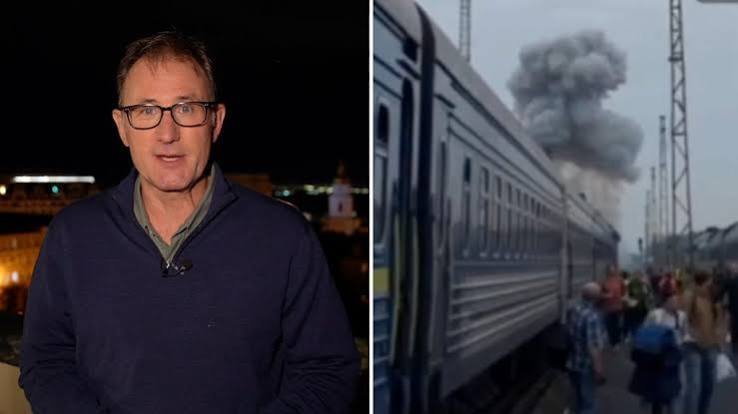
A Russian drone has hit a train near the Ukraine-Poland border shortly after former UK Prime Minister Boris Johnson and top European security officials had passed through.
No casualties were reported after the strike at Yahodyn, which hit the train’s engine.All the passengers had been evacuated, Ukrainian authorities said.
Johnson and other European national security advisers, including the UK’s Jonathan Powell, had passed along the same line on a different train on their way back from a conference in Kyiv.
Russia’s defence ministry said it had struck “railway infrastructure” in western Ukraine, but Ukraine’s state railway company Ukrzaliznytsia said the drone’s target “could have been the diplomatic train”.
Professor Katarzyna Pisarska, chair of the Warsaw Security Forum, told the BBC she was in the same carriage as Johnson and Powell, and the attack had happened about 30 minutes after their train had crossed into the Polish border.
In a statement, Ukraine’s railway authority Ukrzaliznytsia said the diplomatic train “had left the station earlier than expected because of the timetable change… due to constant threats of Russian strikes”.
It also said that an evacuation order for passengers on the hit train had been given “just 15 minutes” before the strike by a Russian jet-propelled drone.
Former CIA chief David Petraeus, who had been on board another train at Yahodyn station at the time of the strike, said the incident was “terrifying”.
In an interview with the New York Times, Petraeus said: “This is the act of a truly barbaric leader trying to terrorise Ukrainian civilians.”
Both Ukrainian and Polish authorities said the Russian drone had struck 2km
Johnson wrote on X: “I don’t know what warped logic drove Putin to blow up a stationary Ukrainian locomotive on the Polish border this morning.
He said this was “the kind of random and senseless attack Ukrainians are enduring every day – even on civilian railways” and urged Kyiv’s allies to urgently provide Ukrainians “the air defences they need”.
Ukraine has made repeated pleas to its allies – particularly the US – to provide more interceptors to defend against daily Russian attacks that increasingly use fast-moving ballistic missiles and jet-propelled drones.

Ukrainian Foreign Minister Andrii Sybiha said the “barbaric strikes” at the Ukraine-Poland border in Yahodyn amounted to “[Russian President Vladimir] Putin’s terror ‘knocking’ directly on the doors of the EU and Nato” and renewed calls for more sanctions on Moscow.
In Poland, Prime Minister Donald Tusk held an emergency meeting to discuss the latest developments, saying that Russian actions were “getting closer and closer to our border.”
Meanwhile, the EU’s foreign policy chief Kaja Kallas accused Russia of attempting to scare Western countries with the attack.
In response to a question about the incident, Kremlin spokesman Dmitry Peskov told reporters on Monday: “Our military has been conducting operations across the entire territory of Ukraine and will continue to do so.”
Johnson and other top European security advisers were on their way back from the Yalta European Strategy (YES) conference in Kyiv – an annual event that brings together leaders and experts from politics, business, security and mass media.
Ukraine said strikes had continued overnight, with the country’s air force reporting that 85 of 108 Russian drones that were launched had been shot down.
Police in Chernihiv said on Monday morning that three people had died after a warehouse belonging to an agricultural business was struck in Pryluky.
Russia’s defence ministry also reported that nearly 400 Ukrainian drones had been destroyed over Russian regions overnight.
Russia appears to be escalating its war against Ukraine by targeting trains, railway depots, petrol stations and border crossings.
Earlier this week, two people were killed when Russian drones hit a border crossing between Ukraine and Moldova, Ukrainian President Volodymyr Zelensky said.
Also this week, a female conductor died in a Russian drone attack on a passenger train in southern Ukraine. Six Ukrzaliznytsia employees were killed after a depot was struck in Kyiv at the start of the month.
In January, Zelensky condemned as “terrorism” a Russian strike on a crowded passenger train in the north-eastern Kharkiv region that left five people dead.
The Russian attacks have significantly damaged Ukraine’s vast train network – the main mode of transportation for millions of Ukrainians as all air travel has been suspended since the start of Russia’s full-scale invasion in 2022.
European countries are also blaming Russia for suspicious incidents on their territory.
Last week, Germany said Russia was responsible for August’s drone attack at Leipzig’s airport – a claim denied by Moscow as “absurd”.
There have also been a number of suspicious fires at defence facilities from Italy to Estonia, with some of the affected countries blaming Russia.
Russian authorities have also accused Ukraine of targeting trains and busses in recent months.
Last year, Ukraine’s Security Service (SBU) said it targeted a railway bridge in Crimea following an operation lasting “several months”.
The Crimea bridge – also known as Kerch Bridge – was built by Russia after it invaded and annexed the Crimean Peninsula in 2014. It was inaugurated by Russian President Vladimir Putin to great fanfare in 2018.

