

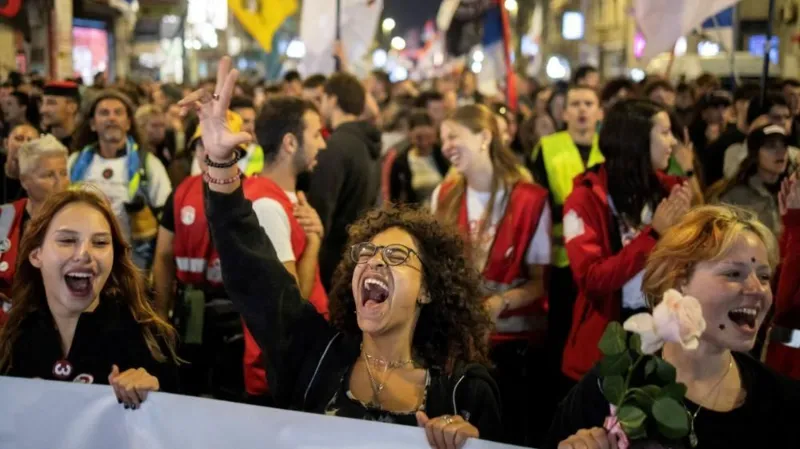
A student-led protest movement is emerging as the strongest challenge yet to Serbian President Aleksandar Vučić’s political dominance, as the country prepares for snap parliamentary elections following two years of anti-government demonstrations.
Serbians will vote on Sunday in an election widely viewed as a referendum on the country’s future. The campaign has been marked by widespread public anger, concerns about electoral fairness and growing support for the movement known as “Student List – Students Win.”
Although students have driven the protests, the movement’s electoral candidates come from a broad range of professions and backgrounds.
How the student movement began
The movement emerged after a concrete canopy collapsed outside the railway station in Novi Sad on 1 November 2024, killing 16 people.
The disaster became a symbol of alleged corruption and negligence in Serbia. Critics linked the collapse to problems with the station’s renovation, a project with which Vučić had closely associated himself.
What began as weekly student demonstrations demanding justice quickly expanded beyond university campuses. Farmers, actors, judges and other sections of society joined protests that spread across the country.
The unrest shook the ruling Serbian Progressive Party (SNS), founded by Vučić, and led to the resignation of the prime minister within weeks. In March 2025, Belgrade witnessed one of the largest demonstrations in its history.
Rather than appointing conventional leaders, the student movement organised itself through assemblies, known as plenums, allowing participants to coordinate their activities collectively.
The movement has since developed into a nationwide political force, attracting voters dissatisfied with the government as well as people who have become disillusioned with traditional opposition parties.
At the 2023 election, Vučić’s SNS faced a loose coalition of pro-European Union parties that subsequently broke apart. This time, the student movement represents a more distinct challenge to the ruling party.
Who is Aleksandar Vučić?
Vučić has held Serbia’s highest political offices since 2014, serving as prime minister and president after previously spending two years as deputy prime minister.
Having completed two presidential terms, he cannot seek a third. He is instead leading his party in an effort to return to the premiership, a position he left in 2017.
The right-wing populist has accused his opponents of being backed by powerful foreign interests seeking to overthrow Serbia, claims that critics say are unfounded. He has also pledged to end what he describes as the politicisation of schools and universities.
His foreign policy has involved balancing relations with Western countries while maintaining close ties with Russia. Serbia continues to pursue membership of the European Union, but Vučić has refused to impose sanctions on Moscow over its full-scale invasion of Ukraine.
The attendance of several Serbian government ministers at the Belgrade funeral of convicted Bosnian Serb war criminal Ratko Mladić also prompted anger in the EU over what it viewed as the glorification of a war criminal.
Helena Ivanov, of the foreign policy think tank Henry Jackson Society, said the student movement had mobilised large numbers of people in ways traditional opposition parties had failed to achieve.
She described the movement as Vučić’s biggest challenge since he came to power, while warning that defeating him would not be easy.
How Serbia’s elections work
Serbia’s parliament has 250 seats, with the country operating a proportional representation system in a single national constituency.
Polling stations will open at 07:00 local time and close at 20:00 on Sunday. Around 6.45 million people are registered to vote, with citizens aged 18 and above eligible to participate.
Eighteen electoral lists are contesting the election, although only seven are fielding candidates for all 250 parliamentary seats. Parties must receive more than 3% of the vote to qualify for parliamentary representation.
Several opposition parties have withdrawn from the contest in support of the Student List, strengthening its position as an alternative to the ruling party.
Who is behind the Student List?
Despite its name, the Student List is not made up of student candidates. Its members include teachers, university professors, doctors, actors, farmers and scientists.
The list is headed by Ilija Srdanović, a cardiology professor in Novi Sad. Other prominent figures include former basketball star Dejan Bodiroga, actor Tihomir Stanić and former National Bank of Serbia governor Dejan Šoškić.
As students travelled to Belgrade from different parts of the country for the final campaign rally, Srdanović said the movement’s energy was unstoppable and that history was being rewritten.
The movement’s 11-point programme focuses on tackling corruption, reforming state institutions and reducing political influence over the media.
Its proposals include establishing a police unit to pursue those responsible for corruption, removing officials accused of misconduct during crackdowns on protesters or links to organised crime, and reforming public broadcasting to reduce political control.
It also wants to end the practice of appointing ruling-party loyalists to lead public enterprises.
Vučić and the SNS deny allegations of corruption and attempts to influence the media.
Concerns over the fairness of the vote
European observers are monitoring Sunday’s election, but concerns about the campaign have already been raised by international organisations and independent watchdogs.
The Parliamentary Assembly of the Council of Europe has described the electoral environment as tense and divisive, with an atmosphere resembling a referendum.
Serbia’s election commission maintains that the elections are free and that voting is conducted by secret ballot. However, independent monitoring organisation CRTA has reported threats, physical violence and surveillance targeting opposition activists.
In a report issued before the vote, CRTA said institutions that should ensure fair competition had instead become involved in what it described as electoral engineering. It cited the involvement of ministries and local governments in the campaign.
The watchdog also complained that government representatives received almost three-quarters of television coverage, raising questions about whether competing candidates had equal access to the media.
Meanwhile, the European Centre for Press and Media Freedom says around 160 attacks on journalists and media organisations have been recorded in Serbia this year.
With the student movement drawing support from across society, Sunday’s election will test whether years of demonstrations and public anger can translate into a significant political shift — and whether Vučić’s ruling party can withstand its most serious challenge in more than a decade.

