

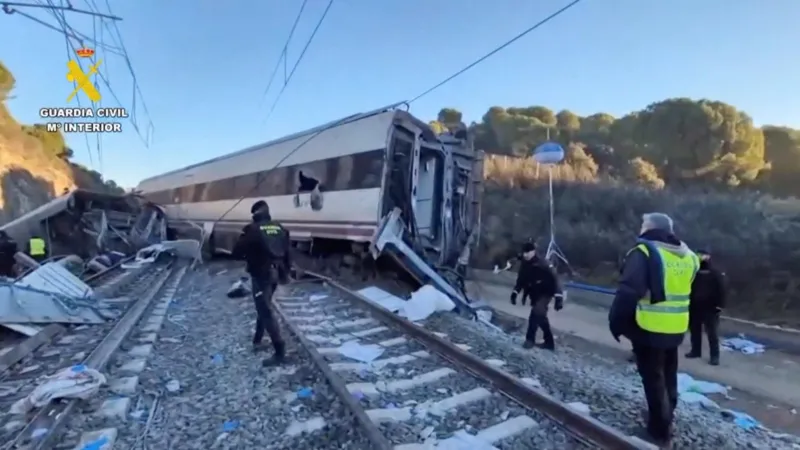
Prime Minister Pedro Sánchez announced the mourning period on Monday, pledging a full and transparent investigation into the cause of the collision, which occurred near the town of Adamuz in the province of Córdoba on Sunday evening.
More than 120 people were injured when a Madrid-bound train derailed and crossed onto the opposite track, colliding with another high-speed train travelling south. Rail authorities said the crash happened at 19:45 local time, around an hour after one of the trains departed Málaga.
Transport Minister Óscar Puente said the impact forced several carriages off the tracks and into an embankment, adding that most of the deaths and serious injuries occurred in the front sections of the second train. Rescue teams described the recovery effort as extremely challenging due to the twisted wreckage.
“This is a day of sorrow for all of Spain,” Sánchez said during a visit to the crash site. “We are going to uncover the truth and make the cause of this tragedy public with absolute transparency.”
Puente said the investigation could take at least a month, calling the circumstances of the crash “extremely strange”.
Around 400 passengers and staff were on board the two trains. Emergency services treated 122 people, with 41 still in hospital, including children. Twelve of those injured are in intensive care, and officials warned the death toll may yet rise as victims are formally identified.
Witnesses described scenes of panic following the collision. Salvador Jiménez, a journalist travelling on one of the trains, said the impact felt like an earthquake, while another passenger told local media there were screams and urgent calls for medical help.
Footage from the scene shows derailed carriages tipped onto their sides as rescue workers climbed over the wreckage to evacuate passengers through doors and windows.
All high-speed rail services between Madrid and the southern cities of Málaga, Córdoba, Seville and Huelva have been suspended until Friday.
King Felipe VI and Queen Letizia expressed their condolences, saying they were following developments “with great concern”. Emergency agencies have urged survivors to contact relatives to confirm they are safe, while the Red Cross has deployed counsellors to support affected families.
Spain’s last major high-speed rail disaster occurred in 2013, when a derailment in Galicia killed 80 people.
Spain has the second-largest high-speed rail network in the world after China, spanning more than 4,000km and linking over 50 cities nationwide.
Spain will observe three days of national mourning after a high-speed train crash in the south of the country killed at least 40 people.
Prime Minister Pedro Sánchez announced the mourning period on Monday, pledging a full and transparent investigation into the cause of the collision, which occurred near the town of Adamuz in the province of Córdoba on Sunday evening.
More than 120 people were injured when a Madrid-bound train derailed and crossed onto the opposite track, colliding with another high-speed train travelling south. Rail authorities said the crash happened at 19:45 local time, around an hour after one of the trains departed Málaga.
Transport Minister Óscar Puente said the impact forced several carriages off the tracks and into an embankment, adding that most of the deaths and serious injuries occurred in the front sections of the second train. Rescue teams described the recovery effort as extremely challenging due to the twisted wreckage.
“This is a day of sorrow for all of Spain,” Sánchez said during a visit to the crash site. “We are going to uncover the truth and make the cause of this tragedy public with absolute transparency.”
Puente said the investigation could take at least a month, calling the circumstances of the crash “extremely strange”.
Around 400 passengers and staff were on board the two trains. Emergency services treated 122 people, with 41 still in hospital, including children. Twelve of those injured are in intensive care, and officials warned the death toll may yet rise as victims are formally identified.
Witnesses described scenes of panic following the collision. Salvador Jiménez, a journalist travelling on one of the trains, said the impact felt like an earthquake, while another passenger told local media there were screams and urgent calls for medical help.
Footage from the scene shows derailed carriages tipped onto their sides as rescue workers climbed over the wreckage to evacuate passengers through doors and windows.
All high-speed rail services between Madrid and the southern cities of Málaga, Córdoba, Seville and Huelva have been suspended until Friday.
King Felipe VI and Queen Letizia expressed their condolences, saying they were following developments “with great concern”. Emergency agencies have urged survivors to contact relatives to confirm they are safe, while the Red Cross has deployed counsellors to support affected families.
Spain’s last major high-speed rail disaster occurred in 2013, when a derailment in Galicia killed 80 people.
Spain has the second-largest high-speed rail network in the world after China, spanning more than 4,000km and linking over 50 cities nationwide.

