

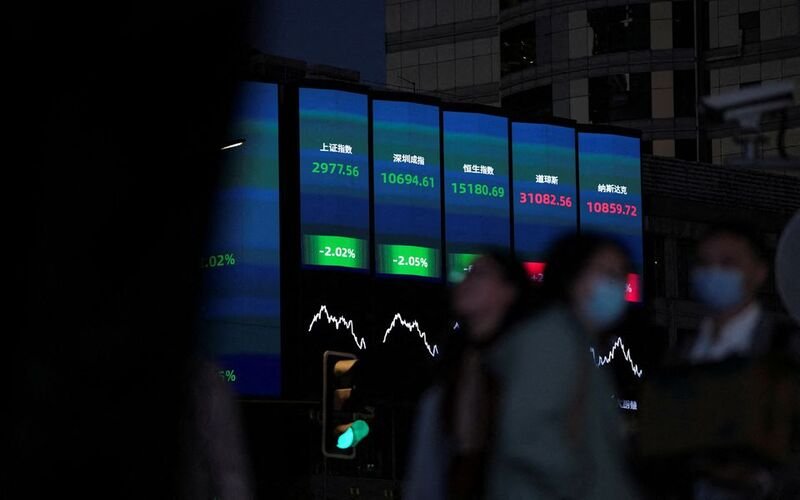
Ahead of central bank meetings in the U.S., U.K., and Japan, where a policy tightening may occur, worries of a larger war sparked by Israel’s incursion into Gaza caused Asian share markets to move in a mixed manner on Monday.
Apple, Airbnb, McDonald’s, Moderna, and Eli Lilly & Co. are just a few companies reporting this week as the earnings season continues. Thus far, the S&P 500 has retreated into the correction zone (.SPX) due to lackluster results.
“The price action is bad as SPX could not defend a key 4,200 level; the risk is it heads to the 200-week moving average of 3,941 before a trading rally,” analysts at BofA stated. On Monday, S&P 500 futures increased by 0.4% to $4,153.5, while Nasdaq futures saw a 0.5% increase. While FTSE futures increased by 0.2%, EURO STOXX 50 futures decreased by 0.1%.
Israel’s drive to encircle Gaza’s capital in what it called the “second phase” of a three-week conflict with Hamas militants backed by Iran tempered the desire for risk.
After hitting a one-year low last week, MSCI’s broadest index of Asia-Pacific equities outside Japan (.MIAPJ0000PUS) decreased by 0.04%. Blue chips in China (CSI300) increased by 0.6%.
The shares of China Evergrande Group (3333. H.K.) had a 23% decline in the morning session but recovered to 5% after the High Court of Hong Kong postponed the request to wind up the troubled property developer.
Amidst rumors that the Bank of Japan (BOJ) may modify its yield curve control (YCC) policy following its two-day policy meeting on Tuesday, Japan’s Nikkei (.N225) dropped 0.95%. Although many experts anticipate that the central bank will increase its inflation estimate to 2.0%, they aren’t sure if it will ultimately give up on YCC in response to bond market pressure.
“Remaining uncertainty about the wage outlook, combined with stresses in global bond markets, could prompt the BOJ to err on the side of caution, making our view that YCC will be scrapped a very close call,” Barclays analysts stated.
“The BOJ could still opt to revise policy but less drastically, perhaps by raising the ceiling for 10-year yields as it did in July.” At 0.89%, yields are already at their highest point since 2013. Giving up on YCC entirely would probably put further strain on international markets that a ferocious sell-off in U.S. Treasury bonds has already battered.
FED FINISHED?
The yield on 10-year Treasury bonds reached a 16-year high of 5.021% on Monday after rising 30 basis points this month.
When Treasury reveals its intentions for refunding, sentiment will be put to the test once again this week, and additional hikes are probably in store. NatWest Markets anticipates marketable borrowing of $885 billion for the fourth quarter and $700 billion for the next.
Analysts are sure that the Federal Reserve will remain unchanged at this week’s policy meeting due to the substantial increase in market borrowing costs; futures indicate that rates will most likely stay between 5.25 and 5.5%.
Additionally, starting in the middle of the year, the market has priced in 165 basis points of relaxation for 2024.
Goldman Sachs analysts calculated that the yield increase was equal to 100 basis points of rate rises. “The Fed appears to have coalesced around the view that the recent tightening in financial conditions led by higher long-term interest rates has made another hike unnecessary,” the analysts said.
“The story of the year so far has been that economic reacceleration has not prevented further labor market rebalancing and progress in the inflation fight,” they stated. “We expect this to continue in coming months.”
After September’s record-breaking surge, job data on Friday is expected to show that U.S. payrolls increased by a healthy 188,000 in October. However, yearly growth in average wages is still predicted to fall to 4.0% from 4.2%.
This week, the Bank of England is likewise anticipated to remain on hold; markets are putting in a 70% possibility that it will end its tightening program entirely.
Strangely, the recent rise in U.S. rates hasn’t contributed to the dollar’s strength. “Likewise, the fall in global equity markets and the ongoing uncertainty around the Hamas-Israel conflict has not done much to drive the dollar higher against risk-sensitive currencies,” a note from Capital Economics stated.
“This reinforces our sense that a relatively optimistic assessment of the outlook in the U.S. is by now largely discounted in the dollar.”
The dollar fluctuated between 105.350 and 106.890 last week, but it remained stable at 106.56 versus a basket of currencies. It closed at 149.60, flat against the yen and below the peak of 150.78 set last week.
The euro was trading at $1.0563, essentially steady for the month. Gold remained stable in the commodity markets at $1,998 per ounce.
Concerns about demand trumped threats to Middle East supply, at least temporarily, and oil prices started to decline. U.S. crude dropped $1.13 to $84.41, while Brent shed $1 to $89.45 a barrel.

