

It took only hours for Donald Trump to dismantle a relationship China had spent decades nurturing.
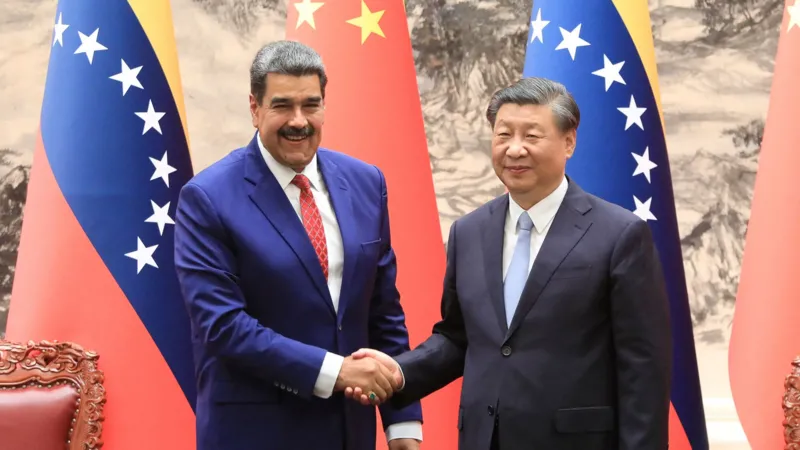
Just before his dramatic overnight capture, Venezuelan President Nicolás Maduro had been publicly praising Chinese President Xi Jinping, calling him an “older brother” and applauding his global leadership during a meeting with senior Chinese diplomats. Chinese state media highlighted the encounter, showcasing smiling officials reviewing hundreds of bilateral agreements.
The next image of Maduro, however, was starkly different: blindfolded, handcuffed, and dressed in grey sweats aboard a US warship.
Beijing swiftly condemned Washington’s actions, accusing the US of acting as a self-appointed global authority and violating international law. China insisted that national sovereignty must be respected.
Behind the strong rhetoric, Chinese leaders are now carefully reassessing their position. They must protect their strategic interests in South America while navigating an already fragile relationship with Trump, as US China rivalry enters a volatile new phase.
Although some see opportunity for China amid the upheaval, Beijing is deeply uncomfortable with unpredictability. Trump’s second term has repeatedly introduced disorder from trade tensions to sudden military actions forcing China to adapt rather than plan.
China’s concerns extend beyond Venezuela itself. Trump’s apparent bid for Venezuelan oil has reinforced Beijing’s suspicions about how far Washington is willing to go to curb Chinese influence globally.
US Secretary of State Marco Rubio made America’s stance clear, saying the Western Hemisphere would not be allowed to become a base for US rivals a message widely interpreted in Beijing as a warning.
China has no intention of withdrawing quietly. It recently condemned reports suggesting the US may pressure Venezuela’s interim leadership to cut economic ties with China and Russia, calling such actions bullying and a violation of sovereignty.
The arrest of Maduro has also sparked debate in China about Taiwan. Some online nationalists questioned whether US actions in Caracas set a precedent. However, analysts note that China’s hesitation over Taiwan is rooted more in military risk than diplomatic precedent.
What Beijing did not want was another destabilising crisis. Venezuela had been a straightforward partnership: China provided loans and infrastructure investment, while Venezuela supplied oil. Between 2000 and 2023, China lent more than $100bn to Caracas, securing access to energy resources vital to its economy.
Today, China receives roughly 80% of Venezuela’s oil exports, though that represents only a small share of China’s overall imports. Experts caution that while Chinese firms face risks including nationalisation or marginalisation the full financial impact remains uncertain.
Still, instability could discourage future Chinese investment across Latin America, especially if governments fear attracting US attention. This worries Beijing, as the region is a crucial supplier of food, energy, and raw materials, with trade volumes exceeding $500bn annually.
China also views US pressure on Panama to sever Chinese port investments near the Panama Canal as another troubling sign of Washington’s strategy.
Beijing’s broader approach remains patience and persistence. It continues to position itself as a stable alternative to what many countries view as an increasingly unpredictable US. China’s message opposition to unilateral force and support for a multipolar world resonates with parts of the Global South.
Over the past two decades, several Latin American nations have shifted diplomatic recognition from Taiwan to Beijing, drawn by economic partnerships and long-term engagement.
In contrast, Trump’s actions underscore how volatile ties with Washington can be a reality China may use to its advantage as it promotes Xi as a steady global leader.
Still, Venezuela’s future remains deeply uncertain. Analysts warn the country could descend into prolonged instability, echoing past US interventions where promised economic recovery never materialised.
For years, US lawmakers urged Washington to counter China’s influence in Latin America. The US has now acted but what follows remains unclear.
For China, everything about this situation feels like a gamble. And Beijing, above all, dislikes gambling.

