

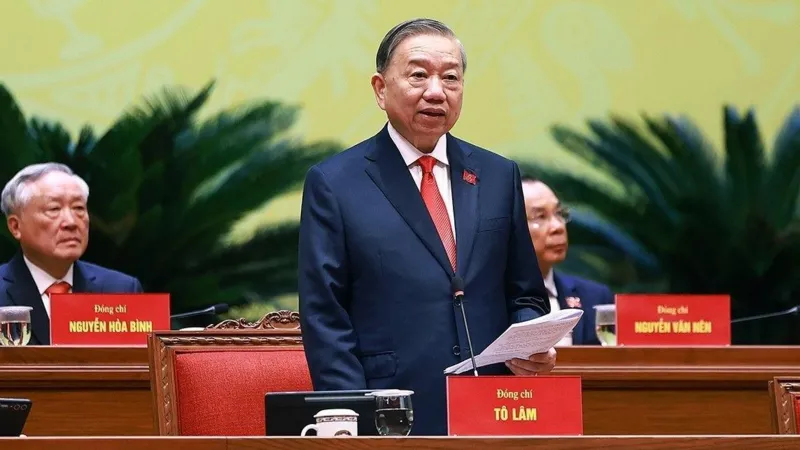
Vietnam’s Communist Party has reaffirmed To Lam as its most powerful leader, granting him another five-year term and placing him firmly at the centre of the country’s political and economic future.
Addressing nearly 1,600 delegates at the party congress this week, To Lam promised a new era of “national rise”, laying out bold plans to transform Vietnam’s economy and break free from what economists describe as the middle-income trap. His reappointment as party chief was widely expected, but the early conclusion of the congress suggested either strong internal consensus or limited resistance to his growing authority.
Observers say the scale of power now concentrated in To Lam’s hands is unprecedented in decades. Analysts note that it represents the strongest individual leadership seen since the early 1990s, raising questions about how internal party rivalries—particularly between security and military factions—will play out.
To Lam assumed leadership 18 months ago following the death of his predecessor, Nguyen Phu Trong, who had overseen a sweeping anti-corruption campaign. As former head of the Ministry of Public Security, To Lam was closely associated with that purge, but once in power he pivoted sharply towards economic reform and growth.
He announced a dramatic restructuring of the state, cutting layers of bureaucracy, reducing the number of provinces from 63 to 34, and laying off at least 100,000 government employees. His administration also passed a landmark resolution elevating the private sector to the position of the most important driver of national economic growth, a significant shift in a country that officially adheres to socialist principles.
The government has set ambitious targets, including sustained double-digit growth, doubling the number of private businesses by 2030, and transforming Vietnam into an upper-income, technology-driven economy by 2045. No major South East Asian nation has yet achieved such a leap.
A core part of the strategy involves backing large private firms to become globally competitive “national champions”. While Vietnam has seen impressive growth over the past three decades, its economy remains dominated by state-owned enterprises, which still account for nearly a third of GDP and benefit from preferential access to land, funding and licences.
Recent policy decisions suggest resistance within the party to diminishing the role of state companies, with new measures reaffirming their place alongside private firms as drivers of growth. Critics warn this could entrench political favouritism rather than foster genuine competition.
Vietnam’s heavy reliance on foreign investment and export-led manufacturing also presents challenges. Much of the country’s industrial success is built on assembling goods for global brands, with limited domestic value added. Leaders have acknowledged that without moving up the value chain, long-term growth will be difficult to sustain.
Some see promise in Vietnam’s emerging technology sector, particularly firms such as FPT, which has expanded globally and invested heavily in education and software development. Others point to conglomerates like Vingroup as central to the government’s vision, though their success has largely been confined to the domestic market and supported by strong political ties.
Attempts by Vietnamese firms to compete internationally, including in electric vehicle manufacturing, have so far struggled to gain traction outside the country. Analysts caution that state-backed private giants risk becoming rent-seeking entities that crowd out smaller businesses, which are often the biggest drivers of innovation and employment.
To Lam’s push for reform comes at a difficult moment. Vietnam is highly dependent on access to the US market, which has become less certain amid renewed tariffs under President Donald Trump. The country’s long-standing policy of balancing relationships with major powers will be tested as global trade tensions intensify.
While To Lam has warned that failure is inevitable without urgent reform, the scale of transformation he is attempting—combined with growing geopolitical pressure—raises questions about whether Vietnam can deliver on its bold promises.

